




Identity Proofing vs Identity Verification: Key Differences and Why You Need Both

Key Takeaways
- Identity proofing establishes that a claimed identity is real and belongs to the person presenting it, once, before access is granted.
- Identity verification confirms the same proofed person is present at every login, transaction, and sensitive account event afterward.
- NIST SP 800-63 separates the two formally: Identity Assurance Levels (IAL) govern proofing rigor, and Authenticator Assurance Levels (AAL) govern verification strength.
- Weak proofing lets fake hires and synthetic identities enter with legitimate credentials; weak verification exposes real accounts to takeover. Neither control compensates for the other.
- Proofing should recur at high-risk lifecycle moments, including credential resets, role changes, and device re-enrollment, since attackers target these gaps.
- Shared-device and frontline environments need both processes redesigned, because standard one-person-one-device assumptions leave sessions anonymous and audit trails broken.
A logistics company hires a remote IT contractor to support its warehouse management system. The resume checks out, the interviews go smoothly, and IT provisions credentials on day one. Three weeks later, the security team notices logins from a region the contractor never mentioned. The person doing the work was never the person who interviewed.
Scenarios like this are moving from anomaly to expectation. Gartner predicts that by 2028, one in four candidate profiles worldwide will be fake, and 6% of job seekers already admit to posing as someone else in an interview or having someone pose as them. Defending against this starts with understanding identity proofing vs identity verification, two processes that teams frequently collapse into one. Identity proofing establishes that a claimed identity is real and belongs to the person presenting it, usually before any access exists. Identity verification confirms that the same trusted person is present at every access that follows. This blog breaks down how each process works, the key differences between them, why organizations need both, and how to implement them without slowing your workforce down.
How Identity Trust Works Across the Lifecycle
Most organizations secure access at the login screen and assume that covers identity. It covers one step. Trust actually has to be built once, established at the start, and then maintained at every access point that follows. The flow below shows how those layers connect:
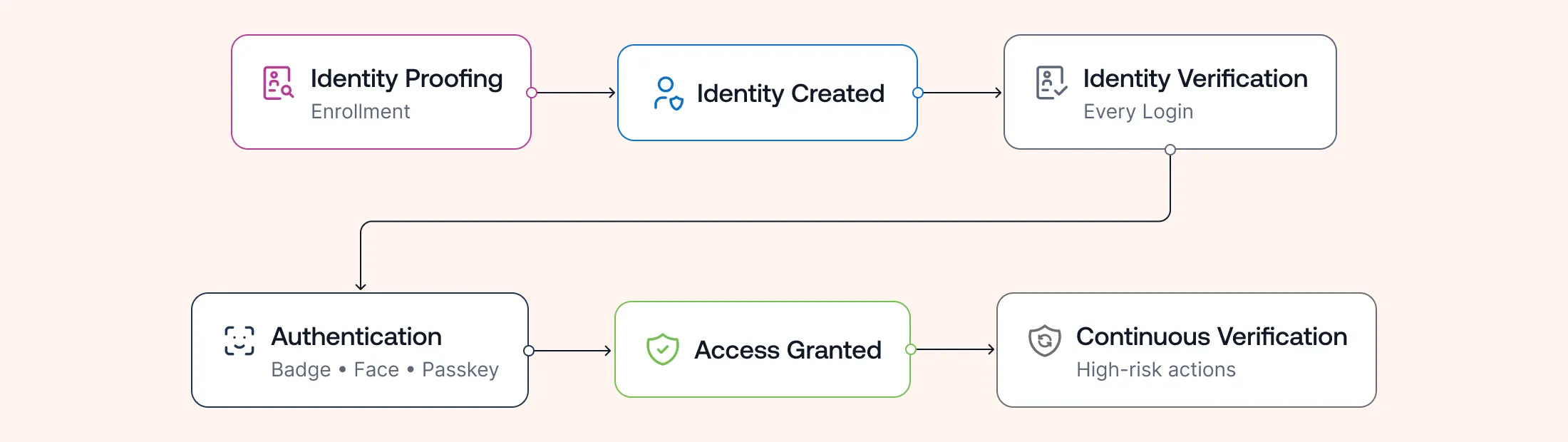
Each stage depends on the one before it. Skip proofing, and every downstream check authenticates the wrong person flawlessly. Skip continuous verification, and a legitimate session can be hijacked after access is granted. The rest of this guide breaks down what happens at each stage and where organizations typically lose control.
What is Identity Proofing?
Identity proofing is the process of confirming that a person's claimed identity is genuine and that it belongs to them before an organization grants access or issues credentials. NIST SP 800-63 describes it in three steps: Resolve the claimed identity to a single, unique individual, validate the evidence they provide, and verify that the person presenting the evidence matches it.
Proofing typically happens once at onboarding, whether that means enrolling a new customer, hiring an employee, or activating a contractor. It answers the foundational question: Is this identity real, and does it belong to this person?
How Identity Proofing Works
Most identity proofing programs combine several checks, scaled to the risk of the access being granted:
- Document validation, which examines government-issued IDs for security features, tampering, and expiry
- Database checks, which compare the claimed name, date of birth, and address against authoritative records
- Biometric matching, which compares a live selfie against the photo on the submitted document
- Liveness detection, which confirms a real person is present rather than a photo, replay, or deepfake
NIST formalizes the required rigor through Identity Assurance Levels. IAL1 requires no proofing, IAL2 requires remote or in-person evidence checks, and IAL3 requires supervised, in-person proofing for the highest-risk systems.
What is Identity Verification?
Identity verification is the recurring process of confirming that the person accessing a system, account, or device is the same individual whose identity was previously verified. It runs continuously across the identity lifecycle: At login, at checkout, before sensitive changes like password resets or payment updates, and at any access point where trust needs to be re-established.
If proofing builds the foundation of trust, verification maintains it every time someone shows up claiming to be that trusted person.
How Identity Verification Works
Verification evaluates who is present right now against what the organization already knows:
- Authentication factors, such as passkeys, hardware tokens, one-time codes, or biometrics
- Device intelligence, which checks whether the device and browser match known patterns
- Contextual signals, such as location, time of access, and network characteristics
- Behavioral patterns, including how a session compares with the account's normal activity
Strong verification is risk-adaptive. A routine login from a known device passes quietly, while an unusual location combined with a password reset request triggers a step-up check.
Modern identity verification increasingly relies on phishing-resistant authentication methods such as passkeys, FIDO2 security keys, and platform biometrics rather than reusable passwords. Because these methods use cryptographic credentials instead of shared secrets, attackers cannot steal reusable login credentials through phishing pages or password database breaches.
Identity Proofing vs Identity Verification: Key Differences
The clearest way to compare identity proofing vs identity verification is across five dimensions:
The differences become clearer when viewed side by side.
| Dimension | Identity Proofing | Identity Verification |
|---|---|---|
| Stage | Once, at onboarding or enrollment | Every login, transaction, and sensitive event |
| Core question | Is this identity real, and does it belong to this person? | Is the person the one present right now? |
| Primary inputs | Government IDs, authoritative databases, biometric enrollment, liveness checks | Credentials, MFA factors, device signals, behavioral context |
| Fraud it prevents | Fake hires, synthetic identities, fraudulent enrollments | Account takeover, credential sharing, session hijacking |
| NIST anchor | Identity Assurance Levels (IAL1 to IAL3) | Authenticator Assurance Levels (AAL1 to AAL3) |
The NIST distinction matters more than it first appears. An organization can run strong AAL2 authentication on top of an identity that was never properly proofed, which means every future check simply re-confirms a fraudulent enrollment.
Think of IAL and AAL as answering two different questions. IAL asks, "Can we trust this identity?" while AAL asks, "Can we trust that the right person is using it right now?" Organizations need both to establish end-to-end identity assurance.
Proofing vs Verification vs Authentication vs KYC
Four terms get tangled together in any identity proofing vs identity verification discussion, and separating them removes most of the confusion:
- Identity proofing establishes that a claimed identity is real, once, before access exists.
- Identity verification confirms the right person is present at a specific moment or action.
- Authentication is the technical mechanism verification uses at an access point, such as a password, passkey, biometric scan, or one-time code.
- KYC (Know Your Customer) is a regulatory framework in financial services that mandates identity proofing and screening before onboarding customers.
In short, proofing happens first, verification happens repeatedly, authentication is how verification gets done, and KYC is a compliance context that requires all of it.
For example, when a new employee joins an organization, verifying their government ID and biometric during onboarding is identity proofing. Logging into a shared workstation later using a badge and facial recognition is identity verification, while the badge and biometric themselves are the authentication methods used to perform that verification.
Why You Need Both: Where Identity Gaps Get Expensive
Framing identity proofing vs identity verification as a choice misses the point, because each one fails in a different way and each failure carries its own bill.
When proofing is weak, bad identities enter the system and every downstream control inherits the compromise. Fake contractors gain legitimate credentials, synthetic identities open accounts, and fraudulent hires pass background checks that were run on someone else's records. No amount of MFA fixes an identity that was fraudulent at enrollment.
When verification is weak, legitimate identities get hijacked. Attackers take over accounts through phished credentials, convince helpdesks to reset passwords for identities they never owned, and inherit whatever access the real person held.
Proofing also cannot remain a one-time event. Credential resets, role changes, device re-enrollment, and dormant accounts returning to activity all warrant re-proofing, because these lifecycle moments are exactly where attackers now concentrate. Helpdesk reset requests, in particular, have become a favored entry point precisely because most organizations verify nothing beyond a few knowledge questions at that moment.
Identity Proofing and Verification for the Frontline Workforce
Most guidance on identity proofing vs identity verification assumes a customer onboarding flow: one person, one personal device, one account. Frontline and operational environments break every one of those assumptions.
In manufacturing plants, distribution centers, hospitals, and retail stores, dozens of workers share the same kiosks, terminals, and rugged devices across shifts. Many have no corporate email or laptop, so they were never enrolled the way office employees are. Proofing gets skipped or reduced to an HR paperwork check, and verification collapses into shared PINs or generic floor logins that make every session anonymous.
Traditional IAM deployments often assume every employee has a dedicated workstation, corporate device, and persistent operating system profile. Frontline environments rarely meet those assumptions, making proofing and verification significantly harder to implement using conventional enterprise authentication models.
That creates a specific gap: The organization cannot prove who was on the device when a pallet went missing, a batch record was signed, or a controlled substance cabinet was opened. Purpose-built platforms like OLOID address this by proofing each frontline worker once at onboarding, then verifying the individual behind every session on shared devices using passwordless factors such as facial biometrics or badge taps. Each session ties back to a proofed individual instead of a shared credential, which restores both accountability and audit readiness.
How to Implement Both without Adding Friction
A workable identity proofing vs identity verification program balances assurance with usability. Five steps cover most of the ground:
- Classify access by risk: Map which systems and actions need IAL2-level proofing and which need lightweight checks. Newsletter signups and badge-controlled cleanrooms deserve different treatment.
- Proof once, properly: Combine document validation, database checks, and biometric enrollment with liveness detection at onboarding, including for contractors and frontline workers who lack corporate accounts.
- Make verification risk-adaptive: Let low-risk, in-pattern access flow with passive signals, and reserve step-up challenges for anomalies and sensitive actions. Use phishing-resistant authenticators wherever practical. Passkeys, FIDO2 security keys, and passwordless biometrics reduce dependence on passwords while strengthening resistance to credential theft and phishing attacks.
- Define re-proofing triggers: Require fresh identity checks at credential resets, role changes, and device re-enrollment rather than trusting knowledge questions.
- Measure both sides: Track enrollment fraud caught at proofing and takeover attempts blocked at verification, along with the friction metrics that show whether legitimate users are paying the price.
Conclusion
Identity proofing vs identity verification is ultimately a question of when trust is established versus how it is maintained. Proofing decides whether an identity deserves to enter your environment. Verification confirms, at every access, that the trusted person is still the one present. Skip the first and you authenticate impostors flawlessly. Skip the second and you leave proven identities open to takeover.
The organizations most exposed are the ones whose workers never fit the one-person-one-device model in the first place. If your workforce shares devices across shifts, OLOID’s identity assurance agent can help you tie every session back to a proofed, verified individual without adding a single password.
Organizations often focus on strengthening authentication while overlooking whether the original identity was ever properly established. Effective identity security requires both: confidence that an identity is genuine when it is created and confidence that the same individual is present every time access is requested.
FAQs
1. What is the difference between identity proofing and identity verification?
Identity proofing confirms a claimed identity is real and belongs to the person, once at enrollment. Identity verification confirms that the same proofed person is present at each subsequent login or sensitive action.
2. Is identity proofing the same as authentication?
No. Proofing establishes an identity before credentials exist. Authentication is the mechanism, such as a password, passkey, or biometric, used later to verify the person at an access point.
3. What are NIST Identity Assurance Levels?
NIST SP 800-63 defines three IALs. IAL1 requires no proofing, IAL2 requires remote or in-person evidence validation, and IAL3 requires supervised, in-person proofing with biometric collection for the highest-risk access.
4. Is identity verification the same as KYC?
No. KYC is a regulatory framework in financial services that mandates identity proofing and screening before onboarding customers. Identity verification is one of the processes used to satisfy it.
5. Is identity proofing a one-time process?
Initial proofing happens once at enrollment, but high-risk events such as credential resets, role changes, and device re-enrollment should trigger re-proofing to prevent social engineering attacks.
6. Can identity verification be passwordless?
Yes. Identity verification increasingly relies on passwordless authentication methods such as passkeys, FIDO2 security keys, badge-based authentication, and biometrics. These methods improve security by eliminating reusable passwords while providing a faster user experience.

Get the latest updates! Subscribe now!

