




What is Identity Proofing? A Complete Guide

Key Takeaways
- Identity proofing confirms a claimed identity is real before any access or credentials are issued.
- NIST's three-step framework (resolution, validation, verification) is the global baseline for structured proofing.
- Identity proofing, identity verification, and authentication are three distinct processes. Conflating them creates exploitable gaps.
- Proofing is not a one-time event. Role changes, credential resets, and risk signals all require step-up verification.
- Synthetic identities, deepfakes, and AI impersonation have made biometrics and liveness detection essential, not optional.
- Shared-device and frontline environments need purpose-built proofing. Standard single-user flows create friction and security gaps at scale.
- NIST SP 800-63, KYC, AML, HIPAA, and SOX compliance all depend on a documented, structured proofing program.
- Weak identity proofing costs more than fixing it. Large enterprises average $4.5 million annually in fraud prevention costs tied to identity gaps.
Every access control system assumes one thing: that the identity behind the login is real. In many environments, that assumption is wrong.
In 2024, the U.S. Federal Trade Commission received over 1.1 million identity theft reports, with total fraud losses exceeding $12.5 billion, a 25% jump from the prior year. Behind that number sits a consistent pattern: organizations trusted that the person on the other end of a login, an onboarding form, or a help desk call was who they claimed to be. Many were not.
This is the problem identity proofing exists to solve.
[[content-box]]
It matters everywhere users interact with systems digitally, and it matters especially in environments where shared devices and rotating workforces, such as healthcare wards, factory floors, and logistics operations, make the question of "who is actually present" harder to answer than it looks.
This guide covers how identity proofing works, the methods behind it, the regulations that require it, the modern threats it must address, and how to build a strategy that holds up in the real world.
What is Identity Proofing
Identity proofing operates on a clear distinction:
| Claimed Identity | Actual Identity |
|---|---|
| Information a user provides that is unvalidated (who they say they are) | Information that has been verified and confirmed (who they actually are) |
NIST defines identity proofing across several publications as the process of providing sufficient evidence, including identity history, credentials, and documents, to establish an identity. The most current guidance, NIST SP 800-63-4, describes it as the processes used to collect, validate, and verify information about a subject to establish assurance in the subject's claimed identity.
Why Identity Proofing Exists: The Problem It Solves
Passwords were never designed to carry the weight of modern digital access. They get shared, forgotten, stolen, and reused. In environments like healthcare or manufacturing, where workers rotate across shared terminals, a password alone tells you nothing about who is physically present.
Identity proofing fills that gap by tying a digital account to a real, verifiable human being. Without it, organizations face:
- Unauthorized access by individuals exploiting weak credential controls
- Identity fraud through stolen or fabricated personal information
- Synthetic identity attacks where real and fake data are blended to create entirely new personas
- Regulatory non-compliance with standards that require verified identities before granting account access
How Identity Proofing Works: The Core Process
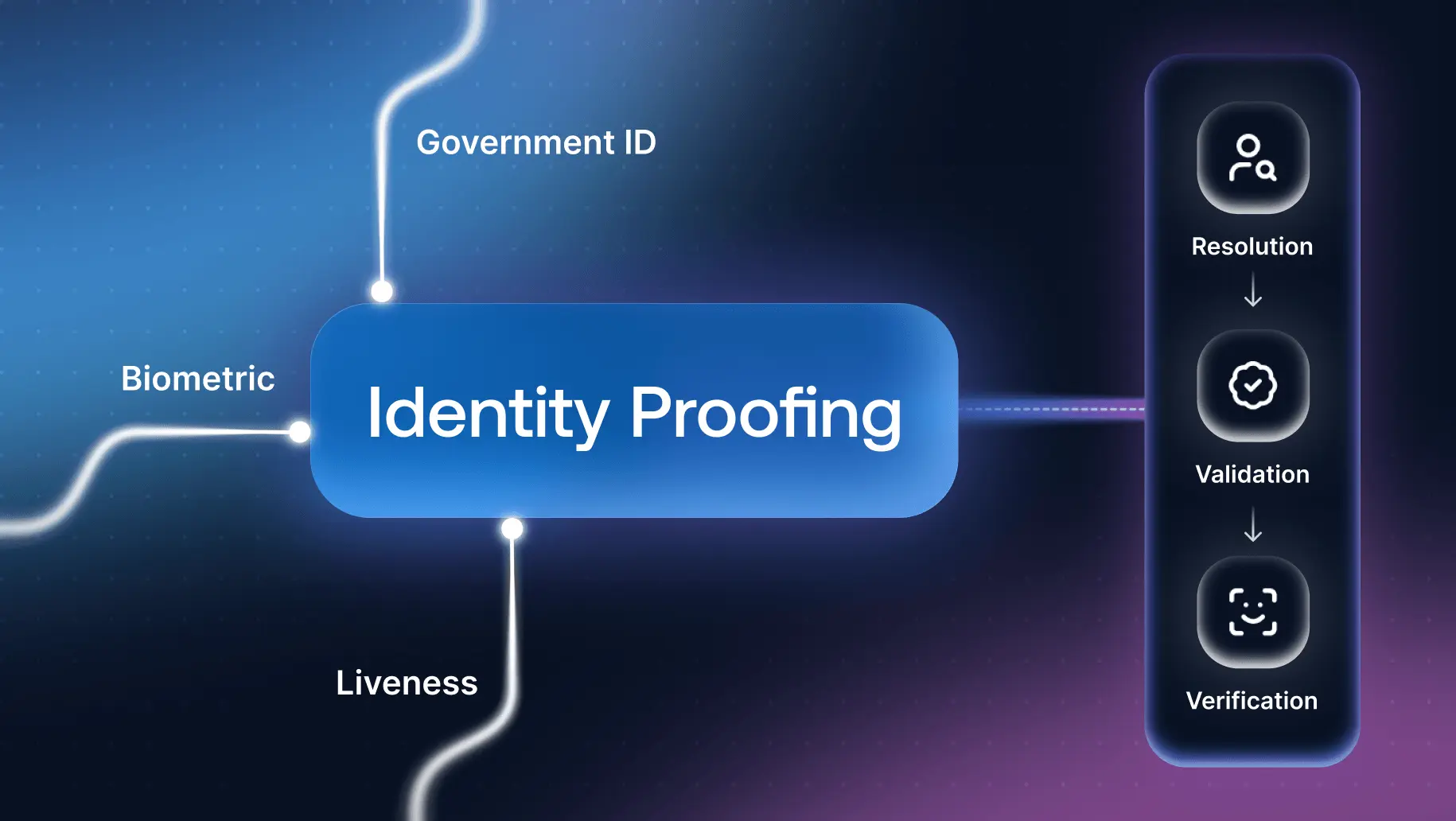
NIST's SP 800-63A establishes three steps that form the foundation of every identity proofing process:
Step 1: Identity Resolution
The organization gathers basic identifying information to determine which unique individual is being registered within its system. This step aims to distinguish one person from all others, even when minimal data is provided.
Step 2: Identity Validation
The organization collects evidence, including government-issued documents, credentials, or supporting records, and confirms that the evidence is authentic, accurate, and current. This may involve checking against authoritative databases or running AI-powered document analysis.
Step 3: Identity Verification
The organization confirms that the identity actually belongs to the person submitting the information. This often involves biometric comparison (matching a live selfie to the photo on a submitted ID) or liveness detection to confirm physical presence.
Methods of Identity Proofing
Organizations typically combine multiple methods based on the level of trust required:
Document Verification
Confirms that a government-issued ID, such as a passport, driver's license, or national ID card, is legitimate and unaltered. AI-powered systems analyze security features, holograms, and data patterns in real time.
Biometric Verification
Compares unique physical characteristics, including facial geometry, fingerprints, and iris patterns, to a pre-verified source such as a government-issued document photo.
Liveness Detection
Confirms that the biometric capture comes from a live person, not a photograph or deepfake video. This step directly counters spoofing attacks.
Knowledge-Based Authentication (KBA)
Asks the individual questions drawn from their personal credit or financial history that only they should be able to answer. KBA provides a lower level of assurance on its own and works best as a supplementary check.
One-Time Passcode (OTP) Verification
Sends an OTP to a registered mobile number or email address, confirming the individual controls that contact point.
Video Verification
Conducts a live video session with the individual, checking for liveness and performing document verification within the call.
Out-of-Band Verification
Requires verification through a second, independent channel, such as multi-factor authentication, confirming identity across two separate communication paths.
NIST Identity Assurance Levels (IAL1, IAL2, IAL3)
NIST defines three Identity Assurance Levels that determine how rigorous identity proofing must be, based on the risk level of the system being protected:
- IAL1: No identity proofing required. Appropriate for low-risk interactions such as newsletter sign-ups or loyalty accounts.
- IAL2: Limited proofing required. The individual provides identifying information remotely or in person, along with evidence such as a photo ID upload. Biometric checks are optional but recommended.
- IAL3: Highest level of assurance. Requires in-person or supervised remote verification, address verification, and biometric checks. Mandatory for systems handling sensitive government, financial, or health data.
Identity Proofing vs. Identity Verification vs. Authentication
Identity proofing, identity verification, and authentication are often used interchangeably. Each plays a different role:
| Aspect | Identity Proofing | Identity Verification | Authentication |
|---|---|---|---|
| What it is | The full process of establishing who someone is before issuing access or credentials | Confirming that specific evidence submitted is genuine, a step within identity proofing | Confirming a returning user holds valid credentials at the point of access |
| When it happens | At onboarding or account creation | During the identity proofing process | At every login or access attempt |
| Who it applies to | New users, new hires, high-risk transactions | Anyone submitting identity evidence | Any returning user |
| Security goal | Establish trust in a new identity | Validate the evidence supporting that identity | Maintain trust in an already-established identity |
| Methods used | Document check, biometrics, liveness detection, KBA | Document authenticity scan, database cross-check | Password, OTP, MFA, passkey |
| Example | Scanning a passport and taking a live selfie to open a bank account | Confirming the passport is genuine and unaltered | Entering a password and an OTP to log in |
Get the first step wrong, and verification and authentication mean nothing.
Modern Threats Identity Proofing Must Address
Synthetic Identity Fraud
Synthetic identity fraud blends real and fabricated data to create a new persona that has no real-world counterpart. The Federal Reserve has identified it as the fastest-growing type of financial crime in the United States, with U.S. lenders facing $3.3 billion. It is particularly difficult to detect because no single individual reports being victimized.
Deepfakes and AI-Generated Fake IDs
AI tools now produce fake government IDs with realistic holograms and scannable barcodes. Deepfake video and voice cloning can bypass facial recognition and voice authentication systems. Liveness detection and behavioral analytics are the primary defenses.
Impersonation at the Hiring Stage
Nation-state actors and criminal organizations have deployed fake IT workers, supported by forged documents, fabricated social profiles, and AI-generated interview proxies, to gain employment inside target organizations. Once hired, they exfiltrate data and extort victim companies. The FBI has issued multiple warnings about this pattern, specifically targeting U.S. technology firms.
Social Engineering at the Help Desk
Attackers armed with basic personal data and AI voice tools call IT help desks, impersonate employees, and request credential resets. Without robust identity proofing at the help desk, this attack vector remains wide open.
Remote vs. In-Person Identity Proofing
| Aspect | Remote Identity Proofing | In-Person Identity Proofing |
|---|---|---|
| Convenience | High: users complete proofing from any device | Low: requires physical presence |
| Fraud risk | Higher: susceptible to deepfakes and spoofing | Lower: physical presence is harder to fake |
| Scalability | High: works for distributed and global workforces | Limited: requires physical infrastructure |
| NIST compliance | Supports IAL1 and IAL2; supervised remote can satisfy IAL3 | Satisfies all IAL levels |
Frontline environments that rely on shared devices and shift-based workflows often benefit most from supervised remote proofing or in-person verification at onboarding, followed by continuous step-up checks throughout the employee lifecycle.
Compliance and Regulatory Landscape
Identity proofing sits at the center of several major regulatory frameworks:
- NIST SP 800-63: U.S. digital identity guidelines defining IAL1/2/3 and the three-step proofing process
- KYC (Know Your Customer): Requires financial institutions to verify customer identity before opening accounts or processing transactions
- AML (Anti-Money Laundering): Mandates identity verification to prevent illegal funds from entering the financial system
- KYE (Know Your Employee): Extends identity verification requirements to the full employee lifecycle, from hiring through offboarding
- HIPAA: Requires healthcare organizations to verify the identity of individuals accessing protected health information
- FFIEC: Requires financial institutions to implement risk-based authentication and identity proofing
- FATF: Sets global AML and counter-terrorism financing standards that include digital identity verification requirements
- SOX: Requires public companies to restrict access to sensitive financial data to verified, authorized users
- GDPR and CCPA: Data privacy laws that require organizations to securely handle the personal information collected during identity proofing
Cross-border consideration: When users present documents issued in other countries, organizations must use verification systems capable of authenticating international ID formats and must apply the compliance framework relevant to each jurisdiction.
Consequences of Poor Identity Proofing
The cost of getting this wrong is concrete:
- Account takeover and data exfiltration
- AML non-compliance fines and regulatory penalties
- Reputational damage and loss of customer trust
- Identity spoofing and transaction fraud
- Money laundering facilitated through unverified accounts
- Unauthorized access to sensitive systems by impersonators
Building an Effective Identity Proofing Strategy
Map Your Use Cases and Risk Levels
Start by identifying every point in the user or employee journey where identity needs to be established or reconfirmed. Match the verification intensity to the risk level of each touchpoint.
Balance Security with User Experience
Every additional check adds friction. The goal is to apply stronger verification exactly where risk is highest, not uniformly across all interactions. A tiered, risk-based approach reduces abandonment while maintaining security.
Layer Multiple Verification Methods
No single method is sufficient. Combining document verification with biometrics and liveness detection produces a far higher level of assurance than any one check alone.
Integrate and Test with Existing Systems
Map current systems, identify gaps, and run pilot programs before full deployment. Identity proofing must integrate cleanly into existing onboarding and access management workflows.
Train Stakeholders
Help desk staff, HR teams, and IT administrators must understand why identity proofing protocols exist and how to apply them, especially in high-pressure account recovery scenarios.
Monitor, Adapt, and Continuously Improve
Threats evolve. Identity proofing systems must be reviewed and updated regularly to address new attack techniques and comply with updated regulatory requirements.
Identity Proofing for Frontline and Shared-Device Environments
Most identity proofing solutions are designed with a single-user, single-device assumption. That assumption breaks down fast in frontline environments.
A nurse moving between shared workstations, a warehouse operative clocking in across shifts, or a retail associate logging into a shared terminal mid-floor; none of these users can afford a 3-minute verification flow. And yet, these are the exact environments where knowing who is physically present matters most.
The challenges are real:
- Shared devices mean credentials do not reliably identify the individual at the keyboard
- High shift turnover creates constant onboarding and offboarding cycles that strain traditional proofing workflows
- Workers often lack personal devices, making SMS-based OTP or app-based verification impractical
- Speed matters; a 30-second login delay in a clinical or production environment has operational consequences
This is where purpose-built solutions change the equation. OLOID is designed specifically for these environments, combining passwordless authentication with identity proofing that works at the pace of frontline work. Instead of friction-heavy document flows, OLOID ties physical presence to verified identity using biometrics and tap-based access. Hence, the right person gets in fast, and the wrong person does not get in at all.
When evaluating any identity proofing solution for frontline or operational environments, look for:
- Biometric verification that works without a personal device
- Support for shared-device workflows without compromising per-user identity assurance
- Step-up verification triggered by role change or suspicious activity, not just at onboarding
- Audit trails that track who accessed what, on which device, and when
- Compliance coverage for HIPAA, NIST IAL2, and industry-specific frameworks
- Integration with existing access management infrastructure without requiring a full rip-and-replace.
The Future of Identity Proofing
- AI-driven behavioral biometrics will detect fraud through patterns in keystroke dynamics, mouse movements, and interaction behavior, without requiring any active input from the user
- Blockchain-based decentralized identity will give individuals portable, tamper-proof identity credentials they control and share selectively with organizations
- Continuous proofing will replace point-in-time verification, with systems dynamically re-confirming identity throughout a session based on behavior and context
- IoT and cross-platform verification will extend identity proofing to connected devices across operational environments, from smart factory floors to hospital rooms
Conclusion
Identity proofing is the foundation on which every access control decision rests. Without it, credentials alone cannot tell an organization who is actually present, what their intentions are, or whether the account they hold genuinely belongs to them.
As fraud grows more sophisticated, encompassing synthetic identities, deepfake hiring scams, and AI-powered help desk attacks, organizations cannot afford to treat identity proofing as a one-time onboarding checkbox. It must run continuously, adapt to risk signals in real time, and extend across every moment in the user lifecycle where trust needs to be re-established.
For industries like healthcare, manufacturing, and logistics, where shared devices and frontline workflows create unique verification challenges, passwordless authentication platforms like OLOID show what purpose-built identity proofing looks like in practice: frictionless enough for a nurse between patients, rigorous enough to satisfy IAL2 requirements, and flexible enough to scale across an entire operational workforce.
The organizations that treat identity proofing as a strategic capability rather than a compliance box will stay ahead of the threats that other organizations are still trying to clean up after.
FAQs
1. What is the difference between identity proofing and authentication?
Identity proofing happens once, at the start of a relationship, to establish that a person is genuinely who they claim to be before issuing credentials. Authentication happens repeatedly after that, each time a returning user requests access, using the credentials that were established for proofing. One sets the foundation; the other builds on it at every login.
2. What are the three steps of identity proofing?
NIST SP 800-63A defines the three steps as resolution (identifying the unique individual within a system), validation (confirming that the evidence provided is authentic and accurate), and verification (confirming the identity actually belongs to the person submitting it). All three must be completed for a proofing event to meet assurance standards.
3. What is NIST identity assurance level 2 (IAL2), and when is it required?
IAL2 requires remote or in-person identity proofing with supporting evidence such as a government-issued photo ID. It applies to systems where incorrect identity claims could cause moderate harm, including financial accounts, healthcare portals, and government services. Biometric checks are recommended but not mandatory at IAL2.
4. How does identity proofing work for frontline workers on shared devices?
In these settings, effective proofing combines biometric verification at onboarding with tap-based or biometric step-up checks at each login on a shared terminal, ensuring each session is tied to a verified individual without adding friction that disrupts operational workflows.
5. What happens if identity proofing fails or is skipped?
Synthetic identities pass through onboarding unchecked, social engineering attacks succeed at help desks, and unauthorized users gain access using someone else's credentials. The downstream consequences include account takeover, data breaches, AML non-compliance fines, and reputational damage that can take years to repair.
Get the latest updates! Subscribe now!
