




RFID in Healthcare: The Complete Guide

Key Takeaways
- RFID in healthcare does more than track assets. It controls who enters restricted zones, who logs into shared workstations, and who accesses medication cabinets, all from a single badge tap
- Frontline healthcare workers share workstations across shifts. RFID-based authentication replaces shared passwords with individual, verified, tap-to-login sessions that close automatically when a clinician steps away
- Every RFID badge interaction creates a timestamped audit trail, turning access control into automatic compliance documentation for FDA UDI, HIPAA, and EPCS requirements
- Passwords fail in clinical environments. Staff lose 15 to 30 seconds per login, share credentials across shifts, and leave sessions open. RFID eliminates all three problems with a single infrastructure
- The same badge that opens a restricted door can authenticate a clinician at a workstation and verify access to a controlled substance cabinet, one credential, one tap, full audit trail
- Successful RFID deployment requires an identity-first approach where authentication is the foundation, not an afterthought bolted onto an asset tracking system
It is 6 AM. The night shift is ending, and the day shift is starting. A frontline clinician walks up to a shared workstation outside the ICU, taps her RFID badge, and is logged in within seconds. Two floors down, a pharmacist taps his badge at the controlled drug cabinet. The door opens, logs his identity, timestamps the access, and records exactly what was removed. Nobody signed a paper. Nobody typed a password. Nobody waited.
This is what RFID in healthcare looks like at full capacity. Not just tracking where a wheelchair went, but controlling who walks through which door, who logs into which system, and who touches which medication, all in real time, without friction. For frontline workers rotating across shifts and sharing devices, that distinction matters more than most hospital administrators realize.
The global RFID in healthcare market was valued at USD 4.64 billion in 2023 and is projected to reach USD 14.65 billion by 2030, growing at a CAGR of 17.85%. Hospitals are not spending at that scale just to find misplaced equipment. They are building an operational infrastructure where every asset, every door, and every system access point is connected, verified, and logged.
[[content-box]]
This blog explores how RFID works, what it tracks, how it controls physical and digital access across hospital environments, the real implementation challenges, and why the identity layer beneath it all determines whether the technology delivers on its promise.
What is RFID and How Does It Work
An RFID system has three core physical components. An RFID tag is a small microchip attached to an object, door, workstation, or person that stores a unique identifier and relevant data. An antenna creates a magnetic field that activates the tag. An RFID reader receives the data broadcast by the tag and sends it to a central software system for processing.
Unlike barcodes, RFID works differently: it requires no direct line of sight.. A reader detects multiple tags simultaneously from several meters away, even through walls, packaging, or fabric. In a hospital environment where speed and accuracy define patient outcomes, this distinction matters enormously. The full system also includes a communication infrastructure connecting RFID to the hospital IT network, and application software that stores, displays, and analyzes the collected data across every use case, from asset location to door access to workstation login.
Active vs Passive Tags
Active RFID tags carry their own battery and continuously broadcast their location. They deliver real-time tracking across large areas and are ideal for high-value equipment, staff monitoring, and access-controlled zones. The trade-off: they cost more, require Wi-Fi coverage throughout the facility, and need regular battery maintenance.
Passive RFID tags carry no battery. They draw power from the reader's electromagnetic field when in range. They are smaller, cheaper, and work without Wi-Fi. The trade-off: they do not update location in real time, which limits their use in time-critical scenarios.
Most hospitals deploy a combination of both depending on the asset category, the access control requirement, and the urgency of the use case.
What RFID Tracks in a Hospital
RFID's reach inside a hospital is broader than most people assume. Here is what it covers.
Medical Equipment, Surgical Tools, and Consumables
Every tagged item gets a digital identity and a logged movement history. IV pumps, ventilators, scalpels, sponges, syringes, and PPE are all trackable. After surgery, a patient scan confirms no instrument was left behind.
Patients, Staff, and Newborns
Patient wristbands carry medical history, allergies, and treatment plans, verified before every medication or procedure. Newborn tags link to the mother and trigger alerts if the infant leaves a designated zone. Staff badges do far more than identify, they control door access, workstation login, and medication cabinet entry, with every interaction timestamped.
Medications, Pharmaceuticals, and Cryogenic Samples
Medication tags verify drug identity, dosage, and patient match at the point of administration. Cabinet readers log every access event with staff identity and timestamp. Temperature-sensitive drugs and cryogenic samples carry environmental monitoring tags that alert staff the moment storage conditions shift outside safe thresholds.
Core Use Cases in Healthcare
RFID's value in a hospital is not limited to one workflow. Here is where it makes the most measurable difference.
Patient Safety and Identification
Patient misidentification is one of the most common errors in hospitals. RFID wristbands eliminate this at every touchpoint, from medication administration to lab sample collection to surgical preparation. The wristband scan triggers an instant verification check against the patient's electronic record before any clinical action proceeds.
Access Control, Security, and Compliance
RFID controls entry to restricted areas, including operating rooms, pharmaceutical storage, ICUs, and server rooms. A staff member taps their RFID badge at a reader. The system verifies their identity, checks their authorization level, and either opens the door or denies access, all in under a second. Every access event creates a timestamped audit trail, and unauthorized entry attempts trigger immediate alerts.
In shift-based environments where frontline workers rotate across zones and share physical spaces, this level of access control is not optional. Solutions like OLOID extend this beyond physical doors, letting staff authenticate into hospital systems using the same RFID badge, without passwords, without friction, and with a full audit trail behind every interaction.
Shared Workstation Access and Clinical Authentication
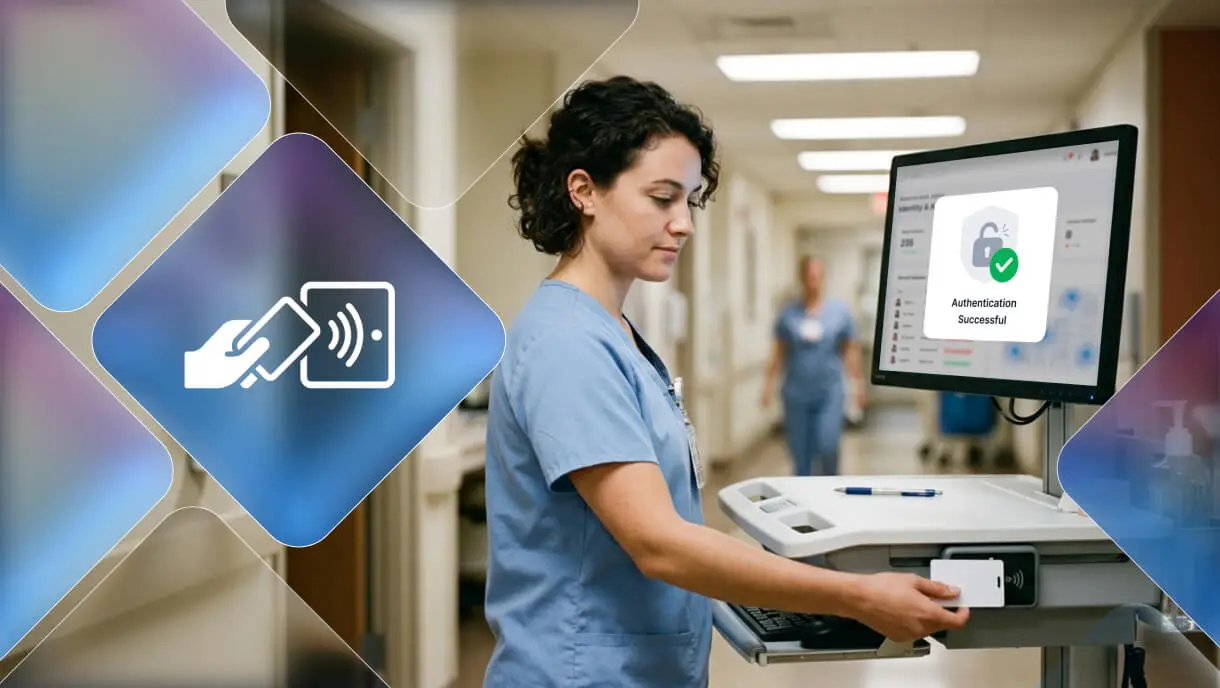
Frontline healthcare workers share workstations across shifts. In a traditional setup, a nurse either leaves her session open when she steps away, a compliance risk, or the next clinician logs in from scratch, adding friction to an already demanding workflow. RFID solves this cleanly. Tap to log in. Step away, and the session closes automatically. Tap again, and the next verified user is in within seconds.
OLOID was built for exactly this, enabling tap-to-login and tap-to-logout on shared clinical workstations so every session is tied to a verified identity and no patient data is ever left exposed between shifts.
Medication Management
RFID tracks medication from the pharmacy shelf to the patient's bedside. Dispensing cabinets log who accessed them, what was taken, and when. The system cross-checks the drug against the patient's prescription in real time. Any mismatch triggers an alert before the medication reaches the patient.
Asset and Equipment Tracking
RFID gives every hospital asset a permanent digital location. A dashboard shows the real-time location of every IV pump, wheelchair, and infusion device across the facility. Without it, up to 75% of equipment maintenance time is spent simply searching for the item HHM Global, and staff can lose up to 30 minutes per shift hunting for a single piece of equipment, costing hospitals approximately $3,000 per misplaced asset in replacement costs and lost productivity (AiRISTA, 2025) RTLS Solutions. RFID eliminates that search.
Inventory and Supply Chain Management
RFID-enabled smart cabinets and storage rooms automatically update stock levels as items enter or leave. The system triggers reorder alerts when inventory drops below set thresholds, eliminating both stockouts and waste from expired supplies. Surgical departments benefit especially, since every instrument used in a procedure gets logged automatically without manual entry.
Key Benefits of RFID in Healthcare
The case for RFID is not just operational. It shows up in patient outcomes, staff efficiency, and the bottom line.
Error Reduction and Patient Safety
RFID removes the human element from identification and verification at the highest-risk moments. Patient misidentification, wrong medication, and retained surgical instruments: each of these error categories has a direct RFID countermeasure. Hospitals that deploy RFID in medication administration report measurable reductions in adverse drug events.
Real-Time Visibility and Staff Efficiency
Frontline healthcare workers operate across shared environments, picking up equipment left by the previous shift, logging into shared workstations, and covering multiple zones in a single shift. Real-time RFID visibility reduces the time these workers spend searching, verifying, and manually logging, freeing them to focus on patient care.
Cost Savings and Loss Prevention
Equipment loss, theft, expired medication, and unnecessary reorders represent high operating costs. RFID reduces equipment loss by 30 to 40% in major hospital deployments. Automated inventory management reduces waste from expired supplies and eliminates the labor cost of manual stock counts.
RFID vs Traditional Authentication Methods
Hospitals have long relied on passwords, PIN codes, and ID badges to control who accesses what. Each of these methods carries a hidden operational cost that compounds in high-turnover, shift-based clinical environments.
| Feature | RFID | Password/PIN | Barcode | Biometrics |
|---|---|---|---|---|
| Line of sight required | No | No | Yes | No |
| Works when hands are wet or gloved | Yes | No | No | No |
| Speed of authentication | Under 1 second | 15 to 30 seconds | Manual scan | 2 to 5 seconds |
| Supports physical door access | Yes | No | No | Limited |
| Supports workstation login | Yes | Yes | No | Yes |
| Audit trail per interaction | Yes | Partial | No | Yes |
| Works across shared devices | Yes | Problematic | No | Yes |
| Infection risk | None | High (shared keyboards) | Low | Medium (shared scanners) |
Pros and Cons of RFID in Healthcare
Advantages
Here is what RFID gets right across clinical environments of every size.
- Real-time location data for equipment, patients, and staff
- Simultaneous reading of multiple tags without manual scanning
- Tap-to-access for doors, cabinets, and shared clinical workstations
- Detailed audit trails for compliance and quality control
- Reduces medication errors through point-of-care verification
- Scales from small clinics to large multi-floor hospital systems
Limitations and Challenges
No technology is without trade-offs. Here is where RFID requires careful planning.
- Active RFID infrastructure requires Wi-Fi coverage across the entire facility
- Active tags need regular battery replacement and carry higher upfront costs
- Passive tags do not provide real-time data, limiting use in urgent scenarios
- Metal surfaces, MRI machines, and liquids can interfere with RFID signal accuracy
- High-density antenna installations in older hospital buildings can be complex and disruptive
How to Implement RFID
Integration with EMR and EHR Systems
RFID data in isolation is just location data. The real value comes when it feeds directly into EMR and EHR systems like Epic or Cerner, updating patient records, equipment logs, and access events automatically. Before buying any hardware, audit your existing IT stack.
Staff Training and Change Management
Clinicians resist anything that adds steps. RFID removes steps, but badge-wearing habits, alert response protocols, and tag attachment compliance still need structured training. Skip this phase, and the investment underperforms from day one.
Environmental Interference
Metal surfaces distort radio waves. MRI machines disrupt nearby readers. Liquids in IV bags absorb RFID signals. Antenna placement and tag selection must be tested in the actual physical environment before any full rollout begins.
Failure Modes and Backup Plans
Batteries die, readers go offline, networks drop. Every critical workflow that depends on RFID needs a documented manual fallback, tested and trained before go-live, not after the first outage.
Beyond Tracking: How RFID Becomes an Authentication Tool
Most RFID conversations stop at asset tracking. The more critical layer is what RFID does for identity and access across a hospital's physical and digital environments.
Consider a single nursing shift. A clinician taps her badge at the ward door, logs into a shared workstation, verifies a medication order, and steps away. The session closes automatically, the next clinician taps in and sees only what her role permits. No passwords, no open sessions, no compliance gap. The same badge, reader, and network that tracks an infusion pump can authenticate a clinician at a workstation, verify access to a medication cabinet, and log every restricted zone entry as one seamless interaction.
Most RFID vendors build for tracking and treat authentication as an afterthought. Frontline healthcare environments need the opposite. This is where OLOID fits: enabling hospitals to use existing RFID badge infrastructure for passwordless workstation login, role-based access control, and automatic session management across shared clinical devices, so every access event is tied to a verified individual, not a shared credential.
Regulatory and Privacy Compliance
RFID deployments in healthcare touch patient data, medical devices, and access-controlled environments. That makes compliance non-negotiable. Here is what each major framework requires:
FDA UDI (Unique Device Identification) Every medical device must carry a traceable identifier throughout its lifecycle. RFID audit trails satisfy this automatically, with no manual logging required. Non-compliance risks include device recalls, penalties, and operational shutdowns.
HIPAA requires strict access controls for any system touching patient data. Every access event must be logged with the staff identity and timestamp. Shared workstation sessions must be tied to individual verified users, not shared credentials.
EPCS (Electronic Prescriptions for Controlled Substances) DEA regulations require two-factor authentication before any controlled substance can be prescribed or dispensed. An RFID badge tap serves as one factor, replacing the need for hardware tokens or one-time passwords. Every dispensing event gets logged with a verified practitioner identity, timestamp, and drug record, satisfying DEA audit requirements automatically.
GDPR applies to any European deployment or hospital handling data of European patients. Patient identifiers stored on RFID tags require encrypted transmission and storage. Staff must be informed of what data their badges collect and how it is used.
In shared clinical environments where the same workstation is accessed by multiple clinicians across a single day, meeting these requirements without slowing down workflows is the real challenge. Identity access management built for frontline workers addresses this directly, turning every badge tap into a compliant, auditable, and frictionless access event.
Conclusion
RFID in healthcare started as an asset tracking technology. Today it is how hospitals control movement, verify identity, and secure access across physical and digital environments at the same time. Track the infusion pump, log who entered the pharmacy at 3 AM, know who accessed a patient record, for how long, and from which device. Together, these three layers create an auditable, secure hospital environment that manual processes cannot replicate.
For frontline workers operating across shared spaces and shared devices, this convergence of RFID and identity management is a present operational need. OLOID for healthcare was built for exactly this, enabling tap-to-authenticate workflows on shared clinical workstations and access-controlled zones so every identity is verified, every session is accountable, and no access event goes unlogged. RFID tells you where everything is. The right identity layer ensures the right person is always behind every access event.
FAQs
1. What is RFID used for in healthcare?
RFID tracks medical equipment, patients, medications, and staff in real time. It also controls access to restricted areas and authenticates clinicians at shared workstations, all using the same badge, with automatic audit trails behind every interaction.
2. Is RFID safe for patients?
Yes. The FDA has found no adverse events linked to RFID in clinical settings. The main consideration is electromagnetic interference near devices like pacemakers, which hospitals manage through antenna placement and frequency selection during deployment.
3. What is the difference between active and passive RFID tags?
Active tags carry a battery and broadcast location continuously, ideal for real-time equipment and staff tracking. Passive tags activate only near a reader, suit inventory and point-of-care verification, and cost significantly less. Most hospitals use both.
4. How does RFID improve access control in hospitals?
RFID badges grant or deny access to restricted zones in under a second, log every entry with a verified identity, and replace shared passwords with individual tap-to-login sessions on shared workstations, closing the compliance gap that open sessions create across shifts.
5. What are the biggest RFID implementation challenges?
The four most common: integrating with existing EMR and EHR systems, managing interference from MRI machines and metal surfaces, driving staff adoption through training, and building fallback procedures for system outages. Addressing these before go-live determines whether the investment pays off.



Get the latest updates! Subscribe now!
