




Decoding GDPR and its role in access management
This blog explores the General Data Protection Regulation (GDPR) and its significance in data protection and access management. It explains key GDPR features like data minimization, access control, and identity governance while detailing their impact on organizational data security and compliance. Learn how implementing strong access management systems ensures GDPR adherence, reduces breach risks, and enhances privacy protection.

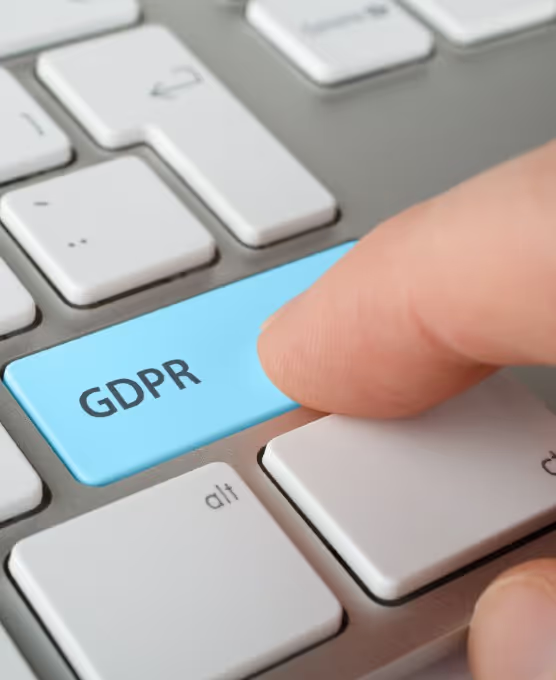
The General Data Protection Regulation (GDPR) is a regulation in European Union (EU) law on data protection and privacy for all individuals within the EU and the European Economic Area (EEA). The regulation replaces the 1995 Data Protection Directive and came into effect on May 25th, 2018.The main purpose of the GDPR is to protect the privacy and personal data of individuals. The regulation applies to all organizations, whether they are based inside or outside the EU, that process personal data of EU citizens.
Key Features of GDPR
Right to Access: GDPR gives individuals the right to access their personal data held by organizations and to be informed of how the data is being used.
Right to be Forgotten: GDPR gives individuals the right to have their personal data erased under certain circumstances, such as when the data is no longer necessary for the purpose for which it was collected.
Data Breaches: Organizations are required to report data breaches to the relevant authorities and to affected individuals within 72 hours of becoming aware of the breach.
Data Processing: Organizations are required to have a lawful basis for processing personal data, such as the consent of the individual or a legitimate interest.
Data Protection Officers (DPOs): Organizations that process large amounts of personal data or engage in certain high-risk activities are required to appoint a Data Protection Officer.
Focussing on Access Controls for GDPR Compliance
The main aim of GDPR is to balance the use of personal data for lawful business purposes and protecting the data by limiting its accessibility and amount. Despite GDPR's focus on privacy, data breaches remain a major concern. They can damage an organization’s reputation, lead to loss of customer trust, and incur massive penalties under the GDPR. Penalties for non-compliance with the GDPR can be significant, with fines of up to 4% of an organization’s global annual revenue or €20 million, whichever is greater.Although access management systems are not specifically mentioned under the GDPR, establishing strong access control policies and reducing data breach risk through strict access controls are crucial for its compliance. This includes implementing secure administrative access, with security measures like multi-factor authentication, password rotation, password complexity, and monitoring of privileged accounts use. The regulation also requires organizations to regularly assess and evaluate the effectiveness of their data protection measures and implement any necessary improvements.
Data handling
The GDPR sets strict regulations for handling personal data, including the obligation to 'protect against unauthorized and unlawful processing.' Failing to establish proper governance around this data can be costly — learn about common data governance mistakes that put organizations at risk. Therefore, businesses need a unified Access Management platform to implement multi-factor authentication and access policies. Businesses scanning restrict access to restricted areas to only those who need it in this way. Employee authentication based on positions could help streamline and fortify an organization's internal access control. The Access Management platform will also need integrated authentication to swiftly add and remove partners and temporary employees from access lists.
Data Minimization
The principle of data reduction is central to the GDPR. Keep only as much information as is necessary for the processing at hand. Access Management allows you to manage your employees', customers', and partners' access and authorization credentials from a single location.It can be used to figure out for how long the data must be stored and the duration for which users have the permission to access it. This ensures secure user management. Since ghost accounts are a significant security risk because they give hackers a backdoor into the system, Access Management can help mitigate this issue while still meeting privacy regulations.
Governance of Identities
What customers and employees checked in at what times and what information they accessed are just some of the useful details obtained by Access Management. Besides enhancing safety, this may also improve usability. In addition, access Management systems provide features like self-service access management and multifactor authentication solutions to help users take control of their credentials.This is all done per your company's Access Management strategy and policies. In addition, the platform will provide audit tools to guarantee that all internal policies and external standards, including GDPR, are strictly adhered to.
Data Security
When handling personal information, strict measures must be taken as per Article 32 of the GDPR. It's essential to swiftly restore access after a compromise while still ensuring the continuous secrecy and integrity of processing. The potential for data loss and illegal access can be mitigated by access management.It safeguards personal information and the identity of the person using the system by limiting their access to business networks. In addition, access management enables rapid system restoration by determining which individual's details have been compromised in a data breach.
Administration and Audit
These crucial processes control user authentication and authorization. Subtle but significant gaps in authority can result in security holes. A more reliable path to GDPR compliance is to delegate access level determination and verification to line-of-business managers.Businesses must demonstrate regularly and immediately upon request that their authentication, authorization, and administration processes do not put personal data at risk or are not to blame for any data breaches.
Do non-EU organizations need to follow GDPR?
The answer is - yes! Non-EU organizations are also required to comply with the General Data Protection Regulation (GDPR) if they process personal data of individuals in the European Union (EU) in connection with the offering of goods or services to those individuals or monitoring their behavior within the EU.The GDPR applies to organizations regardless of where they are based, as long as they are processing the personal data of EU citizens. This means that non-EU organizations operating in the EU, or offering goods or services to EU citizens, must comply with the GDPR requirements. Therefore, non-EU organizations must be aware of the GDPR requirements and take appropriate measures to ensure their practices are in compliance with the regulation. Failure to comply with the GDPR can result in significant fines and reputational damage.
Conclusion
The implementation of the GDPR has greatly improved data privacy and protection laws, giving individuals more control over their personal information. Organizations must make sure they are fully compliant with the regulation to avoid costly penalties and secure the privacy of individuals. A centralized access management solution can simplify the administration of personal data by consolidating multiple sources of identity and associated information, reducing the risk of accidental or malicious disclosure.


Get the latest updates! Subscribe now!

