




How to Prevent Account Takeover: A Security Team's Guide to Detection and Response

Key Takeaways
- Account takeover fraud is the single largest component of identity fraud, generating $16 billion in losses in 2024 and affecting roughly 29% of US adults and attack volume is still climbing.
- Most organizations experience account takeover fraud despite having MFA deployed because attackers now bypass authentication entirely through session token theft, AITM phishing kits, and browser cookie hijacking.
- Effective account takeover fraud prevention starts during the session, not just at login. Behavioral anomalies, device signals, and account change patterns are the earliest and most reliable indicators.
- Passwordless authentication and FIDO2 standards remove the credential layer that account takeover fraud depends on most, making them the most structurally durable prevention measure available today.
- Shared-device environments in healthcare, manufacturing, logistics, and retail create detection blind spots that standard enterprise ATO tools were never built to address. Session-level identity verification is the missing control.
- A successful account takeover fraud incident carries direct regulatory exposure under HIPAA, PCI-DSS, and GDPR, making account takeover fraud prevention a compliance obligation, not just a security program priority.
You rolled out MFA across the organization. You have a WAF. Your IT team ran a phishing simulation last quarter. And then, three months later, a logistics coordinator's account was used to quietly reroute a vendor payment at 2 AM from an IP address in another country. No failed logins, no alerts. Just a valid session doing invalid things.
According to Javelin Strategy & Research's 2025 Identity Fraud Study, account takeover fraud accounted for $16 billion of the $27 billion in total identity fraud losses in 2024, making it the single largest component of the identity fraud crisis. Account takeover prevention refers to the layered set of controls, detection mechanisms, and response protocols that stop unauthorized access to legitimate accounts before damage escalates. And the hard truth is that most organizations already have some version of these controls deployed. In 2024, 99% of accounts monitored by email security firm Proofpoint were targeted in account takeover attempts, and 62% of those businesses experienced a successful takeover.
The gap is not awareness; it’s execution. This blog covers why existing defenses break down, how to detect ATO before damage escalates, what a prevention stack that actually holds looks like, and what your team should do when an attack gets through anyway.
Why ATO Keeps Happening Despite Existing Controls
Most organizations have MFA deployed. Many have WAF rules, login monitoring, and security awareness training. The incidents still happen because the threat has outpaced the tools most teams deployed two or three years ago.
Attackers have largely stopped trying to brute-force their way past MFA. Instead, they steal the session after authentication. A valid token captured through a man-in-the-middle attack gives an attacker full account access without ever triggering a failed login. Adversary-in-the-Middle phishing kits now intercept OTPs in real time, making SMS-based 2FA far weaker than it appears on paper. Malware targeting browser cookies bypasses the login process entirely.
The other structural problem: most ATO detection logic watches the front door and ignores everything that happens inside. By the time behavioral anomalies surface, the attacker has already made their move.
How Session Hijacking Bypasses MFA
MFA secures the login. It does not secure what happens after it.
Once a user authenticates, the server issues a session token that acts as a standing pass for the rest of that session. Attackers who steal that token through a man-in-the-middle intercept, a browser cookie exploit, or a malicious script inherit a valid session with no authentication step required. From the system's perspective, nothing looks wrong. The session is legitimate. The credentials were never touched.
This is post-authentication abuse, and it is where most MFA-protected environments have a blind spot. The attacker does not need your password. They need your token, and tokens are far easier to steal than they appear. Long-lived sessions, weak logout enforcement, and the absence of continuous verification all extend the window of exposure well beyond the moment of login.
How Attackers Actually Get In
Credential Stuffing and Password Spraying
Billions of leaked credentials circulate on the dark web from years of data breaches. Attackers run automated bots to test these combinations across dozens of platforms simultaneously. Password spraying takes a slower, quieter approach, trying one or two common passwords across thousands of accounts per day, staying below lockout thresholds. Neither method requires advanced intrusion techniques, and both scale cheaply using automated tooling.
Phishing and Session Hijacking
Modern phishing has moved well beyond fake bank emails. AI-generated phishing messages now closely mimic legitimate communications. More dangerously, AITM phishing kits sit between the user and the real login page, capturing credentials and OTPs live. Once the attacker has a valid session token, the password becomes irrelevant.
Malware and Token Theft
Keyloggers capture credentials as they are typed. Newer malware variants go further, targeting authentication cookies stored in browsers. An attacker who extracts a valid session cookie can replay it from a different device and inherit full account access without triggering any authentication step.
Where Shared Devices Create Blind Spots
Standard ATO detection assumes one person, one device. In manufacturing plants, retail environments, and clinical settings, workers rotate across shared terminals across shifts. When multiple employees authenticate from the same device IP, location-based anomaly detection generates noise or, worse, gets tuned down to reduce false positives. Shared workstation environments need session-level identity verification, not just device-level controls. Without it, a stolen credential used on a shared terminal looks indistinguishable from a normal shift change.
Common Account Takeover Prevention Failures
Most ATO incidents do not happen because organizations have no controls. They happen because specific gaps in those controls go unaddressed. These are the failure points that show up most consistently:
Relying only on SMS MFA. OTP codes sent via SMS are interceptable through SIM swapping and AITM phishing kits. SMS MFA raises the bar but does not hold against targeted attacks.
Long-lived sessions. A session token that never expires gives an attacker unlimited access after a single successful steal. Session timeout and forced reauthentication policies are basic controls that many environments skip.
Weak logout enforcement. Logging out should invalidate the server-side session token immediately. Many implementations only clear the client-side cookie, leaving the token active and replayable.
No behavioral analytics. Login telemetry alone tells you who got in. It does not tell you what they did once inside. Without behavioral monitoring, post-authentication abuse goes undetected until damage surfaces.
Shared credentials. When multiple workers use the same login, there is no individual accountability and no meaningful behavioral baseline. Any anomaly gets absorbed into the noise of normal shared access.
Poor token lifecycle management. Tokens without rotation, expiry, or binding to device context are persistent attack surfaces. One successful theft equals indefinite access.
Overreliance on login telemetry. Failed login counts and lockout thresholds only catch unsophisticated brute force. Modern ATO techniques produce zero failed logins.
Ignoring shared terminals. In shift-based environments, the same device is used by multiple people across a day. Standard detection logic cannot distinguish a legitimate shift change from a credential replay on that device.
Lack of phishing-resistant MFA. FIDO2 and hardware security keys are phishing-resistant by design. Environments that deploy only app-based or SMS MFA remain exposed to AITM attacks regardless of coverage.
How to Detect ATO Before Damage Escalates
Detection that works does not wait for a failed login count to cross a threshold. It watches behavior across the entire session.
Behavioral and Session Anomalies
A user logging in from Chicago and then from Singapore twenty minutes later is a signal. So is a session that navigates directly to high-value pages without the browsing patterns a real user would generate. Unusual navigation paths, rapid account setting changes, and high-value transactions initiated immediately after login all warrant investigation.
Device and IP Signals
Unknown device fingerprints, logins from Tor exit nodes or anonymizing proxies, and sudden shifts in browser or OS profile are reliable indicators. A single device authenticating against multiple accounts in a short window is a strong signal of credential stuffing in progress.
Account Change Patterns
Attackers rarely go straight for the money. They first make small account changes, updating a recovery email, adding an authorized contact, and adjusting notification preferences. Monitoring these low-friction changes, especially clusters of them in a short window, often surfaces an ATO before financial fraud occurs.
How to Prevent Account Takeover: What Actually Works
MFA That Goes Beyond OTP
SMS OTP is better than no second factor. It is not sufficient against AITM attacks or SIM swapping. Push-based authenticators, hardware security keys, and biometric verification raise the bar meaningfully. Adaptive MFA, which triggers step-up authentication only when risk signals are elevated, adds protection without creating friction for every legitimate user.
Passwordless Authentication and FIDO2
The most durable account takeover prevention removes the attack surface that attackers depend on most: the password itself. FIDO2 and passkey-based authentication replace reusable shared secrets with cryptographic credentials tied to trusted devices or device ecosystems. For high-turnover, shift-based environments where password hygiene is operationally difficult to enforce, passwordless authentication solves the problem at the architecture level rather than the policy level. This is the gap that solutions like OLOID are built to close, specifically for frontline and shared-device environments where standard enterprise IAM tools were never designed to operate.
Bot Management and WAF Rules
WAF rules block known attacker IPs and flag credential stuffing patterns at the login endpoint. Bot management goes further, using behavioral signals to distinguish automated traffic from human sessions in real time. Both are necessary baseline controls, though neither addresses post-authentication threats.
Zero Trust and Least-Privilege Access
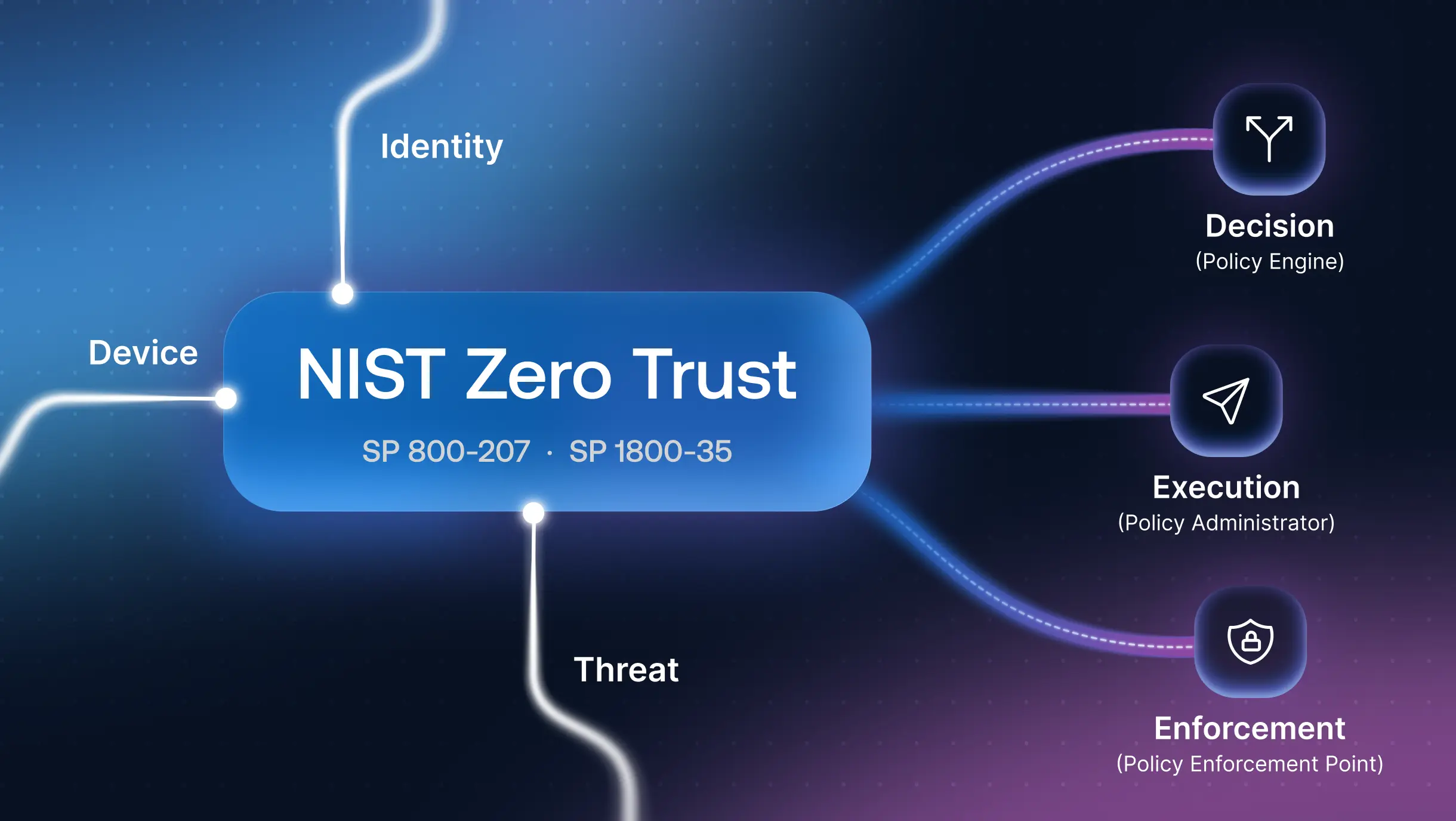
A Zero Trust architecture treats every access request as unverified until proven otherwise, regardless of network location or prior session. Combining continuous verification with least-privilege access controls limits what an attacker can do even after a successful account compromise. Lateral movement becomes significantly harder when every account only reaches what it operationally needs.
Dark Web Credential Monitoring
Stolen credentials do not get used the moment they are stolen. There is typically a lag between when credentials appear on dark web markets and when attackers deploy them. Continuous monitoring of credential exposure gives security teams the window to force password resets or step up authentication before an ATO attempt happens.
Session-Level Detection and Continuous Verification
Stopping an attacker at the login page is the goal. Catching one who gets past it is the requirement.
Most prevention stacks treat authentication as a one-time checkpoint. Once a session is granted, monitoring drops off. That gap is where post-authentication abuse lives.
Closing it requires detection logic that runs for the full duration of every session:
Impossible travel flags sessions that resume from a location physically inconsistent with the previous login. It should trigger immediate step-up authentication or termination.
Session drift catches gradual behavioral shifts mid-session. A user who suddenly jumps to payment settings or export functions without following their normal navigation pattern warrants investigation.
Behavioral analytics builds a baseline of how each user interacts with a system. Deviations from that baseline within a live session surface anomalies that login monitoring cannot catch.
Continuous authentication reassesses identity throughout the session rather than trusting it indefinitely after a single login event.
Session scoring assigns a real-time risk score to active sessions. When that score crosses a threshold, it triggers an automated response: a reauthentication prompt, a session freeze, or a security alert.
Reauthentication triggers ensure high-value actions like credential changes, fund transfers, or sensitive record access always require re-verification, regardless of session age.
Risk-based session termination ends sessions automatically when risk signals accumulate beyond acceptable levels. In shared-terminal environments like clinical workstations or factory floor devices, automatic termination on inactivity or behavioral deviation is a critical safeguard.
The Compliance Cost of Getting ATO Wrong
Account takeover prevention is not just a security program priority. For organizations operating under HIPAA, PCI-DSS, or GDPR, it carries direct regulatory exposure.
HIPAA requires covered entities to implement technical safeguards that guard against unauthorized access to electronic protected health information. A successful ATO that results in patient record access is a reportable breach. PCI-DSS mandates strict access controls and authentication requirements for any system that touches cardholder data. GDPR requires prompt notification of data subjects and regulators following a breach affecting personal data.
Beyond notification obligations, regulators increasingly scrutinize whether organizations had reasonable controls in place before an incident. "We had MFA deployed" is a weaker defense when the investigation reveals that shared workstations had no session-level identity controls or that credential monitoring was not part of the program.
When ATO Happens: A Response Playbook
Detection is only useful if it triggers a fast, structured response.
Immediate Containment: Revoke active sessions for the compromised account the moment a takeover is suspected. Do not wait for confirmation. Force reauthentication and temporarily restrict access to sensitive functions. Check for lateral movement by reviewing whether the account accessed other systems or sent internal communications during the suspicious window.
Credential Rotation: Rotate credentials and invalidate session tokens for the affected account and any accounts that shared credentials, were linked to the same recovery email, or were accessible from the same device.
User Notification and Account Recovery: Notify the affected user through an out-of-band channel, not the compromised account. Walk them through account recovery with identity verification. Document the incident timeline for compliance reporting requirements.
Post-Incident Review: Map how the attacker got in. Identify which detection signal, if any, fired and how long the gap was between compromise and discovery. Use that gap to tune detection thresholds and close the specific control failure that allowed the incident to progress.
Building an ATO Prevention Stack That Holds
Account takeover prevention works when it operates in layers: strong authentication at the front door, behavioral detection across the session, credential monitoring in the background, and a structured response playbook ready when something gets through.
The organizations that still experience ATO despite having controls in place are usually missing one of three things: session-level detection after authentication, coverage of non-standard environments like shared devices or shift-based access, or a practiced incident response process that triggers fast enough to matter.
For security teams operating in healthcare, manufacturing, logistics, or retail, the shared-device problem deserves specific attention. OLOID was built for environments where a single workstation changes hands across a shift, and every session needs to be tied to a verified individual, not a shared credential sitting in a browser cache.
ATO is not going to slow down. Gartner predicts that by 2027, AI agents will reduce the time it takes to exploit account exposures by 50%. The window between credential exposure and active attack is shrinking. The prevention stack you have today needs to be stress-tested against the attack methods of tomorrow.
FAQs
1. What are the early warning signs of an account takeover?
The clearest signals are logins from unusual locations or devices, account setting changes like updated recovery emails or phone numbers, and sessions that access high-value pages immediately after login. Behavioral anomalies during a session, not just at login, are often the earliest indicators.
2. Does MFA fully prevent account takeover?
MFA significantly raises the bar but does not fully prevent ATO. Adversary-in-the-Middle phishing kits can intercept OTPs in real time, and session token theft bypasses authentication entirely. FIDO2 and hardware security keys offer stronger protection because they are phishing-resistant by design.
3. What is the difference between account takeover and identity theft?
Account takeover is the act of gaining unauthorized access to an existing account using stolen credentials. Identity theft is the broader crime of using stolen personal information to open new accounts, apply for credit, or commit fraud under someone else's name. ATO often leads to identity theft, but it is a distinct event.
4. How does account takeover expose organizations to compliance risk?
Under HIPAA, PCI-DSS, and GDPR, a successful ATO that results in unauthorized access to protected data triggers breach notification obligations and regulatory scrutiny. Regulators will examine whether reasonable controls were in place before the incident, not just what was done after it.
5. Why do shared-device environments face higher ATO risk?
Standard ATO detection relies heavily on device and location signals. In shared-device environments, multiple users authenticate from the same terminal, making behavioral baselines harder to establish and anomaly detection noisier. Without session-level identity verification tied to the individual, not the device, stolen credentials used at a shared workstation can go undetected.

Get the latest updates! Subscribe now!

