




Accountability in IAM: The Missing Layer in Shared-Workforce Security

Key Takeaways
- Most frontline identity programs have invested heavily in authentication and authorization. Accountability, the ability to trace an action to a specific person, has largely been assumed.
- In shared-device environments, the account and the person often diverge, and every downstream security function that depends on attribution weakens with it.
- Behavioral detection, incident containment, and offboarding all rely on individual identity. Shared credentials degrade all three at once.
- Organizations that cannot attribute actions tend to tighten controls for everyone. The added friction drives more credential sharing, which makes attribution worse.
- Individual attribution also protects workers. When an incident happens on a shared login, the entire shift falls under suspicion.
- Accountability has to be built into the identity layer at the session level. Policy and logging alone cannot add it later.
Security architecture has long been described in three parts: authentication, authorization, and accounting. Authentication confirms identity, authorization governs what that identity can do, and accounting records who did what. Over the past two decades, enterprises have invested heavily in the first two. The third has mostly been assumed, on the reasoning that if every user holds their own credential, accounting takes care of itself.
In shared-workforce environments, that reasoning breaks down. A distribution center can run SSO, role-based access, and phishing-resistant MFA and still be unable to say which of six associates on a shared receiving terminal approved an inventory adjustment at 2:40 a.m. The controls may be working as configured, but the resulting activity records can still lack reliable individual attribution. On the frontline, the account being used and the person performing the action are not always the same.
The consequences extend beyond audit trails. When investigators cannot reliably identify who performed an action, they may need additional time to establish the scope of an incident, determine which access to revoke, and reconstruct what happened. Shared accounts can complicate each of these steps, making individual attribution an important part of frontline security.
Nobody Owns Attribution on the Frontline
Frontline identity initiatives are usually measured by adoption metrics: login times, help desk tickets, lockout rates, and MFA coverage. These are reasonable metrics, and they all describe the moment of entry. Very few programs track whether an action taken on a shared device can be tied to the individual who took it.
Part of the challenge is organizational. Security owns identity controls, operations manages frontline workflows, HR maintains employee records, and compliance oversees audit requirements. Each function addresses part of the problem, but individual attribution depends on these processes working together. Without clear ownership across them, gaps in shared-device accountability can persist even when each team is meeting its own objectives.
Shared Accounts Complicate Behavioral Detection
User and entity behavior analytics (UEBA), insider-risk platforms, and anomaly-detection tools look for deviations from expected activity. Individual user histories can help security teams identify unusual access patterns, activity times, and behavior.
When several workers operate under the same account, however, those histories become harder to interpret. Activity from different people, roles, and shifts can be blended into a single account profile, making it more difficult to establish which behavior belongs to which individual.
This does not make behavioral analytics ineffective, but it can weaken individual-level attribution and complicate investigations. Reliable identity information at the point of access gives security teams a clearer basis for interpreting activity and investigating anomalies.
Shared Logins Slow Down Incident Response
When something goes wrong, incident response begins with establishing the scope: who was involved, which systems or records were affected, and whose access needs to be revoked. Reliable individual attribution helps investigators answer these questions. Shared credentials make the process more difficult because the account's activity may span several workers and shifts.
Consider a pricing override pushed through a shared store-level account at a retail chain. Disabling the account stops the threat and also stops every associate who relies on it mid-shift. Leaving it active keeps the store running and leaves the exposure open. Security leaders are forced to choose between containment and operations, and the investigation that follows relies on shift schedules, camera footage, and interviews to reconstruct what a properly attributed log would have shown in seconds. Every day spent reconstructing is a day added to containment time, and the Ponemon data makes clear how directly that translates into cost.
Why Offboarding Breaks on Shared Accounts
Offboarding works cleanly when access belongs to a person. Disable their account and their access ends. A shared credential behaves differently. Removing one departing worker requires rotating the credential for everyone who uses it, which in practice often gets deferred.
The pattern is common well beyond the frontline. A July 2025 PasswordManager.com survey of 1,200 US workers found that 40% had used login credentials from a former employer after leaving, and 15% were still doing so. Among those who retained access, six in ten said their employer never changed the password, and 28% said a current employee had shared it with them. Apply those dynamics to frontline workforces with high turnover and seasonal hiring, where shared logins are often the default, and the population of people holding valid credentials can grow well beyond the population currently on payroll.
Individual Logins Protect Workers Who Follow Process
Accountability does most of its work before any incident occurs. People handle sensitive actions differently when those actions are clearly theirs. A quality sign-off, a safety interlock override, or a controlled-substance count carries more weight when the person completing it knows the record will show their name.
When an error or a policy violation surfaces on a shared login, suspicion spreads across everyone who had access to it. The worker who followed every procedure ends up in the same investigation as the one who did not. Individual attribution can help distinguish the actions of one worker from those of others who share the same device. It supports fairer investigations by giving managers and security teams better evidence of who performed a particular action, rather than treating everyone with access to the shared account as equally responsible.
Why More Security Friction Can Backfire on the Frontline
When organizations struggle to establish who performed an action, they may respond by tightening controls across the board. Shorter session timeouts, additional approvals, and more frequent re-authentication can improve certain aspects of security, but they can also add friction to time-sensitive frontline workflows.
When authentication becomes disruptive, workers may be more inclined to leave sessions open or look for workarounds, including sharing credentials. These practices can undermine the individual attribution that stronger controls were intended to support.
The goal is not simply to increase authentication frequency. It is to make individual authentication and session switching practical within the realities of frontline work, so workers can maintain secure, attributable sessions without unnecessary disruption.
Many organizations already have strong controls deciding who gets access. What they lack on the frontline is the ability to say, with confidence, who used that access. Accountability has to be designed into the moment someone picks up a shared device, because it can't be reconstructed afterward.
Aman Khanna, VP, Product Growth, OLOID
How to Build Accountability Into Every Session
Closing the accountability gap requires more than recording login events. Organizations need to connect individual authentication, session management, and audit records so that activity on shared devices can be traced to the person who performed it. Four capabilities are particularly important:
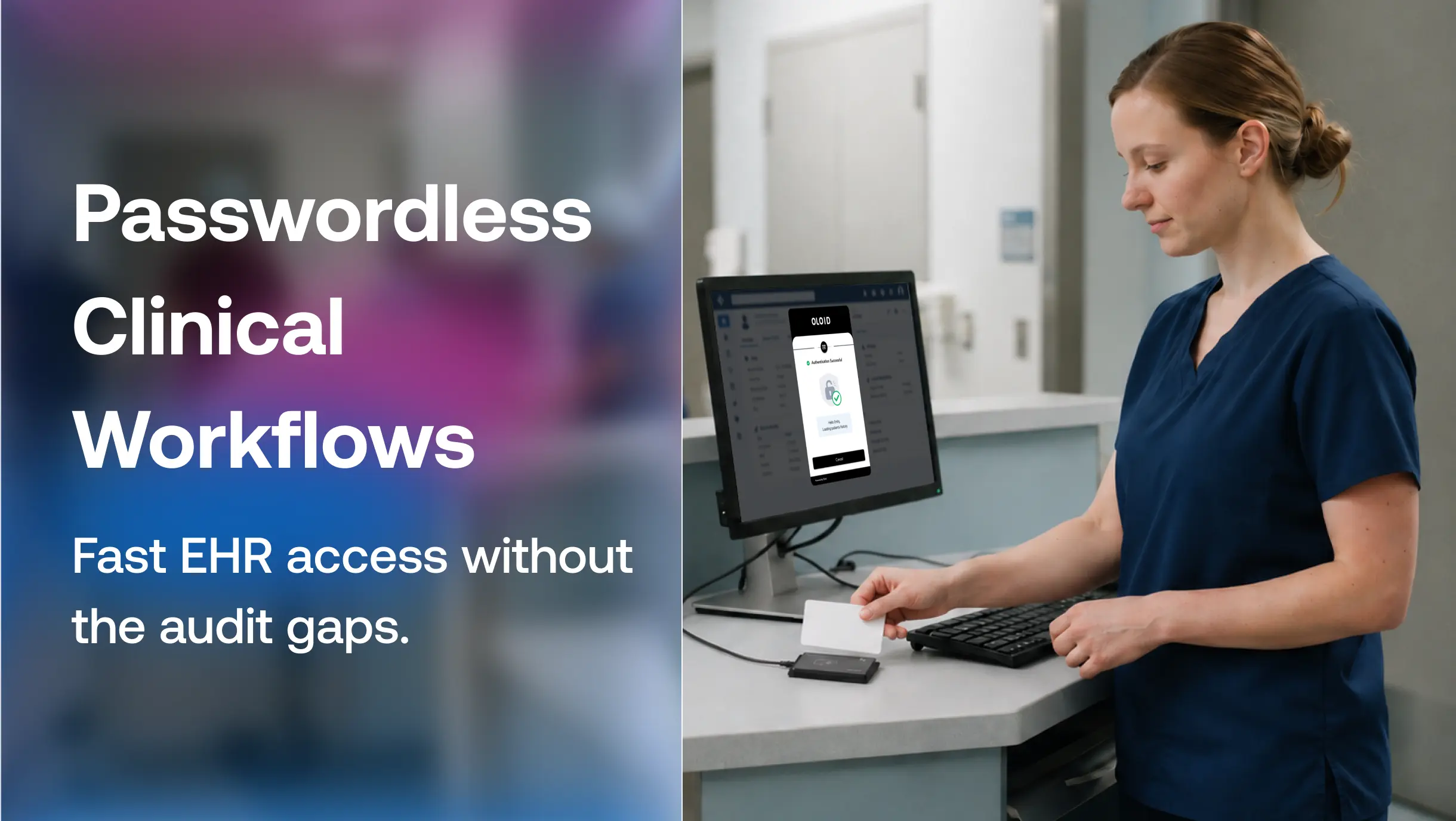
Person-bound authentication at every session start. Use authentication methods such as badge tap, face authentication, or PIN in a supported configuration to establish which individual is accessing a shared device.
Clean handoffs between workers. Ensure that one worker's session ends or is appropriately locked before another worker begins using the device. Session transitions should preserve a clear distinction between users.
Alignment with identity lifecycle processes. Connect authentication and access changes to employee onboarding, role changes, and offboarding processes. This helps ensure that a worker's ability to authenticate reflects their current authorization.
Audit records linked to individual identities. Ensure that available identity and application logs preserve the information needed to associate relevant activity with the correct individual. The level of attribution depends on how sessions, applications, and audit events are integrated.
Organizations using Okta, Ping Identity, or Microsoft Entra ID can build on their existing identity and access controls. Shared-device environments introduce additional requirements around frontline authentication, session switching, and individual attribution. OLOID helps address these requirements by extending authentication to frontline workflows and supporting person-bound access on shared devices, while complementing existing identity-provider investments.
The specific level of attribution depends on the device, application, session configuration, and available audit records. Organizations should assess these components together when evaluating how to improve accountability.
Make Every Shared Session Traceable to a Person
Strong authentication and access policies are essential, but they do not guarantee individual accountability when multiple workers use the same device or account.
For frontline organizations, the next step is to connect individual authentication, clear session handoffs, and reliable audit trails. These capabilities help security teams investigate incidents, support access reviews, and distinguish one worker's actions from those of others sharing the same terminal.
The key question is simple: if a sensitive action occurred on a shared terminal during the last shift, could your team reliably identify the person who performed it? If the answer is unclear, it may be time to reassess how your IAM environment handles frontline authentication and shared-device access.
FAQs
1. What does accountability mean in identity and access management?
Accountability in IAM is the ability to associate relevant system activity with the individual who performed it. Authentication verifies identity, authorization determines what that identity can access, and accounting records system activity. Accountability depends on being able to connect those records to the correct individual.
2. Why is accountability harder to achieve in shared-device environments?
Shared terminals, kiosks, scanners, and other frontline devices may be used by multiple workers across shifts. If workers use a shared account or inherit an existing session, system logs may identify the account without reliably identifying the person who performed a particular action.
3. How does a lack of individual attribution affect incident response?
A lack of individual attribution can make it harder to establish who was involved, determine the scope of an incident, and decide whose access needs to be revoked. Investigators may need to reconcile application logs with shift schedules, interviews, and other records, potentially extending the investigation.
4. Can existing IAM platforms support individual accountability on shared devices?
Existing identity providers can remain part of the solution. Organizations may need additional frontline authentication and session-management capabilities to distinguish workers using shared devices. The level of attribution also depends on application behavior, integration, and the audit records available.
5. Does multifactor authentication alone solve accountability on shared devices?
No. Multifactor authentication strengthens identity verification, but it does not by itself ensure that subsequent activity remains attributable to the same individual. Session management, clean user handoffs, and application-level audit records are also important.



Get the latest updates! Subscribe now!

