




What is Network Segmentation? A Complete Guide

Key Takeaways
- Network segmentation divides a network into isolated subnets, each governed by its own security policies, so a breach in one zone cannot automatically spread to another.
- The perimeter trust model is no longer sufficient. Flat networks can give attackers broad access to internal systems once they gain an initial foothold, increasing the potential impact of a compromise.
- Network segmentation is a foundational layer of Zero Trust, enforcing least-privilege access at the network level and shrinking the blast radius of any compromise.
- Physical segmentation uses dedicated hardware; logical segmentation uses VLANs and software. Logical approaches are more flexible and cost-effective for modern, distributed environments.
- Shared-device and frontline environments face a distinct segmentation challenge: devices change hands across shifts, which means identity enforcement at the segment level requires more than network architecture alone.
- Segmentation is an ongoing discipline, not a deployment checkbox. Misconfiguration, oversegmentation, and policy drift are the most common failure modes, and all three require active management.
Picture a manufacturing plant where dozens of workers share tablets and terminals across three shifts. No personal devices, just shared endpoints and a network that runs 24/7. Now imagine an attacker compromising a single shared device on the factory floor. If the network is flat, that one entry point opens a free path to ERP systems, production controls, and HR records sitting in the same environment.
This is the breach scenario security teams dread. According to the 2024 IBM Cost of a Data Breach Report, the average breach now costs $4.88 million, a 10% jump from 2023 and the steepest annual rise since the pandemic. What drives that cost is not just the initial compromise. It is what happens next: attackers move laterally across a poorly divided network, reaching sensitive systems long before anyone detects them.
[[content-box]]
This guide covers how network segmentation works, why the perimeter trust model collapsed, how segmentation connects to Zero Trust, where implementations go wrong, and how to build one that holds.
What is Network Segmentation
Network segmentation breaks a larger network into distinct zones or subnets. Each segment operates under its own rules, controlling what traffic flows in, what flows out, and who can cross segment boundaries.
How It Works at the Technical Level
Administrators define segments based on device type, user role, data sensitivity, or application function. Firewalls, VLANs, access control lists, and routing policies enforce those boundaries at the segment gateway. A device in one segment cannot reach resources in another without explicit authorization, forcing every cross-segment interaction through a policy enforcement point where it can be inspected, logged, or blocked.
Physical vs. Logical Segmentation
Physical segmentation uses dedicated hardware, separate switches, routers, and firewalls, to build hard boundaries between subnets. It offers strong isolation but carries high infrastructure costs and limited flexibility as environments scale.
Logical segmentation achieves separation through software and network configuration rather than dedicated physical infrastructure. VLANs, network addressing, software-defined networking, and policy controls can divide traffic without requiring separate physical networks. Logical approaches are generally more adaptable as environments change, making them useful in distributed and shared-device environments where device populations and access requirements shift frequently.
Why the Old Perimeter Model Broke Down
Legacy networks operated on a single assumption: everyone inside the perimeter is trusted. The firewall sat at the edge, inspected external traffic, and left internal traffic largely unrestricted.
The Trust Assumption and Its Failure
Flat network architectures with one perimeter firewall as the only inspection point made sense when networks were small and stable. They stopped making sense when remote work, cloud adoption, IoT devices, and shared endpoints removed the clean line between inside and outside. Insiders, whether careless or deliberate, represent a genuine threat. Third-party vendors with internal network access extend that risk further.
How Lateral Movement Became the Dominant Attack Vector
When an attacker compromises one endpoint on a flat network, the damage potential extends to everything that endpoint can reach. In a poorly segmented environment, that is often most of the network. Attackers escalate privileges and move toward high-value systems, frequently completing that traversal before any alert fires. Lateral movement now drives roughly 70% of successful breaches, and network segmentation forces every move through a controlled boundary.
How Network Segmentation Fits Into a Zero Trust Architecture
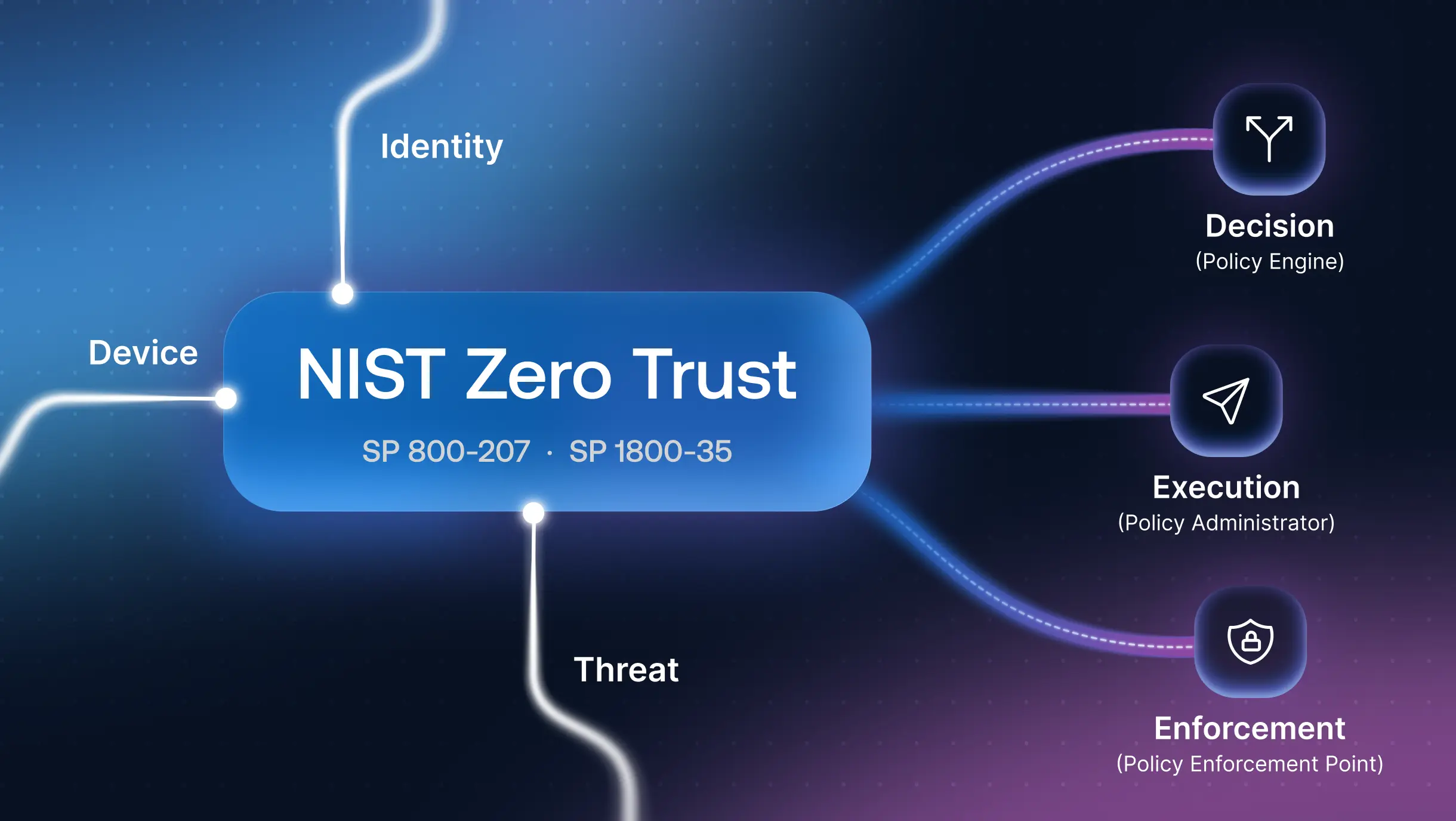
Zero Trust operates on the principle that no user, device, or session receives trust by default, regardless of network location. Network segmentation is one of the foundational controls that makes Zero Trust enforceable at the network level. For the rollout sequence, see how to implement Zero Trust.
From Perimeter Defense to Protect Surface
Zero Trust organizations build a protect surface around their most critical assets: sensitive data, key applications, and mission-critical systems. Segmentation creates a microperimeter around that protect surface, establishing a second line of defense that holds independently of whether the outer perimeter is breached. This microperimeter model is the foundation of Zero Trust Network Access (ZTNA).
Where IAM and NAC Enforcement Happen at the Segment Level
Segmentation controls where users and devices can go, but it does not by itself establish who is using a shared device at any given moment. That's the layer identity and access management (IAM) adds. That distinction matters in operational environments where workers share devices across shifts. A frontline worker finishing a shift should not leave behind an authenticated session that carries access into the next worker's session. Identity-aware authentication adds this missing layer by tying each session to a verified individual and applying the appropriate access policy. In practice this often means continuous authentication that re-verifies presence throughout the shift. OLOID provides passwordless authentication designed for these shared-device environments.
Where Segmentation Gets Deployed
Regulated Industries
Healthcare, manufacturing, and financial organizations each face mandates that require network segmentation. Healthcare organizations use network segmentation as an important safeguard for limiting access to systems containing electronic protected health information (ePHI), alongside other HIPAA Security Rule requirements. PCI DSS requires cardholder data environments to be isolated with tightly defined access rules. Segmentation is how organizations demonstrate that regulated data stays within a defined, auditable scope.
Frontline and Shared-Device Environments
Manufacturing floors, hospital wards, logistics hubs, and retail operations share a structural challenge: workers share devices, access points rotate across shifts, and per-user network access models break down at scale. Segmenting by function, separating production controls from business systems and clinical devices from administrative networks, is a foundational control. In these environments, whether segmentation is in place often determines whether an incident stays contained or becomes an operational shutdown.
Cloud and Hybrid Environments
Cloud providers secure their infrastructure. Organizations secure the workloads, applications, and data running on top of it. Segmentation isolates applications across public, private, and hybrid cloud environments so a misconfigured container or compromised workload cannot reach sensitive systems elsewhere.
User Groups and Third-Party Access
Departments, contractors, and vendors each carry different risk profiles. Segmenting them into isolated subnets limits the damage any one group can cause if compromised. Guest Wi-Fi places visitors in a microsegment with internet access only and no path into internal systems. Third-party vendor access follows the same principle: access only the segment the engagement requires, with everything else blocked by default.
Benefits of Network Segmentation
- Lateral movement containment: Segmentation limits lateral movement. Attackers attempting to move between zones must pass through controlled enforcement points, allowing security teams to detect and block unauthorized activity before the damage spreads.
- Performance improvement: Smaller subnets carry less broadcast traffic. Resource-intensive workloads like machine telemetry or video conferencing perform better when isolated from general network noise.
- Monitoring scope reduction: Watching traffic within a defined segment is manageable. Watching an entire flat network for anomalies buries real signals in noise. Segmentation makes meaningful detection achievable.
- Compliance footprint reduction: Fewer in-scope systems mean smaller, less expensive audits. Segmentation limits which systems fall within a regulated environment, directly cutting compliance overhead.
- Insider threat containment: Segmentation limits what any single user or device can reach by default, reducing the blast radius of compromised credentials or malicious insiders.
What Bad Segmentation Looks Like
Oversegmentation and Visibility Loss
Creating too many segments fragments visibility. Security teams lose the ability to correlate events across the environment. Effective segmentation is coarse enough to maintain operational clarity and fine enough to contain real threats. Micro-dividing every system without a coherent policy framework adds management overhead without security gains.
Misconfiguration Risks
VLANs, ACLs, and firewall rules interact in ways that create gaps when improperly configured. A single permissive rule between segments can open a path an attacker later exploits. Misconfiguration risk rises sharply in multi-cloud environments and wherever third-party infrastructure reduces direct control. Regular policy reviews and automated configuration audits are the practical defense.
Treating It as a Finished Project
Segmentation degrades over time. New devices join the network. Roles change. Applications migrate. An architecture that was sound at deployment develops gaps within months without active maintenance. Periodic audits and a defined review cadence are what keep segmentation functional under real conditions.
How to Implement Network Segmentation
- Map assets and data flows first: Document every device, system, and data type on the network and how traffic moves between them before drawing any boundaries. Segmenting blind creates misaligned zones.
- Define access policies per segment: Determine which users and devices belong in each zone and what they need to reach. Default-deny between segments is the target posture.
- Automate classification and enforcement: New devices need to land in the correct segment automatically. Manual classification breaks down in environments with high device turnover, including shift-based operations and high IoT density.
- Control third-party and guest access explicitly: Contractors and vendors get access to only the segments their work requires, reviewed and revoked when the engagement ends.
- Test enforcement boundaries before going live: Assumed isolation and actual isolation are not the same thing. Validate that controls block what they are supposed to block.
- Tie access to verified identity: In shared-device environments, ensure access decisions are tied to the individual worker using the device, not simply the device or network segment.
- Set a review cadence: Quarterly at minimum. Segmentation policy needs to reflect the current network, not the state it was in at deployment.
Network Segmentation vs. Microsegmentation
| Aspect | Network Segmentation | Microsegmentation |
|---|---|---|
| Scope | Subnet or zone level | Individual workload or application level |
| Traffic controlled | Traffic between network zones | Granular workload-to-workload traffic |
| Primary method | VLANs, firewalls, ACLs | Software-defined policies, virtual firewalls |
| Policy granularity | Segment-level rules | Per-workload rules |
| Best for | Separating networks, departments, devices, and regulated environments | Controlling communication between individual workloads and applications |
| Zero Trust role | Establishes the structural foundation | Adds granularity on top of segmentation |
| Complexity | Moderate | High |
| Typical use | Separating departments, isolating regulated data, guest access | Containing lateral movement at the workload level |
Conclusion
Network segmentation is not a firewall setting or a one-time configuration. It is an ongoing architectural discipline that determines how far an attacker can travel once they are inside your network. The perimeter alone has not been enough for years. What contains a breach today is what you built inside: defined zones, enforced boundaries, and policies that reflect how your environment actually operates.
For most organizations, the weak point is not the segmentation architecture itself. It is the identity layer sitting on top of it. A well-segmented network still fails when shared devices carry over authenticated sessions between shifts, when contractors access more than their role requires, or when a badge reader and a business system share the same zone by default.
This is where architecture meets operational reality. In healthcare, manufacturing, logistics, and other frontline environments, segmentation becomes more effective when every session can be tied to a verified individual rather than a shared credential. Identity-aware authentication ensures that access policies remain meaningful even when the underlying device is shared. OLOID brings passwordless authentication to these shared-device environments, helping organizations connect network controls with the identity of the worker actually using the device.
Segment the network. Enforce identity at every boundary. Audit both regularly.
FAQs
1. What is network segmentation in simple terms?
Network segmentation splits a computer network into smaller, isolated sections so that a security breach in one area cannot automatically reach the rest of the network. Each section operates under its own access rules.
2. Does network segmentation prevent cyberattacks?
It does not prevent initial access. What it does is limit how far an attacker can move after gaining a foothold, reducing the scope of damage and giving security teams a realistic window to detect and contain the threat.
3. What is the difference between network segmentation and microsegmentation?
Network segmentation divides a network into broad zones with controlled traffic between them. Microsegmentation applies policy at the individual workload or application level, controlling traffic within zones as well as between them. Both serve a role, with microsegmentation adding granularity on top of the foundational architecture segmentation provides.
4. Is network segmentation required for compliance?
Segmentation is an important security and compliance control for many regulated environments. PCI DSS requires organizations to protect and control access to cardholder data environments, while healthcare organizations use segmentation to limit access to systems containing ePHI. NIST SP 800-207 and CISA Zero Trust guidance also support segmentation and isolation as part of a broader Zero Trust architecture.
5. How does network segmentation support Zero Trust?
Segmentation enforces the Zero Trust principle of least privilege at the network level. It ensures that access to any zone requires explicit authorization rather than being granted by default because a user or device already sits inside the network perimeter.

Get the latest updates! Subscribe now!

