




Third-Party Access Management: A Complete Guide to Secure Vendor Access
Third-party access management governs how external vendors, contractors, and partners access internal systems and data. Organizations face growing risks from uncontrolled vendor privileges, making structured access policies essential. This blog covers risk factors, implementation strategies, and security best practices. You'll learn how to balance business needs with robust protection for your critical assets.

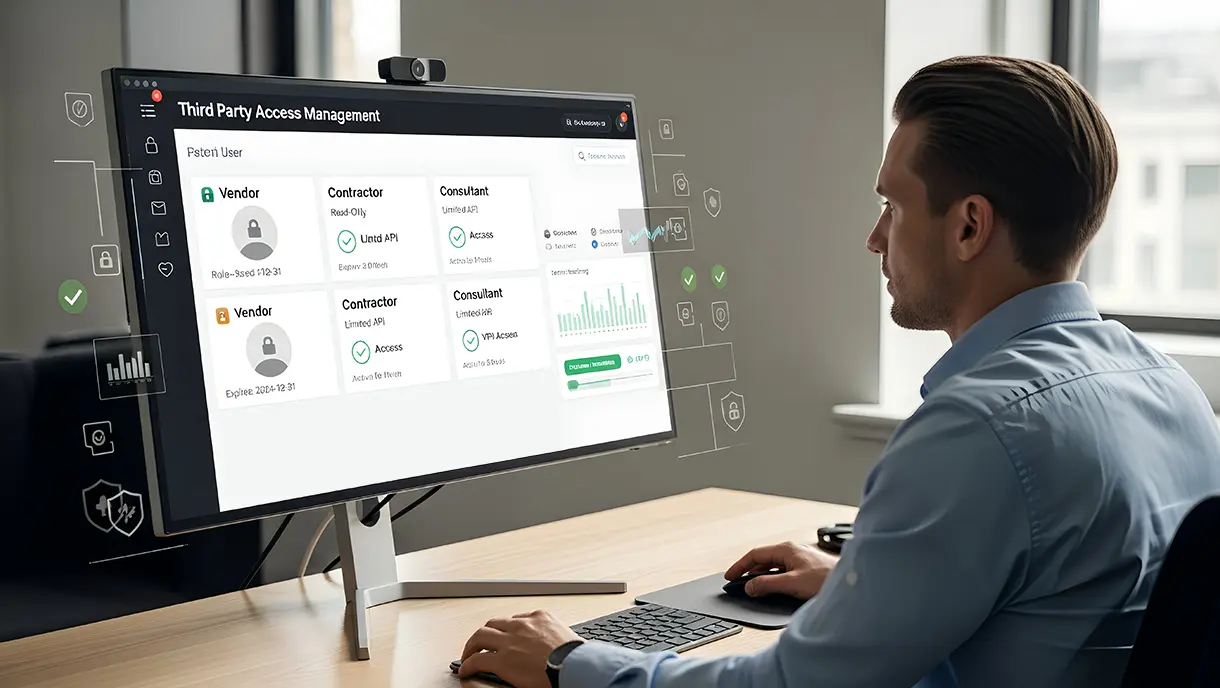
Managing external access has become a major security priority for modern enterprises. Organizations depend on vendors, contractors, service providers, and temporary workers who all need controlled access to internal systems. While this ecosystem supports operations, it also expands the attack surface and increases the risk of unauthorized access.
Recent breaches show a clear pattern. Cybercriminals target third-party credentials because they are often unmanaged, overprivileged, or shared across users. Once compromised, these accounts can give attackers direct access to sensitive systems, resulting in data loss, operational downtime, and compliance issues.
This raises some critical questions for every organization:
- How secure is your organization’s vendor and contractor access?
- Are third-party accounts creating hidden risks in your systems?
- Do you have proper visibility and control over every external user session?
- Are your access processes compliant with industry regulations and security frameworks?
- Are you confident that external users only have access to what they truly need?
Strong third-party access management provides the answer. By controlling, monitoring, and governing vendor access, organizations can enforce least privilege, reduce risk, and ensure every external user can only access what they need for the shortest time necessary. With the right strategy and tools, enterprises can secure their vendor ecosystem without slowing down operations.
This guide will walk you through what third-party access management is, why it matters, the risks involved, best practices, and how to build a secure, scalable framework for external access.
What Is Third-Party Access Management?
Third-party access management is the practice of controlling and monitoring external users who need entry to internal systems. It encompasses identity verification, permission assignment, session monitoring, and access revocation. Organizations use these processes to ensure that vendors have access only to the resources necessary for their specific roles.
The framework applies to contractors, suppliers, consultants, and any external entity requiring system connectivity. This discipline differs from standard employee access management in scope and risk profile. External users typically need temporary, project-based permissions rather than permanent accounts.
They access systems from unmanaged devices and networks outside organizational control. Their employment status and security training vary significantly. These differences demand specialized policies, approval workflows, and technical safeguards.
Why Strong Third-Party Access Management Matters
External access creates exposure points that attackers actively exploit for initial compromise. Organizations face both operational risks and regulatory obligations when managing vendor relationships. Understanding these drivers helps prioritize security investments and policy development.
1. Rising Cybersecurity Risks from Vendors and Contractors
Third parties represent attractive targets because their security posture often lags behind enterprise standards. Attackers compromise vendor credentials to bypass perimeter defenses. Once inside, they move laterally to high-value targets.
According to the SecurityScorecard report, more than one out of three breaches comes from third parties. Organizations inherit the security weaknesses of every connected partner.
2. Third Parties Hold Privileged Access to Critical Systems
Vendors frequently require administrative rights to perform maintenance, support, and development work. They access production databases, cloud infrastructure, and customer information.
Some external users possess more powerful credentials than internal staff. This elevated privilege creates catastrophic risk if accounts become compromised. A single stolen vendor credential can provide attackers with complete system control.
3. Regulatory Pressures to Secure Vendor Access
Compliance frameworks increasingly mandate third-party access controls and documentation. GDPR, HIPAA, SOC 2, and PCI DSS all require organizations to protect data accessed by external parties.
Auditors scrutinize vendor management practices during assessments. Failures result in penalties, certification denials, and contractual violations. Companies must demonstrate technical and administrative controls that appropriately limit vendor access.
Key regulatory frameworks that mandate third-party access controls include:
- HIPAA (Healthcare): Requires Business Associate Agreements (BAAs) and access controls for any third party handling Protected Health Information (PHI). Violations can result in fines up to $1.5 million per incident category.
- PCI-DSS (Payment/Financial): Requirement 8 mandates unique IDs and multi-factor authentication for all third-party remote access to cardholder data environments. Requirement 12.8 specifically addresses service provider management.
- SOX (Public Companies): Section 404 requires companies to assess and document internal controls over financial reporting, including third-party access to financial systems.
- GDPR (Data Processing): Article 28 requires data controllers to ensure processors (often third parties) implement appropriate technical and organizational measures. Non-compliance penalties reach up to 4% of global annual revenue.
- NIST SP 800-53 (Government/Critical Infrastructure): The AC (Access Control) and SA (System and Services Acquisition) control families prescribe specific requirements for external system services and third-party access.
Organizations operating across multiple jurisdictions must map vendor access controls to each applicable framework and maintain audit evidence of compliance.
4. Business Impact of Uncontrolled Third-Party Access
Breaches originating from vendor access cause severe financial and reputational damage. Recovery costs include incident response, legal fees, regulatory fines, and customer notification. Organizations experience operational disruptions when compromised systems require isolation or rebuilding. Customer trust erodes when external partners cause security incidents.
Real-World Breaches Caused by Third-Party Access Failures
The consequences of poor third-party access management are not theoretical. Recent high-profile incidents demonstrate the scale of risk:
- National Public Data Breach (2024): A third-party vulnerability exposed 2.9 billion records, with stolen data sold on the dark web for $3.5 million. The breach originated through an external service provider with excessive access privileges.
- FBCS Data Breach (2024): A financial business and consumer solutions provider breach affected 4.2 million individuals when a third-party vendor's credentials were compromised, exposing sensitive financial records.
- Okta Identity Provider Breach (2023): Attackers exploited a third-party support vendor's access to steal session tokens, compromising 134 enterprise customers. The breach highlighted risks when identity providers themselves rely on poorly managed vendor access.
These incidents share a common thread: external parties had more access than necessary, for longer than necessary, with insufficient monitoring.
5. Growing Complexity of Multi-Vendor Ecosystems
Modern enterprises engage dozens or hundreds of external service providers. Each vendor relationship multiplies security management overhead. Organizations struggle to maintain accurate inventories of active vendor accounts.
Access provisioning delays frustrate business teams and vendors. Manual processes cannot scale effectively across complex supplier networks. This complexity creates gaps where excessive permissions accumulate, and outdated accounts remain active.
Strong third-party access management protects systems, reduces exposure to credential-based attacks, and maintains control over every external connection. To make this clearer, let us explore the most common third-party access scenarios and the types of external users who typically require secure access.
[[cta]]
Common Third-Party Access Scenarios & Who Needs It
Third-party access requirements span numerous business functions and technical environments. Understanding common scenarios helps organizations design appropriate controls for each situation. Here are the typical scenarios where strong third-party access management is required:
- IT Service Providers: Managed service providers, cloud infrastructure vendors, and software support teams need access to configure systems, troubleshoot issues, and perform maintenance.
- Software Developers and Integrators: Development partners require connectivity to staging and production environments to deploy code, test integrations, and resolve bugs.
- Business Process Outsourcers: External teams handling customer support, billing, or data processing need application and database access to perform operational tasks.
- Auditors and Consultants: Compliance assessors and business consultants require temporary access to review configurations, documents, and system settings.
- Supply Chain Partners: Logistics providers, manufacturers, and distributors need access to inventory management systems, planning tools, and partner portals.
- Facility and Equipment Vendors: Building maintenance contractors, security system providers, and equipment technicians access physical and operational technology systems.
- Financial Service Providers: Payment processors, accounting firms, and banking partners connect to financial systems to process transactions and reconcile accounts.
Understanding the different scenarios where vendors, contractors, and service partners need access helps organizations map out where external entry points exist across their systems. For building a strong third-party access strategy, it is important to understand the risks that emerge when these connections are not managed properly.
Challenges and Risks When Third-Party Access Is Not Managed Properly
Organizations without structured vendor access management face numerous security and operational problems. Each challenge compounds others, creating systemic vulnerabilities.
1. Lack of Visibility into Who Has Access and Why
Companies often cannot produce accurate lists of active vendor accounts and their associated permissions. Access provisioning happens through informal requests without centralized tracking.
IT teams create accounts without documentation in response to email requests. Over time, organizations accumulate hundreds of unmonitored external connections. This opacity prevents security teams from assessing risk or detecting unauthorized access.
Ways to Overcome This Challenge
- Implement centralized access request and approval workflows that document business justification.
- Maintain a comprehensive inventory linking vendor accounts to contracts, owners, and access scopes.
- Deploy access governance tools that automatically discover and report third-party accounts across systems.
- Require regular attestations from business owners confirming the continued need for vendor access.
2. Excessive Privileges and Standing Access
Vendors frequently receive broader permissions than their actual job functions require. Organizations grant admin rights as the default rather than implementing least-privilege principles.
Access remains active indefinitely even after projects are complete. Standing privileges allow vendors to access systems at any time without approval or monitoring. These excessive permissions maximize damage potential when credentials become compromised.
Ways to Overcome This Challenge
- Define role-based access control aligned to specific vendor functions and responsibilities.
- Implement just-in-time access that grants privileges only when needed for approved timeframes.
- Establish automatic access expiration tied to contract end dates or project completion.
- Conduct quarterly access reviews to identify and remove unnecessary vendor privileges.
3. Weak Authentication and Shared Credentials
Many organizations allow vendors to authenticate using simple passwords without additional verification. Some companies create shared accounts used by multiple vendor employees. Password-only authentication enables credential stuffing and brute force attacks.
Shared accounts eliminate individual accountability and prevent attribution during investigations. Vendors connecting from compromised networks compound these authentication weaknesses.
Ways to Overcome This Challenge
- Mandate multi-factor authentication for all vendor access, particularly privileged accounts.
- Require vendors to use federated identity or unique individual accounts tied to real identities.
- Implement certificate-based authentication or hardware security keys for high-risk access.
- Block access attempts from suspicious locations or known compromised IP addresses.
4. Unmonitored Sessions and Limited Audit Trails
Organizations rarely record or analyze vendor sessions to detect suspicious activities. Standard logging captures authentication events but not the actions performed during sessions. Security teams lack visibility into which vendors access, modify, or exfiltrate data.
This monitoring gap allows attackers to operate undetected after compromising vendor credentials. Insufficient audit trails prevent forensic analysis when investigating potential breaches.
Ways to Overcome This Challenge
- Deploy session recording solutions that capture keystroke and screen activity for privileged vendor access.
- Implement user behavior analytics to detect anomalous actions, such as unusual data access patterns.
- Establish real-time alerting for high-risk activities such as credential modifications or bulk downloads.
- Retain detailed audit logs for a minimum of one year to support compliance requirements and investigations.
5. Subcontractors and Shadow Vendor Access
Primary vendors often engage subcontractors without informing the contracting organization. These fourth parties access systems through credentials issued to the primary vendor. Organizations lack visibility into subcontractor identities, locations, and security practices.
Shadow IT scenarios emerge when business units grant access to vendors without IT involvement. These unmanaged relationships create unmonitored pathways into sensitive environments.
Ways to Overcome This Challenge
- Include contractual clauses prohibiting subcontractor access without explicit written approval.
- Require vendors to disclose all personnel who will access systems with names and roles.
- Implement network access controls that restrict connectivity to approved IP ranges or VPN endpoints.
- Conduct regular audits comparing active vendor accounts against approved vendor lists.
6. Higher Risk of Supply-Chain and Ransomware Attacks
Attackers increasingly target vendor relationships as initial access vectors for supply chain attacks. Compromising a single vendor provides entry to dozens of their customers. Ransomware groups specifically hunt for credentials of managed service providers.
Once inside via vendor access, attackers deploy malware, steal data, and establish persistent backdoors. These attacks bypass perimeter defenses and exploit trusted relationships.
Ways to Overcome This Challenge
- Segment networks to isolate vendor access from critical business systems and data.
- Implement a zero-trust architecture that validates every connection regardless of source.
- Deploy endpoint detection on systems accessible to vendors to identify malicious activity.
- Develop incident response plans specifically addressing third-party compromise scenarios.
7. Compliance Violations and Legal Liability
Inadequate vendor access controls lead to regulatory violations when external parties improperly access protected data. Organizations face penalties for failing to implement required safeguards over third-party data processing.
Breaches caused by vendors can result in legal liability under data protection laws. Customers may sue organizations for damages resulting from vendor-related incidents. Compliance failures damage certifications necessary for business operations.
Ways to Overcome This Challenge
- Document vendor access controls in security policies aligned with applicable regulations.
- Include data protection and security requirements in vendor contracts with audit rights.
- Conduct security assessments before granting vendors access to sensitive data or systems.
- Maintain evidence of compliance through regular audits, assessments, and certification reviews.
The challenges and risks of unmanaged third-party access highlight just how critical proper controls are. Moving forward, let’s explore the top benefits organizations gain by adopting an effective approach to controlling, monitoring, and securing external access.
[[cta-2]]
Top Benefits of an Effective Third-Party Access Management Framework
Implementing structured third-party access management delivers measurable security and operational improvements. Organizations gain both risk reduction and efficiency advantages.
1. Reduced Risk of Vendor-Driven Data Breaches
Proper access controls dramatically lower the probability of breaches originating from external connections. Organizations limit vendor permissions to only necessary systems and data. Time-bound access prevents credentials from remaining active after project completion.
Strong authentication blocks attackers who steal vendor passwords. These layers create defense-in-depth, transforming vendors from major risk factors into controlled, monitored relationships.
2. Greater Visibility Into Who Has Access and Why
Centralized management provides a complete inventory of all vendor accounts and their associated permissions. Security teams understand which external parties can access critical systems.
Business justification links each vendor account to specific contracts and projects. Real-time dashboards display active vendor sessions and access patterns. This transparency enables informed risk decisions and rapid incident response when suspicious activity occurs.
3. Stronger Regulatory Compliance and Audit Readiness
Documented vendor access controls satisfy regulatory requirements across multiple frameworks. Organizations demonstrate due diligence in protecting data accessed by third parties.
Automated compliance reporting reduces audit preparation time and costs. Access reviews and recertification processes provide evidence of ongoing governance. This compliance posture prevents penalties and maintains business-critical certifications.
4. Enhanced Operational Control With Time-Bound, Least-Privilege Access
Just-in-time provisioning grants vendor access only when approved and needed for specific durations. Automatic expiration eliminates forgotten accounts that accumulate over time. Role-based access ensures vendors receive appropriate permissions for their functions.
This operational control reduces administrative overhead while improving security posture. IT teams spend less time managing vendor access requests through streamlined approval workflows.
5. Improved Accountability Through Monitoring and Session Auditing
Session recording creates comprehensive records of all vendor activities within critical systems. Organizations can review exactly what actions vendors performed during each connection. User behavior analytics detect anomalies that indicate compromised credentials or insider threats.
Individual accountability prevents vendors from sharing credentials because every action traces to specific identities. This monitoring capability provides forensic evidence during investigations.
6. Lower Business Disruption and Faster Incident Response
Automated controls reduce vendor lockouts and access delays that frustrate business operations. Self-service access request portals streamline vendor onboarding and permission updates. When security incidents occur, organizations quickly identify affected vendors and revoke access.
Incident response teams leverage session recordings and audit trails to understand the scope of a breach. This operational efficiency balances security requirements with business velocity.
The benefits of a well-implemented third-party access management framework are clear. With these advantages in mind, the next step is to look at actionable best practices for strengthening third-party access security and ensuring every external connection is both safe and efficient.
Best Practices for Strengthening Third-Party Access Security
Organizations should implement multiple complementary controls to create robust vendor access security. These practices address different aspects of the third-party access lifecycle.
1. Enforce Least-Privilege and Time-Bound Access
Grant vendors only the minimum permissions required to complete specific tasks or projects. Define explicit access scopes by job function rather than granting broad administrative rights. Implement automatic expiration that removes access after predetermined periods.
This practice limits the potential damage if vendor credentials are compromised and reduces the attack surface available to external parties.
2. Replace Shared Logins With Unique, Traceable Identities
Eliminate shared vendor accounts that multiple people use with the same credentials. Require each vendor employee to authenticate with individual identities linked to real people. Unique accounts enable attribution during audits and investigations.
They prevent vendors from sharing access with unauthorized subcontractors. Individual accountability improves security awareness and reduces credential-sharing behaviors.
3. Implement Strong Authentication Beyond Passwords
Mandate multi-factor authentication for all vendor access, especially privileged connections to critical systems. Deploy phishing-resistant authentication methods, such as hardware tokens or biometrics.
Consider certificate-based authentication for automated vendor integrations and service accounts. Strong authentication blocks attackers who steal or guess vendor passwords through various attack techniques.
4. Require Approval Workflow for Privileged Vendor Sessions
Establish formal request and approval processes before vendors can access sensitive systems. Implement just-in-time privilege elevation that grants admin rights only after a manager authorizes it.
Document business justification for each privileged access request. Approval workflows create accountability checkpoints and prevent unauthorized access through stolen credentials or social engineering.
5. Monitor, Record, and Audit All Vendor Sessions
Deploy session recording for connections to critical infrastructure and data repositories. Capture keystroke logs, screen recordings, and command histories during vendor sessions. Implement real-time monitoring that alerts security teams to suspicious activities.
Regular audit reviews identify policy violations and unusual access patterns that require investigation.
6. Regularly Review and Revoke Access Privileges
Conduct quarterly access recertification where business owners confirm the continued need for vendor accounts. Implement automated reviews triggered by contract end dates or personnel changes.
Immediately revoke access when vendor relationships terminate or project phases are complete. Regular reviews identify dormant accounts and excessive permissions that have accumulated over time.
7. Restrict Network Pathways With Zero-Trust Security
Implement micro-segmentation that limits vendor connectivity to only approved systems and resources. Deploy a Zero-Trust security network access that validates every connection attempt regardless of source.
Use jump servers or privileged access workstations as controlled entry points for vendor connections. Network restrictions contain lateral movement if attackers compromise vendor credentials.
Following best practices can significantly reduce the risks associated with third-party access. The next step is putting these practices into action. Let’s understand the step-by-step implementation roadmap to help your organization get started with a secure and scalable third-party access management strategy.
[[cta-3]]
Implementation Roadmap: How to Get Started Step-by-Step
Organizations should approach third-party access management as a phased program rather than a one-time project. This roadmap provides a structured progression from initial assessment through mature operations.
Step 1: Identify Third Parties and Map Access Requirements
Conduct a comprehensive discovery to inventory all current vendor relationships and their system access. Document which vendors connect to which systems and why. Gather information from IT teams, business units, and procurement records to build complete visibility.
Expert Tips
- Survey department heads to identify shadow IT vendors that bypass formal IT provisioning.
- Review firewall logs and VPN connections to discover undocumented vendor access points.
- Create a vendor access registry linking companies to contacts, systems, contracts, and business owners.
- Categorize vendors by function, such as development, support, infrastructure, or business process.
Step 2: Classify Vendors by Risk and Criticality
Assess each vendor based on access scope, data sensitivity, and potential business impact. Assign risk ratings that reflect both the likelihood and the severity of the compromise. Prioritize management attention on high-risk vendors with privileged access to critical systems.
Expert Tips
- Consider factors such as access to customer data, financial systems, and infrastructure controls.
- Evaluate vendor security posture through questionnaires, certifications, and third-party assessments.
- Classify systems by data sensitivity and business criticality to understand the impact of vendor access.
- Use risk scoring to determine appropriate control requirements for different vendor categories.
Step 3: Define Access Policies, Contract Clauses & Approval Workflows
Develop written policies that specify requirements for vendor authentication, authorization, and monitoring. Update vendor contracts to include security obligations and audit rights. Design approval workflows appropriate to different risk levels and access types.
Expert Tips
- Establish different control requirements for low-risk versus high-risk vendor access scenarios.
- Include right-to-audit clauses allowing security assessments of vendor security practices.
- Define escalation paths and approval authorities based on access sensitivity and duration.
- Document acceptable use policies that vendors must acknowledge before receiving access.
Step 4: Implement Technical Controls & Secure Access Mechanisms
Deploy tools and infrastructure that enforce policies defined in previous steps. Implement privileged access management platforms, multi-factor authentication, and session recording. Configure network segmentation and Zero-Trust access controls for vendor connections.
Expert Tips
- Start with the highest-risk vendors to demonstrate value and refine processes.
- Use jump servers or bastion hosts as controlled access points for privileged vendor sessions.
- Deploy federation and SSO to eliminate password management for vendor accounts.
- Implement API gateways with rate limiting for vendors integrating with your applications.
Step 5: Automate Onboarding, Reviews, and Offboarding
Build automated workflows that streamline vendor access lifecycle management. Implement self-service portals that allow vendors to request access via standardized forms. Configure automatic expiration tied to contract dates and access recertification schedules.
Expert Tips
- Integrate access provisioning with contract management systems to trigger automated workflows.
- Send automated notifications before access expires to allow renewal if still needed.
- Create offboarding checklists that ensure complete access revocation when relationships end.
- Use identity governance platforms to automate periodic access reviews and certifications.
Step 6: Monitor Real-Time Activity and Audit Vendor Actions
Establish security operations procedures to review vendor access logs and session recordings. Deploy user behavior analytics that detect anomalous activities. Create alert rules for high-risk actions, such as privilege escalation or unusual data access.
Expert Tips
- Focus monitoring efforts on privileged sessions and access to sensitive data.
- Establish baselines for normal vendor behavior to improve anomaly-detection accuracy.
- Integrate vendor access logs with SIEM platforms to correlate them with other security events.
- Conduct sample reviews of recorded sessions to verify vendors follow acceptable use policies.
Modern third-party access monitoring goes beyond simple session recording. Behavioral analytics powered by AI and machine learning can establish baselines for normal vendor activity patterns and flag anomalous behavior in real time — such as unusual access times, bulk data downloads, lateral movement between systems, or access to resources outside the vendor's normal scope.
AI-driven monitoring is particularly valuable for third-party access because:
- External users have less predictable behavior patterns than employees
- Compromised vendor credentials are a primary attack vector
- Manual monitoring cannot scale across dozens or hundreds of vendor relationships
- Anomaly detection can identify threats before data exfiltration occurs
Step 7: Test Response to Third-Party Compromise
Develop and exercise incident response plans specifically addressing third-party access compromise scenarios. Conduct tabletop exercises that simulate vendor credential theft. Test the ability to identify affected vendors and revoke access during incidents rapidly.
Expert Tips
- Include vendor communication procedures in incident response playbooks.
- Practice coordinating with vendors during simulated breaches to identify process gaps.
- Test backup access methods when primary vendor authentication systems fail.
- Document lessons learned and update procedures based on exercise findings.
Step 8: Continuously Improve Based on Metrics and Posture Scoring
Track key performance indicators that measure program effectiveness and maturity. Monitor metrics like time-to-provision, access review completion rates, and policy violation frequency. Use quantitative data to identify improvement opportunities and demonstrate program value.
Expert Tips
- Measure the mean time to detect and respond to vendor access anomalies.
- Track the percentage of vendors meeting security requirements and certification standards.
- Report program metrics to executive leadership to maintain visibility and funding.
- Benchmark your program against industry frameworks and peer organizations.
Strengthening Third-Party Access Management with Modern Authentication
A strong third-party access management strategy is no longer optional. It is essential for maintaining operational security, reducing risk exposure, and meeting compliance requirements.
Traditional username and password-based access models fall short in protecting high-risk environments that rely heavily on external workers. The future of secure third-party access lies in removing passwords altogether and replacing them with stronger, phishing-resistant authentication methods.
This is where OLOID helps frontline enterprises build a more secure and seamless access foundation. OLOID’s passwordless authentication platform enables organizations to verify third-party users using biometric and device-based authentication that cannot be stolen, shared, or phished.
By eliminating passwords, companies can ensure that every external user is authenticated with certainty, every session is traceable, and all access is granted with least privilege controls. With OLOID, enterprises can:
- Prevent credential-based breaches by removing passwords
- Authenticate third parties with strong, frictionless biometrics
- Enforce just-in-time and purpose-based access
- Gain full visibility into external user activity
- Maintain compliance with industry and regulatory standards
For organizations looking to strengthen their third-party access management strategy, OLOID provides a secure, scalable, and modern approach to validating every external user. Book a demo with OLOID’s experts today to strengthen your third-party authentication strategy.
FAQs on Third-Party Access Management
1. How is third-party access different from employee access?
Third-party access differs fundamentally in trust level, duration, and oversight requirements. External users connect from unmanaged networks and devices outside organizational control. Their access needs are typically temporary and project-based rather than permanent.
Organizations have limited ability to enforce security policies on vendor endpoints. Vendors often require privileged permissions despite having lower trust levels than employees. These factors demand stricter authentication, monitoring, and access controls.
2. Do small businesses need third-party access management?
Small businesses face proportionally higher risk from vendor access because they lack dedicated security resources. Attackers target small companies specifically because of weaker controls and vendor management.
Even organizations with limited IT staff should implement basic third-party access practices. Start with an inventory of vendor accounts, multi-factor authentication, and regular access reviews. Many breaches at small businesses originate from compromised vendor credentials.
3. Is it possible to secure third-party access without a PAM tool?
Organizations can implement basic vendor access controls without privileged access management platforms. Essential practices include unique vendor accounts, strong authentication, and manual access reviews. However, scaling these manual processes across many vendors becomes impractical.
PAM tools automate critical controls like session recording, just-in-time access, and credential vaulting. Organizations managing 10-15 or more vendors typically require dedicated tooling for adequate security.
4. How often should third-party access be reviewed or recertified?
High-risk vendor access to critical systems requires, at a minimum, quarterly recertification. Medium-risk vendors should undergo semi-annual access reviews. Low-risk vendor access can follow annual recertification cycles.
Organizations should also trigger reviews when contracts end, projects are completed, or vendor personnel change. Automated review workflows ensure consistent execution regardless of vendor volume.
5. What is third-party remote access management?
Third-party remote access management focuses specifically on controlling and monitoring vendor connections to your systems from external networks. It combines secure remote access technologies (VPN, ZTNA, or privileged access management gateways) with authentication, session monitoring, and time-limited access controls. Unlike general remote access for employees, third-party remote access requires additional controls because external users operate from unmanaged devices and networks.
6. What compliance regulations require third-party access management?
Multiple regulatory frameworks mandate third-party access controls. HIPAA requires access controls for Business Associates handling PHI. PCI-DSS Requirement 8 mandates MFA for third-party remote access to cardholder environments. SOX Section 404 requires documented controls over external access to financial systems. GDPR Article 28 imposes obligations on data processors. NIST 800-53 prescribes specific controls for external system services. Most organizations must comply with multiple overlapping frameworks.
7. How does AI improve third-party access security?
AI and machine learning enhance third-party access management through behavioral analytics that establish baseline activity patterns for vendor users and detect anomalies in real time. AI can identify compromised vendor credentials faster than rule-based systems by recognizing subtle deviations — unusual access times, abnormal data transfer volumes, or lateral movement between systems. AI also automates vendor risk scoring by continuously evaluating vendor security posture against threat intelligence feeds.

.webp)

Get the latest updates! Subscribe now!

