




PCI DSS Compliance on Shared Devices: How to Close the Gaps That Fail Audits

Key Takeaways
- PCI DSS isn't an annual project. It is a continuous operational discipline. Identity controls that degrade every shift eventually become audit findings.
- Requirements 7, 8, and 10 form a dependency chain: unique identity per user is the control that makes access restriction and audit logging meaningful.
- Shared logins on POS terminals, kiosks, and scanners are the most common Requirement 8 finding in operational environments.
- Passwordless authentication closes the gap by making individual identity faster than the shared PIN it replaces, restoring compliance without slowing frontline work.
- Evaluate authentication solutions on shift-change speed, glove-and-PPE-friendly factors, per-user session binding, identity stack integration, and proven frontline scale.
Most compliance teams know the usual pattern. The audit wraps, the attestation gets filed, and everyone exhales. Then a new store opens, a warehouse adds a shift, and workers start sharing a login on the point-of-sale terminal because individual passwords slow the line down. Six months later, the control everyone signed off on no longer exists. The stakes behind that quiet drift keep climbing. Global payment card fraud losses reached $33.41 billion in 2024, according to the Nilson Report, and attackers consistently exploit the same weakness: credentials that cannot be tied to an individual.
[[content-box]]
This blog covers where compliance actually fails, what v4.0 now demands, how to close the gaps, and what to evaluate in an authentication solution before your next assessment.
Why PCI DSS Compliance Fails Between Audits
Passing an assessment proves your controls existed on audit day. Verizon's payment security research has shown for years that most organizations cannot hold full compliance through their interim validation, and the failures cluster in predictable places:
Shared Credentials Return: Workers aren't sharing passwords because they're careless. They're sharing them because traditional authentication was designed around a very different operating model: one employee, one workstation, and uninterrupted computer access. Frontline environments optimize for throughput. When 30 workers rotate across one register, kiosk, or rugged scanner per shift, typing individual passwords costs seconds that the operation cannot spare. Teams revert to shared PINs, and Requirement 8 compliance evaporates without anyone making a formal decision.
Access Reviews Lag Reality: Seasonal hiring, contractor churn, and shift changes create accounts faster than quarterly reviews can deprovision them. Orphaned credentials accumulate in exactly the systems that auditors examine.
Logs Lose Their Meaning: Requirement 10 demands that you trace every action in the cardholder data environment (CDE) to a specific user. When the login is "REGISTER01," your logs record activity but prove nothing about accountability.
Scope Quietly Expands: Every new device or integration that touches cardholder data widens your assessment boundary and multiplies the controls you must maintain.
The Requirements that Decide Your Audit Outcome
While PCI DSS contains more than 300 testing procedures, assessment findings consistently concentrate on identity, authentication, and auditability because these controls underpin nearly every other security requirement:
Requirement 7 restricts access to cardholder data by the business's need-to-know, a core identity and access management control. Role-based access must map to actual job functions, and generic accounts make that mapping impossible.
Requirement 8 requires unique identification and authentication for every user. This is the requirement that shared-device environments violate most, and assessors flag it constantly because it undermines every downstream control.
Requirement 10 requires logging and monitoring all access. Its value depends entirely on Requirement 8: unique identity upstream is what makes an audit trail forensically useful downstream.
These three form a chain. Break the first link with a shared login, and the other two fail with it.
What PCI DSS v4.0 Changed, and Why the Deadline Matters
Version 4.0 replaced v3.2.1, and its future-dated requirements became mandatory on March 31, 2025. If your controls still reflect v3.2.1 assumptions, you are already out of compliance. The changes that hit operational environments hardest:
- MFA for all CDE access: Requirement 8.4.2 extends multi-factor authentication beyond administrators to every user accessing the cardholder data environment, including cashiers, warehouse associates, and floor supervisors on shared terminals.
- The customized approach: Organizations can now meet a security objective through alternative controls, validated by a targeted risk analysis. This creates room for authentication methods designed for frontline workflows rather than office desktops.
- Broader control language: The standard replaced terms like "firewalls" with "network security controls," acknowledging cloud and modern architectures.
The MFA expansion is the operational earthquake. A password plus a phone-based OTP works for a desk worker. It collapses on a manufacturing floor where workers wear gloves, share stations, and often cannot carry phones into production areas.
How to Close the Gaps
1. Eliminate shared credentials at the root cause.
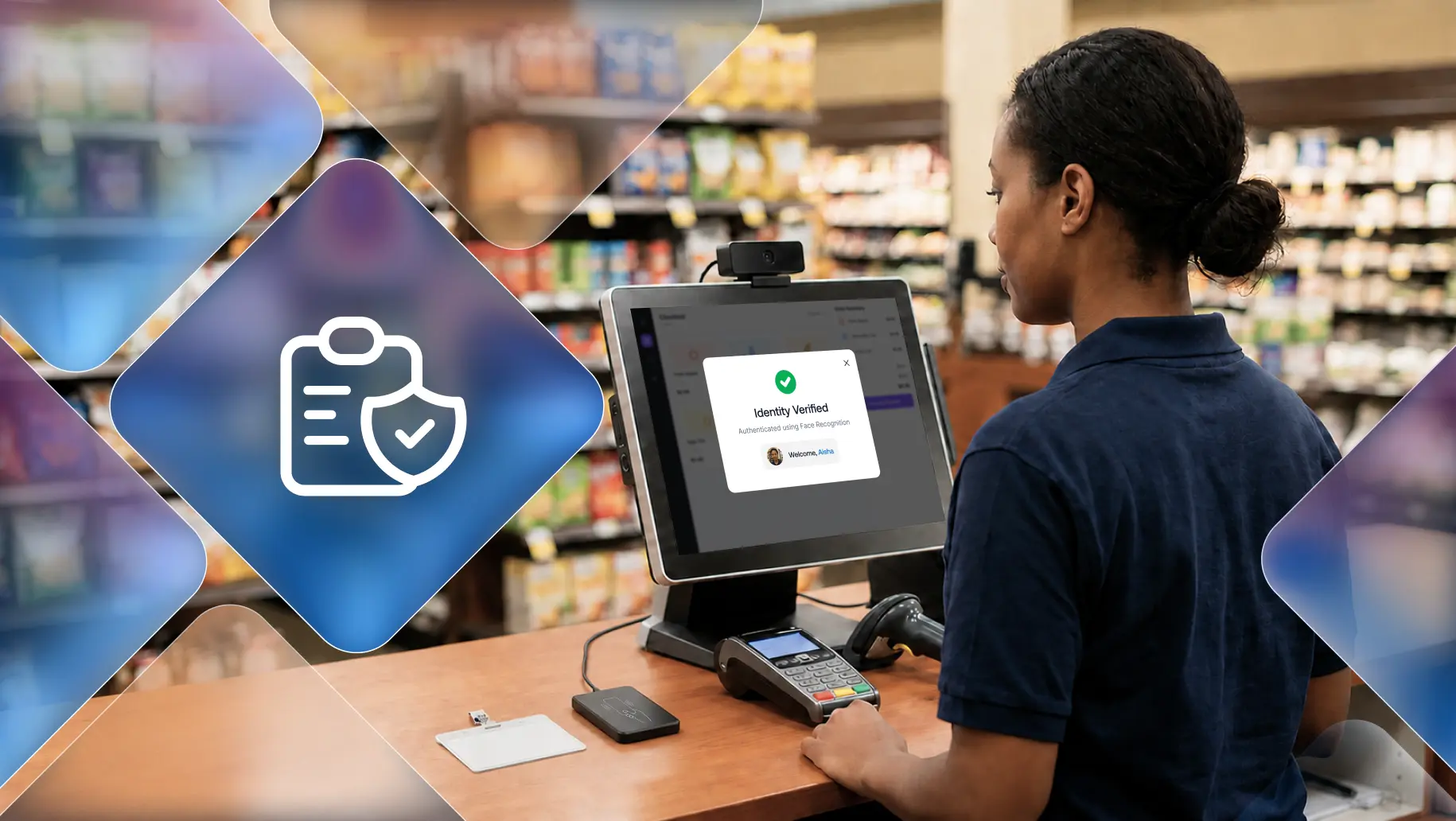
Policies banning shared logins fail because they fight the workflow. Fix the friction instead. Passwordless authentication lets a worker badge in or authenticate with a face scan in under two seconds, making individual identity faster than the shared PIN it replaces. This single change restores Requirements 7, 8, and 10 simultaneously.
2. Deploy MFA that matches the environment.
Satisfy 8.4.2 with factor combinations that work at shared workstations: a physical badge plus a biometric, for example, rather than passwords plus phone OTPs. The customized approach in v4.0 explicitly supports this.
3. Shrink your CDE scope.
Segment networks so fewer systems touch cardholder data, and gate access to the compliant zone through strong authentication. A smaller scope means fewer controls to maintain and a faster assessment.
4. Automate the identity lifecycle.
Tie provisioning and deprovisioning to your HR system so seasonal workers and contractors lose access the day they leave, not at the next quarterly review.
5. Monitor controls continuously.
Assign an owner to each requirement, track control health monthly, and treat the annual assessment as confirmation rather than discovery.
What to Evaluate in an Authentication Solution for PCI DSS
If shared devices sit inside your CDE, your authentication platform decides whether Requirement 8 holds. Evaluate against these criteria:
- Speed at the shared terminal.
Measure authentication during real shift changes rather than controlled demonstrations. A solution that adds even a few seconds per worker can create bottlenecks that encourage credential sharing. - Factors that survive the floor.
Badges, facial authentication, and PIN fallbacks need to work with gloves, PPE, and no personal phones. - Per-user session binding.
Every session on a shared device must resolve to a named individual for your Requirement 10 audit trail. - Integration with your identity stack.
The platform should extend your existing IdP and SSO investments to frontline devices rather than replacing them. - Deployment evidence at scale.
Ask for reference customers running thousands of frontline users. OLOID, for example, supports deployments like Avery Dennison's rollout across 35,000 employees using badge plus PIN authentication on shared devices, which is the scale and environment PCI assessors increasingly scrutinize.
Run a pilot in your highest-friction location first. If authentication holds up during a shift change in your busiest store or plant, it will hold up anywhere.
Sustaining Compliance Where it Breaks First
PCI DSS ultimately isn't about protecting payment cards. It's about proving who accessed sensitive systems, when they did it, and whether that access was authorized. In office environments, passwords once solved that problem. On the frontline, they increasingly create it.
Purpose-built platforms now close that gap. OLOID delivers passwordless, MFA-capable authentication designed specifically for frontline workers on shared devices, tying every session to a verified individual without slowing the shift down. For organizations facing a v4.0 assessment with POS terminals, kiosks, or handheld scanners in scope, fixing identity at those devices is the highest-leverage compliance investment available.
FAQs
1. Does PCI DSS require MFA for all employees?
Yes, under v4.0. Requirement 8.4.2 mandates multi-factor authentication for all access to the cardholder data environment, covering every user rather than administrators alone. This became enforceable on March 31, 2025.
2. Are shared logins ever allowed under PCI DSS?
Effectively no. Requirement 8 demands unique identification for every user with access to the CDE. Shared or generic accounts on registers, kiosks, and scanners are among the most frequently cited audit findings.
3. What happens if my organization fails a PCI DSS assessment?
Your acquiring bank can impose fines, raise transaction fees, require more stringent validation, or terminate your ability to accept card payments. A breach while non-compliant adds forensic costs and liability on top.
4. Can passwordless authentication satisfy PCI DSS requirements?
Yes. Passwordless methods that combine strong factors, such as a badge plus a biometric, satisfy unique identification under Requirement 8 and the MFA mandate under 8.4.2, while producing the per-user audit trail Requirement 10 requires.
5. How do I reduce the scope of my PCI DSS assessment?
Segment your network so fewer systems touch cardholder data, tokenize stored data where possible, and control access to the CDE through strong per-user authentication. A smaller, well-gated scope shortens assessments and reduces the controls you must maintain.


Get the latest updates! Subscribe now!

