



The OLOID Blog
Insights on identity, access, and security for the modern frontline workforce.

Featured
What is Fast User Switching: How It Works and Where It Breaks
Fast user switching lets a new user take over a shared device in seconds without a full logout, so every action stays tied to a verified individual. Most organizations treat it as a convenience feature and miss how much the implementation model matters. In a healthcare environment, where identity lives, how the previous session is handled and which authentication method healthcare professionals use decide whether switching protects the audit trail and the patient record or quietly breaks them. This guide covers the four switching models, their real-world failure points in clinical workflows, what an auditable switch records, and how to evaluate solutions for shared clinical workstations.


Passwordless Clinical Workflows: A Practical Guide
Passwordless authentication in healthcare replaces typed passwords with badges, biometrics, and passkeys that tie every clinical session to a verified individual. Shared workstations break the one-person-per-device model most identity tools assume, which drives open sessions, credential sharing, and broken audit trails. This guide compares passwordless methods for clinical settings and explains risk-based step-up for EPCS. It also covers identity across the clinician lifecycle, HIPAA and DEA alignment, and a phased rollout with measurable KPIs.
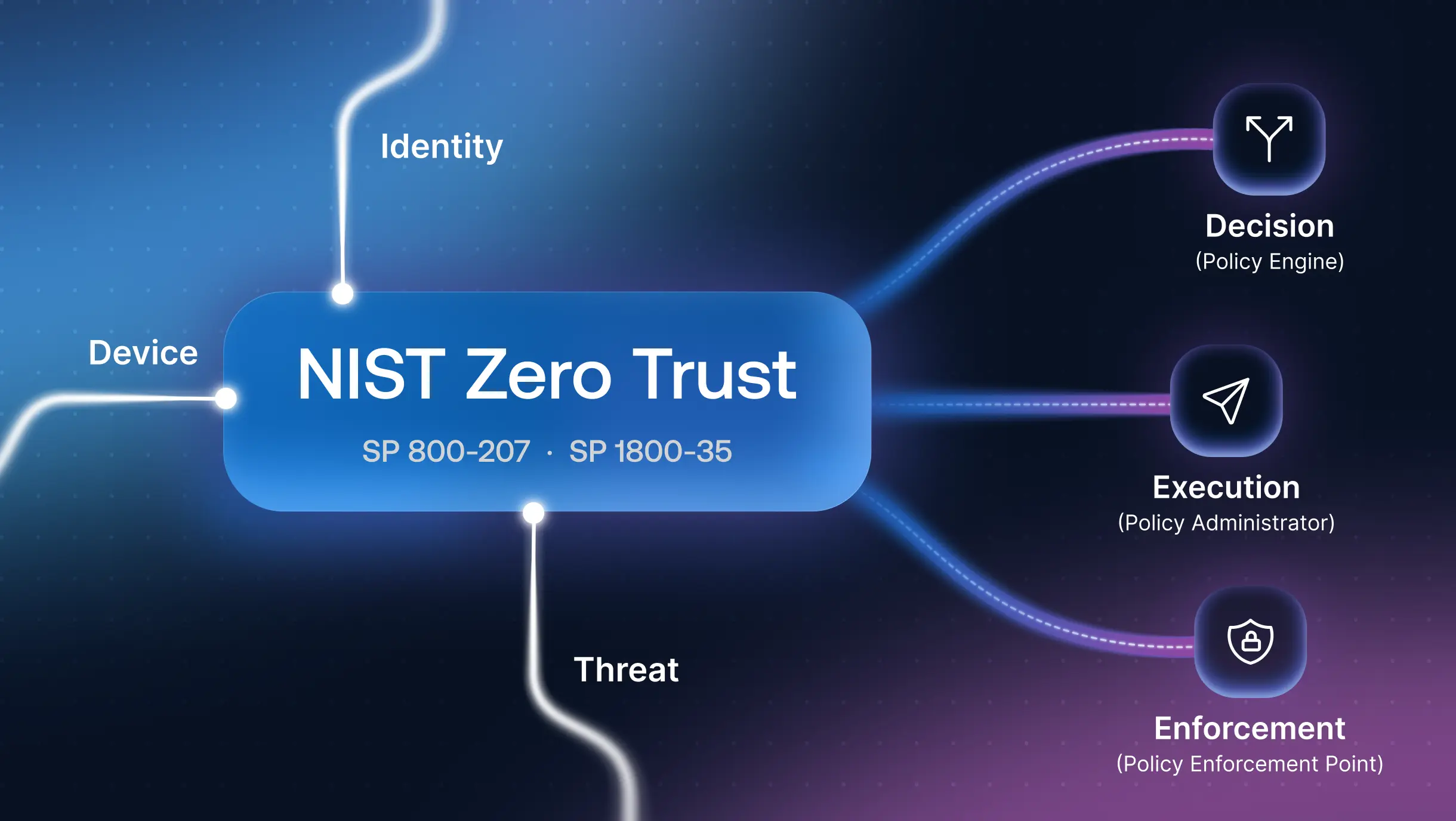
NIST Zero Trust Architecture: A Practical Guide
NIST zero trust architecture is a vendor-neutral security model that evaluates every access request using identity, device posture, and context instead of network location. SP 800-207 defines the model, and SP 1800-35 tests it through 19 implementations built with 24 vendors. This guide explains the reference components, how trust decisions are made, and what NIST's own builds revealed about integration gaps. It also covers the blind spot most programs miss: shared devices and frontline workers, where healthy endpoints can hide unverified users.

Passkey Enterprise Challenges: Why Frontline Environments Break the Model
Passkey enterprise challenges go deeper than legacy system integration and cross-platform fragmentation. The deployment gap most organizations do not plan for is workforce segmentation: standard passkey architecture, both device-bound and synced, was built for knowledge workers on managed devices, not for frontline workers rotating through shared terminals across shifts. This post covers where passkey deployment breaks structurally in shared-device environments, why compliance mandates accelerate pressure without solving the frontline problem, and what an authentication architecture that accounts for the full workforce actually looks like.
Multi-Factor Authentication Examples: Methods, Use Cases, and Best Practices
This guide covers the most common multi-factor authentication examples across the three-factor categories, comparing SMS OTPs, TOTP, push notifications, biometrics, and hardware security keys on security strength and operational fit. It maps MFA method selection to industry context including healthcare, manufacturing, financial services, and retail, and addresses where standard MFA breaks down on shared terminals when sessions are not tied to individual workers. The post closes with how passwordless authentication closes the individual attribution gap that conventional MFA leaves open in shift-based environments.
.webp)
What is Privileged Identity Management (PIM)?
Privileged identity management (PIM) governs the lifecycle of elevated access roles: who holds them, under what approval, and for how long. This guide covers how PIM differs from PAM and IAM, how the role lifecycle works from request through automatic revocation, and why PIM breaks down in shared-device and frontline environments where multiple workers share terminals. It covers compliance requirements under HIPAA, PCI DSS, SOC 2, and NIST 800-53, and explains what individual-level attribution actually requires at the point of access. Practical best practices and a phased starting point are included.
What is Identity Lifecycle Management?
Identity lifecycle management (ILM) governs every digital identity in an organization from creation to deactivation, covering employees, contractors, vendors, and non-human identities. This guide covers the joiner-mover-leaver model, what breaks when ILM is poorly managed: orphaned accounts, privilege creep, stale access, and why the standard model struggles in high-turnover, shared-device environments. It covers compliance exposure under HIPAA, PCI DSS, and CMMC, and explains how passwordless authentication closes the individual attribution gap that shared terminals create.
10 Best Biometric Authentication Solutions in 2026
Most biometric authentication blogs cover desk workers and consumer onboarding. This guide evaluates 10 platforms against the criteria that matter for both populations, with particular depth on frontline and shared device environments where standard platform biometrics fail. OLOID leads as the only purpose-built solution for phone-restricted, shared terminal environments. Windows Hello for Business, Imprivata EAM, HYPR, Cisco Duo, Ping Identity, BlueFletch, 1Kosmos, AuthX, and HID Global each earn their place for specific environments.
6 Best Authentication Solutions for Shared Devices in 2026
Most authentication platforms assume one person per device. This guide evaluates six solutions against the criteria that matter for shared terminals: individual session attribution, phone-restricted environment support, shift-change speed, offline capability, and compliance-ready audit logs. OLOID leads as the only purpose-built platform for this use case. Microsoft Entra ID, Okta, HID Global, Ensurity, and Imprivata each earn their place for specific environments.
Compliance Verifies Policies, Not the People Behind the Login
Compliance frameworks like HIPAA, FDA 21 CFR Part 11, and SOX all rest on one assumption: every access event traces to a specific individual. Shared credentials in frontline environments quietly break that assumption while producing logs that look clean. This post unpacks the gap between access logged and person accountable, and what it takes to close it in shared-device environments.


Authentication Friction on the Frontline Becomes a Security Risk
Authentication friction on the frontline isn't just a usability complaint. It's the direct cause of shared credentials, persistent sessions, and broken audit trails that compliance frameworks can't account for. This post makes the case that frictionless, person-bound authentication is security work, not a nice-to-have, and explains what that looks like in environments where standard MFA was never designed to operate.


What is Credential Harvesting? How It Works and How to Stop It
Credential harvesting is the systematic collection of login credentials at scale, giving attackers authenticated access that bypasses perimeter defenses entirely. Stolen credentials remain one of the most common ways attackers gain initial access to organizations, and the volume of leaked credentials surged significantly in 2025. This guide covers the six methods attackers use, what happens inside a network after credentials are stolen, how credential harvesting creates compliance exposure under HIPAA, SOX, and GDPR, and how organizations close the gaps, including in frontline environments where shared devices compound the risk.
%20(convert.io).webp)
What is Identity Governance and Administration (IGA)?
Identity governance and administration (IGA) is the framework organizations use to define, review, and document who has access to what, across the full identity lifecycle. It sits above IAM, providing the policy layer that decides what access should exist, not just whether it works. Core IGA capabilities include access certifications, SoD enforcement, lifecycle management, and audit-ready compliance reporting for HIPAA, SOX, GDPR, and PCI DSS. This guide covers what IGA means, how it differs from IAM, what a working program includes, and where standard IGA assumptions break down in shared-device and frontline operational environments.
Salesforce Phishing-Resistant MFA 2026: Entra ID, AMR Signals, and How to Stay Compliant
Salesforce now enforces phishing-resistant MFA for privileged users across direct and SSO logins, and organizations on Microsoft Entra ID are running into a specific failure: users who completed MFA at Entra are being challenged again inside Salesforce because the token did not carry the right AMR signal. This blog covers what changed in 2026, how Salesforce evaluates AMR and ACR values, why the multipleauthn retirement blocked users mid-month, and how OLOID Face registered as an Entra External Authentication Method delivers the face AMR value Salesforce requires, with no hardware, no per-device enrollment, and no changes to your existing SSO configuration.
MFA vs Adaptive MFA
MFA vs adaptive MFA is one of the most consequential authentication decisions organizations face as credential-based attacks continue to accelerate. Traditional MFA applies a fixed second-factor challenge to every login regardless of context, while adaptive MFA evaluates real-time risk signals and adjusts the authentication requirement per attempt. This blog covers how both approaches work, where traditional MFA still holds up, where adaptive MFA has a clear operational advantage, and why the gap between them is most visible in shared-device and frontline environments. It also covers the passwordless-plus-adaptive combination and what to actually evaluate when selecting a solution.
IAM vs PAM: What's the Difference
IAM and PAM are two foundational access management disciplines that organizations frequently conflate, but they govern different users, different risks, and different layers of the security stack. IAM manages identity and access for the entire workforce. PAM focuses specifically on privileged accounts with elevated access to critical systems and data. Most organizations underestimate the gap between their IAM coverage and what PAM is actually designed to protect. That gap widens significantly in shared-device and shift-based environments such as healthcare, manufacturing, logistics, and retail, where standard access management assumptions break down. This guide covers what IAM and PAM are, how they differ, where each falls short on its own, and what organizations in high-stakes environments need to get both right.
Microsoft Passkey Migration: Timeline, Deadlines, and Admin Steps for Shared-Device Environments
Microsoft is retiring SMS and voice MFA in Entra ID across two dates: September 1, 2026 (passkeys auto-enabled) and February 1, 2027 (hard cutoff, no opt-out). Users still on SMS or voice after February 1 hit a blocking sign-in prompt they cannot skip. Standard passkey rollouts do not cover frontline workers or shared-device environments, which require a separate credential strategy. This post covers the full timeline, the admin audit steps, and the deployment gap most migration guides leave unaddressed.
What is Network Segmentation? A Complete Guide
Network segmentation is the practice of dividing a computer network into isolated subnets, each governed by its own security policies, to limit lateral movement and contain breaches. Most organizations treat it as a deployment checkbox rather than an ongoing discipline, which is where implementations degrade. This guide covers how segmentation works technically, why the perimeter trust model failed, how segmentation connects to Zero Trust and identity enforcement, where deployments typically go wrong, and how to implement a segmentation architecture that holds under real attack conditions, including in shared-device and frontline operational environments.
Authentication vs. Authorization: Key Differences Explained
Authentication and authorization are two distinct access control decisions that most organizations treat as one. Authentication verifies identity. Authorization enforces what that identity can reach. Conflating them is the most common reason broken access control remains the top web application security risk year after year. This guide covers how each layer works, the protocols behind them, where implementation breaks down in practice, and why shared-device and frontline environments need both layers designed differently from the ground up.
Session Hijacking: What It Is, How It Works, and How to Stop It
Session hijacking is a cyberattack that steals post-authentication session tokens to impersonate legitimate users without touching passwords or MFA credentials. Most security teams underestimate its reach: how it bypasses authentication controls entirely, how it spreads laterally through OAuth integrations, and where standard defenses structurally fail in shared-device and frontline environments. This guide covers what session hijacking is, how the attack works across all major methods, why MFA alone cannot stop it, and what detection and prevention controls actually matter for operational workplaces in healthcare, manufacturing, logistics, and retail.
.webp)
What is Active Directory (AD)? A Security-Focused Guide
Active Directory is Microsoft's centralized identity and access management service, and the most targeted piece of infrastructure in modern ransomware attacks. This guide covers how AD works, how attackers move through it using techniques like Pass-the-Hash, Kerberoasting, Golden Tickets, and DCSync, and what the business impact of a breach looks like in operational environments. It also addresses where standard AD security models break down in shared-device and frontline workplaces, and how AD hardening maps to a Zero Trust architecture.
From Passwords to Verified Identity: The Next Security Layer
Verified identity replaces secret-based authentication with cryptographic or biometric proof tied to a confirmed individual. This post covers why the credential model fails structurally, what verified identity architecture requires, where implementation stalls in operational environments, and how to build the business case for the transition.
How to Choose the Right 2FA Tools for Enterprise Security
Two-factor authentication tools add a second verification layer beyond passwords, but not all methods protect equally against how attacks work today. MFA fatigue, SMS interception, and adversary-in-the-middle phishing kits bypass the most commonly deployed 2FA methods. This guide covers how 2FA methods rank by phishing resistance, what NIST and compliance frameworks actually require, where standard tools fail in shared-device and frontline environments, and what to ask before selecting a provider.
Microsoft's 2027 MFA Deadline and the Passkey Gap for Frontline Workers
Microsoft is retiring SMS and voice MFA in Entra ID by February 1, 2027. SMS MFA was the only Microsoft-native authentication factor tied to the worker rather than the device. Standard passkeys, Windows Hello for Business, and FIDO2 security keys are all device-bound: they register to a specific terminal and don't follow a worker who moves between shared devices. For frontline workers on shared Android devices, iPads, Zebra handhelds, shop-floor kiosks, and shared PCs, removing SMS MFA leaves no person-bound credential in the standard Entra stack. Badge tap and face authentication solve this by traveling with the worker across any shared terminal, delivering phishing-resistant, individually attributed sessions without a personal phone, satisfying Microsoft's mandate within frontline operating constraints.
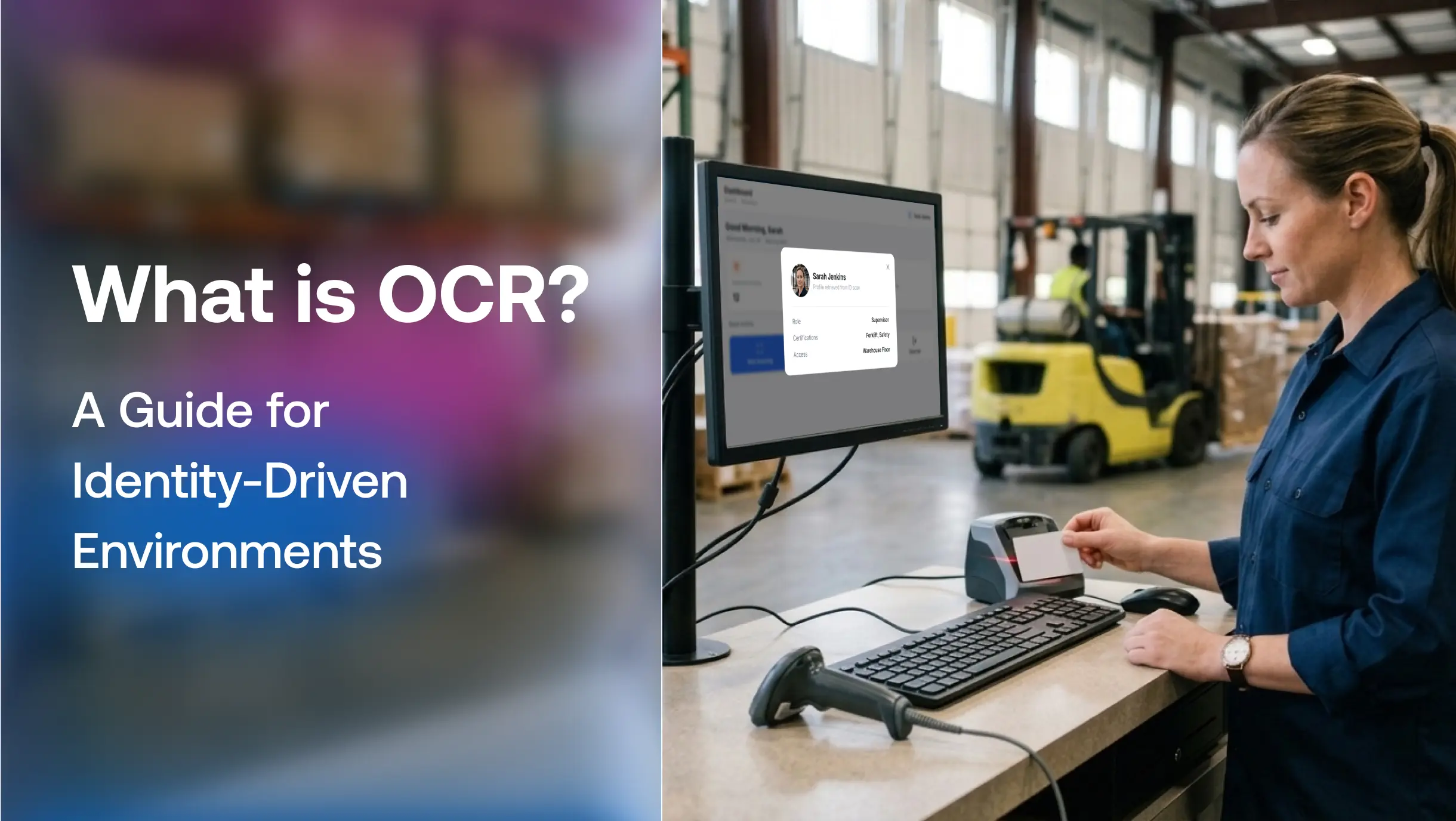
What is OCR? A Guide for Identity-Driven Environments
Optical character recognition converts scanned images and printed documents into machine-readable, editable data, eliminating manual re-entry and making static content actionable. Most organizations understand OCR as a document tool but underestimate its role as the first step in identity verification and access control workflows. This guide covers how OCR works at a technical level, the four types of OCR technology, where accuracy degrades in operational environments, and how OCR connects to passwordless authentication and IAM in shared-device and frontline workplaces.
Types of Biometric Authentication Methods: A Decision Guide for Security and IT Teams
Biometric authentication methods verify identity using physical traits like fingerprints, iris patterns, and facial geometry, or behavioral patterns like keystroke rhythm and gait, replacing passwords with something that cannot be shared or phished. Most organizations understand the basics but underestimate the architectural decisions that determine whether a deployment actually works: on-device vs. centralized storage, FAR/FRR trade-offs, liveness detection requirements, and the gap between standard biometric tools and the shared-device environments common in healthcare, manufacturing, logistics, and retail. This guide covers how each biometric method works, how to choose the right one for your environment, what happens when biometric data is compromised, and how biometrics relate to passkeys and FIDO2 in a modern passwordless architecture.

Healthcare IAM Best Practices: A Step-by-Step Guide
Healthcare identity and access management governs who authenticates into clinical systems, what they can access, and how long that access stays active. Most healthcare organizations underestimate where their IAM programs actually fail: orphaned contractor accounts, shared workstation credentials, manual audit prep, and access models that were never designed for rotating frontline workforces. This guide covers the healthcare IAM best practices that address both the security and operational gaps, from RBAC and MFA to automated provisioning, HIPAA compliance mapping, and purpose-built access control for shared-device and high-turnover environments.
What is Lateral Movement? How Attackers Move Through Your Network Undetected
Lateral movement is the phase of a cyberattack where an adversary navigates from an initial entry point across systems, escalating privileges, and collecting credentials until they reach high-value targets. Most organizations detect lateral movement too late because attackers use valid credentials and native OS tools that generate no unusual signatures. This guide covers how lateral movement works, the specific techniques involved, why shared-device and frontline environments are structurally more exposed, and the identity-first controls that stop it at the source.
Identity Proofing vs Identity Verification: Key Differences and Why You Need Both
Identity proofing establishes that a claimed identity is real and belongs to the person presenting it, once, before access is granted. Identity verification confirms the same proofed person is present at every login, transaction, and sensitive event afterward. Confusing the two leaves organizations exposed on both ends: fake hires and synthetic identities enter through weak proofing, while account takeover exploits weak verification. This guide breaks down how each process works, the NIST IAL/AAL framework behind them, how they differ from authentication and KYC, and why shared-device frontline environments need both redesigned.
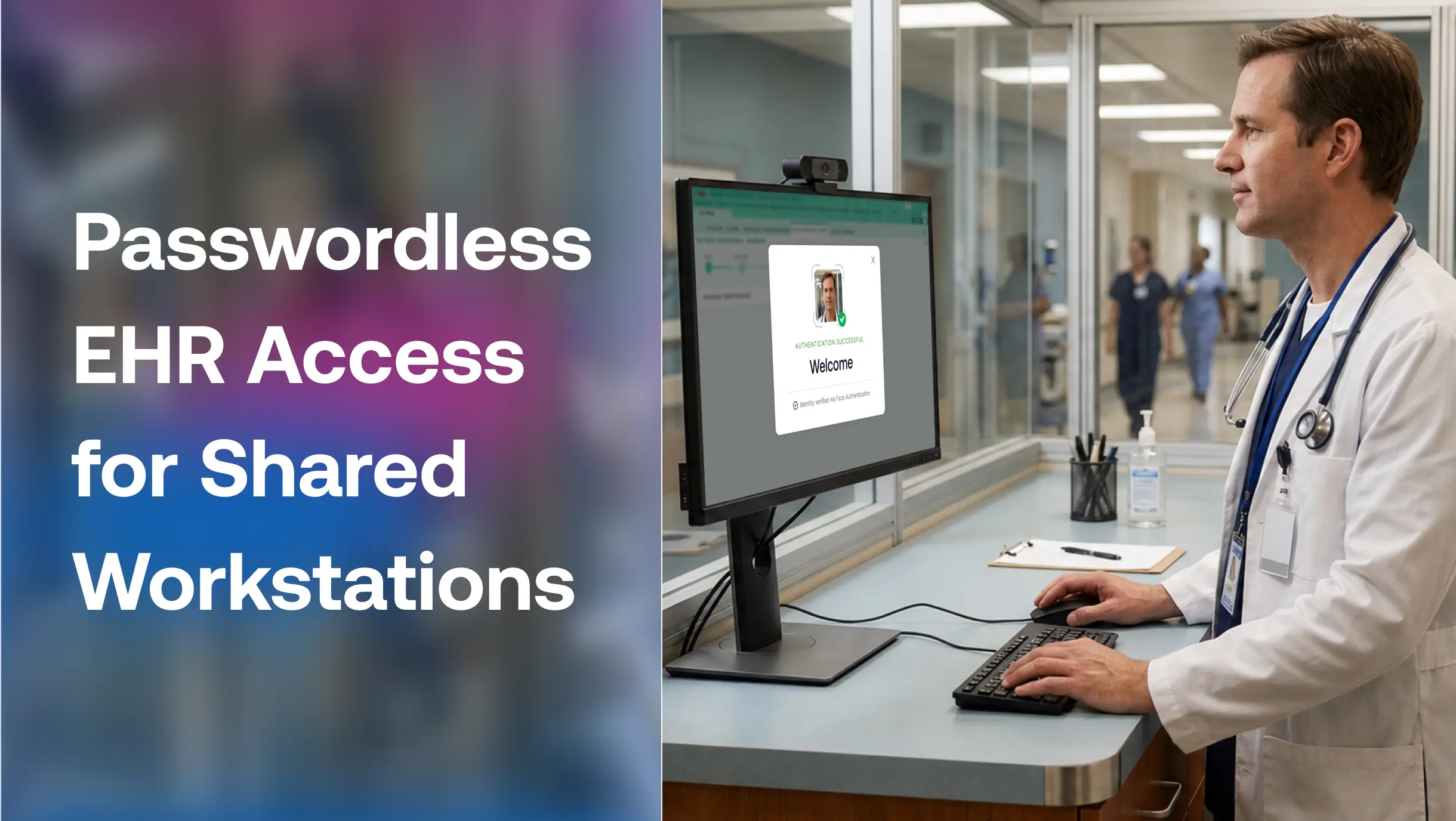
Passwordless EHR Access for Shared Workstations: How It Works and Why Passwords Fail
Electronic health records security on shared workstations fails at a structural level: the one-user-per-device assumption behind passwords and standard MFA does not hold in shift-based clinical environments. Generic logins, open sessions, and credential sharing are not policy failures; they are the predictable output of an access model that was never built for multi-user endpoints. This guide covers why traditional login approaches break on shared terminals, how passwordless authentication methods compare for clinical use, and how organizations can implement passwordless EHR access in a way that satisfies HIPAA audit controls, speeds up clinician workflows, and ties every session to a verified individual.
Identification vs Authentication: Key Differences Explained
Identification and authentication are two sequential steps that decide who gets into a system. Identification is the claim of identity, and authentication is the proof behind it. This guide explains what each term means, how the two differ, how they work with authorization, and where they behave differently on shared devices. It covers the types of identification, the three authentication factor categories, a real login flow, and the failure points shared logins create in healthcare, manufacturing, logistics, and retail. Getting identification vs authentication right is the foundation of secure, low-friction access.

Making every day-in-the-life of frontline workers frictionless & secure!
Get the latest updates! Subscribe now!
