




What is IDaaS (Identity as a Service)? A Complete Guide


Key Takeaways
- IDaaS is cloud-delivered IAM, managed by a third-party provider on a subscription basis
- Core capabilities: SSO, MFA, directory services, provisioning, and access governance
- Every access request routes through the IDaaS provider, which verifies identity and issues a token in real time
- IDaaS is the operational backbone of Zero Trust: no request gets through without verification
- Compared to on-prem IAM, IDaaS cuts capital costs, speeds deployment, and scales without hardware
- Standard IDaaS platforms were built for desk workers with assigned devices; shared-device and frontline environments need a different approach
- Vendor evaluation should cover protocol support, integration depth, compliance certifications, and pricing model
A line operator on a factory floor starts a shift, walks to a shared terminal, and needs to pull up work order instructions before the line moves. There is no personal laptop, no IT desk nearby. Just a shared workstation that five other workers will use before the day ends. If authentication is clunky, workers share credentials, skip logins, or get locked out. Any of those outcomes is a security problem waiting to surface.
This plays out across manufacturing plants, logistics hubs, retail stockrooms, and warehouses every single day. And it is not a fringe scenario. According to the 2024 Verizon Data Breach Investigations Report, 68% of all data breaches involved a human element: credential misuse, social engineering, or error. The 2024 Microsoft Digital Defense Report adds another layer: over 99% of the 600 million identity attacks Microsoft tracks daily are password-based. The identity layer is where most attacks land, and these environments are among the hardest to secure with traditional tools.
That is exactly why Identity as a Service (IDaaS) has become one of the fastest-growing categories in enterprise security. IDaaS is a cloud-based model for delivering identity and access management (IAM) capabilities, including authentication, authorization, provisioning, and governance, through a third-party provider on a subscription basis. Organizations consume it as a managed service rather than building and maintaining identity infrastructure internally.
This guide walks through how IDaaS works, what it includes, how it compares to on-premises IAM, and what to look for when evaluating a solution.
How IDaaS Works
At its core, IDaaS sits between users and the applications they need to access. When a user tries to log into an application, the request routes to the IDaaS provider, which verifies the user's identity, applies the relevant access policy, and issues a token that grants entry, all in seconds.
The Authentication Flow, Step by Step
- A user attempts to access an application (SaaS, on-prem, or internal)
- The application redirects the request to the IDaaS provider
- The IDaaS provider authenticates the user through the configured method (password, biometric, MFA, passkey)
- If authentication succeeds, the provider issues a signed security token
- The token passes back to the application, which grants access based on the user's permissions
- The session is logged for audit and monitoring purposes
This flow happens regardless of device, location, or application type, which is exactly why it works for both a desk-based knowledge worker and a frontline employee sharing a tablet on a warehouse floor.
Key Protocols: SAML, OAuth, OIDC
IDaaS platforms communicate through open standards:
- SAML (Security Assertion Markup Language): Used for enterprise SSO, particularly for browser-based applications
- OAuth 2.0: Handles delegated authorization, commonly used when applications need to act on a user's behalf
- OIDC (OpenID Connect): Sits on top of OAuth and adds identity verification, widely used in modern web and mobile apps
These standards make IDaaS interoperable across virtually any application stack.
IDaaS vs. On-Premises IAM
The shift from on-prem IAM to IDaaS is not just about cost. It is about an organization's ability to keep up with a workforce that is more distributed, more mobile, and accessing more applications than ever before.
Core Capabilities of an IDaaS Solution
Single Sign-On (SSO)
SSO lets users authenticate once and gain access to all authorized applications without re-entering credentials. For users juggling ten or more SaaS tools, SSO eliminates password fatigue and reduces the risk of credential reuse across systems. For IT teams, it centralizes access control into a single policy layer.
Multi-Factor Authentication (MFA)
MFA requires users to verify identity through more than one factor: something they know (password), something they have (phone or token), or something they are (biometric). Modern IDaaS platforms support adaptive MFA, which adjusts the authentication challenge based on real-time risk signals: device posture, location, time of day, IP reputation. A low-risk login from a known device gets a smooth experience. An unusual login attempt from a new location triggers a stronger verification step automatically.
Directory Services
IDaaS platforms maintain a cloud-based directory that stores user identities, attributes, roles, and group memberships. This directory syncs with existing identity stores like Active Directory and LDAP, giving organizations a unified, authoritative source for user data across on-prem and cloud environments.
User Provisioning and Lifecycle Management
When an employee joins an organization, IDaaS automatically provisions access to the applications and resources their role requires. When they move to a different role, their permissions update. When they leave, access revokes immediately and completely. This joiner-mover-leaver automation prevents orphan accounts, one of the most common and overlooked sources of security risk.
Access Governance and Compliance
IDaaS platforms provide audit trails, access certification campaigns, and reporting tools that organizations need to meet regulatory requirements such as HIPAA, GDPR, and SOC 2. Access reviews that used to require manual, spreadsheet-driven processes run automatically, with evidence ready for auditors on demand.
IDaaS vs. IAM vs. SSO
These three terms are often used interchangeably. They are related but distinct:
IAM is the category. IDaaS is the cloud delivery model within that category. SSO is one capability that IDaaS platforms deliver. Understanding the distinction matters when scoping what your organization actually needs.
Why IDaaS Matters Now
SaaS Proliferation and Hybrid IT
The average enterprise uses over 100 SaaS applications. Managing authentication and access policies across that many systems using legacy, on-premises IAM tools is operationally unsustainable. IDaaS provides a single control plane that spans the entire application estate.
Remote and Mobile Workforces
Employees no longer sit at fixed desks on a corporate network. They work from home, from branch offices, from mobile devices, and in environments where consistent network access cannot be assumed. IDaaS extends secure access anywhere without requiring VPN dependencies or hardware tokens.
Rise of Non-Human and Machine Identities
Service accounts, API keys, bots, AI agents, and IoT devices all carry identities that need to be managed, governed, and monitored. Traditional IAM tools were designed around human users. IDaaS platforms are increasingly built to handle machine identities at scale, a critical capability as automated workflows multiply across the enterprise.
IDaaS and Zero Trust
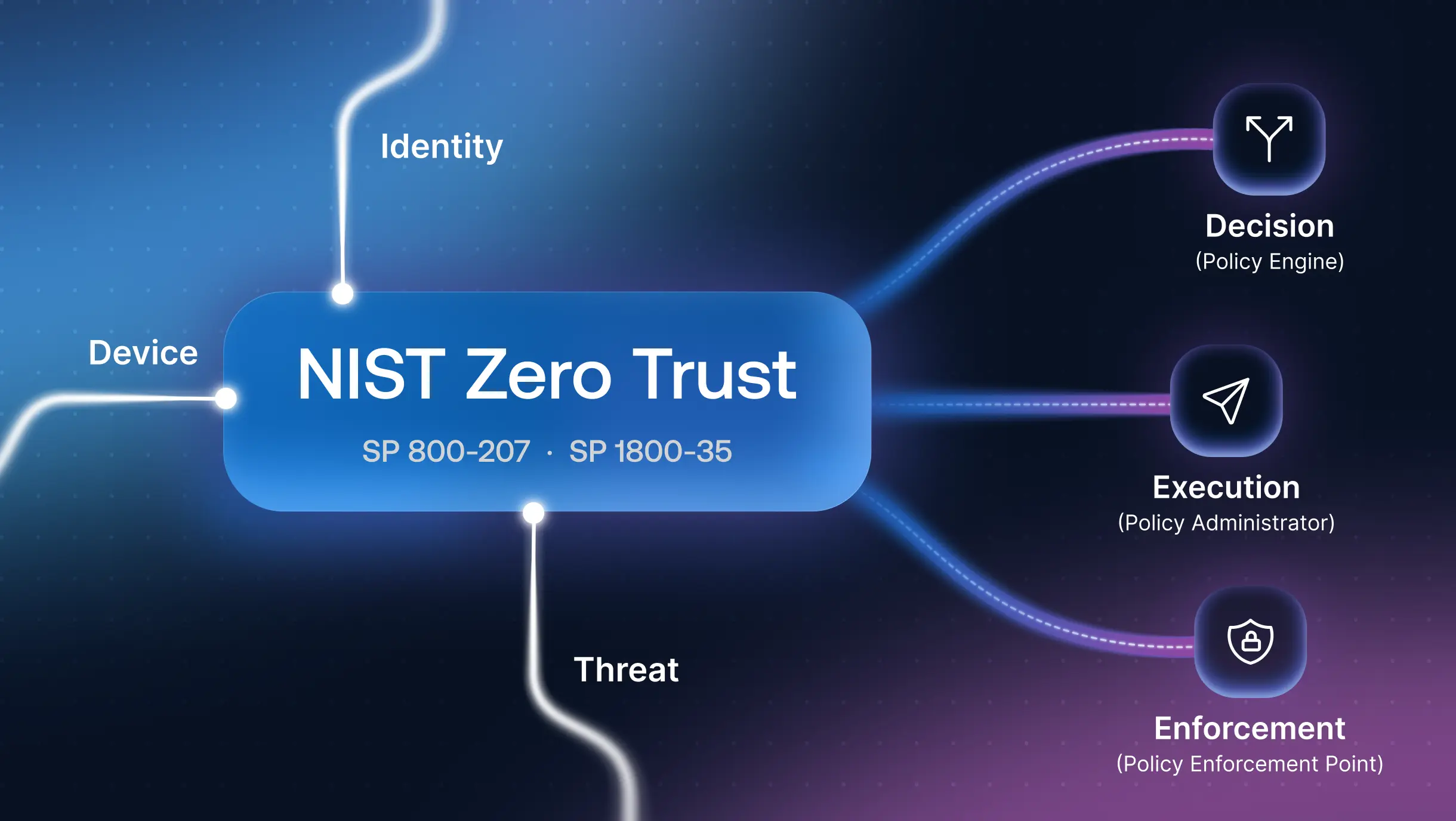
Zero Trust is a security model built on one principle: never trust, always verify. No user, device, or network location gets implicit access. Every access request is authenticated, authorized, and continuously validated.
IDaaS is the operational foundation that makes Zero Trust possible. Without a system that can verify identity in real time, enforce context-aware policies, and log every access event, Zero Trust remains a strategy on paper. IDaaS supplies the identity layer, the control plane through which every user and every device gets evaluated before touching any resource.
Organizations that deploy IDaaS alongside network segmentation and endpoint security get closer to a true Zero Trust architecture than any single tool can achieve alone.
IDaaS Use Cases by Industry
Healthcare
Clinicians moving between shared workstations need instant, secure access to electronic health records without entering passwords each time. IDaaS supports fast, secure authentication methods, including badge tap, biometric, and passkey, that fit clinical workflows without creating friction or compliance risk. HIPAA requirements around access logging and user authentication are met automatically.
Financial Services
Banks and trading platforms need SSO and adaptive MFA to protect customer accounts and internal systems. IDaaS also supports KYC integration during customer onboarding, privileged access controls for traders, and audit-ready reporting for PCI DSS and SOX compliance.
Manufacturing and Logistics
Frontline workers on the production floor or in distribution centers share devices and shift through multiple roles. IDaaS handles shared-device authentication by assigning session-based access tied to the individual worker rather than the device, so the right person gets the right access every time, regardless of which terminal they use.
Retail
IDaaS supports fast onboarding of seasonal staff through automated provisioning, secure POS access, and just-in-time credentialing for contractors, all without burdening an IT team managing hundreds or thousands of temporary accounts.
Government
Inter-agency services, citizen portals, and remote contractor access all require federated identity with auditable controls. IDaaS enables role-based access governance and meets the regulatory baselines required for federal and state compliance frameworks.
Where Traditional IDaaS Platforms Fall Short
Most IDaaS platforms were designed around a single assumption: one user, one device, one browser. That model works well for office workers with a corporate laptop, a smartphone, and a reliable internet connection. It breaks down in operational environments.
Consider what traditional IDaaS was not built for:
- Shared terminals: Multiple workers logging into the same device across a shift, each needing their own access permissions
- No personal smartphone: SMS and push-notification MFA require a phone. Many frontline workers do not carry one on the job.
- Authentication in seconds: A warehouse worker or nurse cannot wait through a multi-step login sequence every time they need to access a system
- PPE and gloves: Touchscreen biometrics and fingerprint readers do not work with gloves on
- Intermittent connectivity: Offline or low-bandwidth environments break cloud-dependent authentication flows
- Fast user switching: Shift-based workforces need to log in and out dozens of times a day without creating IT overhead
These are not edge cases, they are the daily reality for tens of millions of workers in healthcare, manufacturing, logistics, and retail. Standard IDaaS tools treat them as exceptions. OLOID treats them as the primary use case, delivering passwordless, identity-first access specifically for operational workplaces where traditional platforms were never designed to work.
Benefits of IDaaS
- Lower operational costs: No hardware, no software maintenance, no infrastructure team needed for identity. Just a subscription.
- Faster deployment: Weeks instead of months, with pre-built integrations for hundreds of applications
- Stronger security posture: Adaptive MFA, real-time access control, and automated deprovisioning close the gaps that static, on-prem systems leave open
- Better user experience: SSO and passwordless authentication reduce friction without reducing security
- Audit-ready compliance: Automated access reviews and logging satisfy regulatory requirements with minimal manual effort
- Scalability: Cloud-based delivery scales up or down with the organization, handling seasonal peaks, rapid growth, or M&A activity without re-architecting
Limitations and Risks to Consider
- Internet dependency: IDaaS relies on connectivity. Service disruptions at the provider level, or internet outages at the organization's site, can impact authentication. Reputable providers offer uptime SLAs above 99.9%, but the dependency is real and worth planning for.
- Third-party data exposure: Identity data sits with an external vendor. Due diligence on a provider's security certifications (SOC 2, ISO 27001, FedRAMP) and data residency policies matters.
- Integration complexity with legacy systems: Older on-prem applications not built around modern identity standards can require custom connectors or middleware to integrate properly.
- Customization limits: Some IDaaS platforms optimize for standardized workflows. Highly specialized environments, particularly those with non-standard devices or unusual authentication requirements, may need a provider that handles edge cases explicitly.
How to Evaluate an IDaaS Vendor
Before selecting a provider, work through this checklist:
- Protocol support: Does the platform support SAML, OAuth 2.0, OIDC, and SCIM natively?
- Integration breadth: How many pre-built connectors does the vendor offer? Can it connect to your existing HR systems, Active Directory, and SaaS stack?
- Authentication flexibility: Does it support passwordless, biometrics, passkeys, and hardware tokens, not just SMS-based MFA?
- Deployment environment fit: Does it work in your environment, including shared devices, kiosk terminals, or offline-capable scenarios if relevant?
- Compliance certifications: Is the vendor SOC 2 Type II certified? Does it support HIPAA, GDPR, or FedRAMP requirements relevant to your industry?
- Pricing model: Is pricing per user per month? Are there tiers based on features? Understand what drives cost before you scale.
- Uptime and SLA: What is the guaranteed availability? What is the incident response process?
- Identity governance: Does the platform include access certifications, role modeling, and audit reporting, or do those require add-on modules?
The right vendor depends heavily on your environment. A knowledge-worker-heavy SaaS company has different needs than a healthcare network or a manufacturing facility running shift-based operations on shared terminals. Matching the platform's design assumptions to your actual workforce is the most important evaluation step.
Conclusion
IDaaS has moved from a forward-looking category to an operational necessity. As identity continues to be the primary target in the majority of breaches, and as workforces grow more distributed and diverse, spanning remote knowledge workers to frontline employees on shared devices, the question is no longer whether to adopt IDaaS, but how to choose the right approach for your environment.
FAQs
1. What is IDaaS, and how does it differ from traditional IAM?
IDaaS delivers the same IAM capabilities (SSO, MFA, provisioning, governance) as on-prem solutions, but via the cloud and managed by the vendor. Your team consumes it as a service rather than building and maintaining the infrastructure yourself.
2. Is IDaaS secure enough for regulated industries like healthcare or finance?
Yes, but verify the vendor's certifications. Look for SOC 2 Type II, ISO 27001, and HIPAA or PCI DSS support depending on your industry. Compliance does not come automatically; confirm which obligations the vendor covers and which remain yours.
3. Can IDaaS work for frontline workers on shared devices?
It can, but not every platform is built for it. Shared-device environments need authentication tied to the individual worker, not the device. Look for vendors that support badge tap, biometrics, or passkeys for these scenarios rather than assuming standard MFA will fit.
4. What happens if the IDaaS provider goes down?
Access depends on provider availability, so SLA matters. Enterprise providers typically guarantee 99.9%+ uptime with regional failover. Check the vendor's incident history and whether cached or offline authentication is available for connectivity-limited environments.
5. How long does it take to deploy IDaaS?
Cloud-native environments with modern app stacks can go live in days to a few weeks. Legacy systems, Active Directory migrations, or custom integrations push that to one to three months. Most vendors offer professional services to accelerate the process.
Get the latest updates! Subscribe now!
