




What is Endpoint Security? A Complete Guide for IT and Security Teams


Key Takeaways
- Endpoint security protects every connected device, including laptops, servers, shared workstations, medical devices, and IoT sensors, from unauthorized access and cyberattacks
- EPP prevents known threats, EDR detects and responds to threats that slip past prevention, and XDR extends that coverage across the full infrastructure
- Antivirus covers one device and catches only known threats. Endpoint security covers the full network and detects unknown threats, too
- Remote work, BYOD, and shared-device environments have dissolved the traditional network perimeter, making device-level security non-negotiable
- An unmanaged endpoint in healthcare, finance, or critical infrastructure is a regulatory liability, not just a security risk
- Zero Trust and endpoint security work together: device posture informs access decisions before any user reaches sensitive systems
- Centralized management, not individual device configuration, is what makes endpoint security viable at enterprise scale
Every laptop, scanner, shared workstation, badge reader, and mobile device connected to your network is now part of your attack surface. And attackers know it. Endpoint devices have become the primary entry point for ransomware, credential theft, and lateral movement because they sit closest to users, workflows, and sensitive systems. In frontline industries like healthcare and manufacturing, the risk becomes even harder to manage because the same device may be used by dozens of workers in a single shift.
The numbers reflect it. Over 80% of data breaches involve stolen credentials, often harvested from endpoint devices through phishing, keyloggers, or malware, and breaches involving stolen credentials take an average of 292 days to detect and contain. Strong for OLOID since it connects endpoints directly to identity, your actual pitch.
What is Endpoint Security?
Endpoint security is the practice of protecting every device that connects to your network, including laptops, phones, servers, handheld scanners, IoT hardware, and shared workstations, from malware, ransomware, unauthorized access, and data theft. Modern platforms replace standalone antivirus with a cloud-managed software agent that prevents, detects, and responds to threats across the entire device fleet from one central console.
This guide covers how it works, the core components (EPP, EDR, XDR, and MDR), what leading platforms cost, and the part most guides skip: how to keep endpoint security accountable when many workers share the same device.
What is an Endpoint?
An endpoint is any device that connects to a network. The definition has expanded considerably over the last decade. Where it once meant desktops and laptops, it now includes:
- Mobile phones and tablets
- Servers and workstations (including shared ones)
- Printers and ATM machines
- IoT devices, medical equipment, and industrial machines
- Wearables, smartwatches, and voice-enabled devices
- Operational technology, such as sensors in manufacturing, energy, and logistics environments
This expansion matters because every new device type introduces a new category of risk. A connected infusion pump in a hospital wing and a handheld scanner on a warehouse floor are both endpoints. Both are reachable from the network. Both can serve as an entry point if left unprotected.
Why Endpoint Security Matters?
Attackers go where access is easiest. And access, more often than not, is easiest at the device level.
The scale of the problem is significant. BYOD policies, remote work, and the proliferation of IoT devices have multiplied the number of endpoints organizations need to manage. In operational environments like healthcare, manufacturing, and logistics, frontline workers often share devices across shifts, creating environments where identity and access control become especially complex.
Several factors compound the risk:
Remote work and BYOD remove the traditional perimeter (existing sub-heading) When employees connect from home networks, personal devices, or shift-shared terminals, traffic stops flowing through a central corporate network. A firewall at the edge protects much less when the edge is everywhere.
Compliance and regulatory exposure is real Industries like healthcare (HIPAA), finance (PCI DSS), and critical infrastructure operate under strict data protection mandates. An unmanaged or compromised endpoint can trigger a violation before anyone realizes a breach has occurred.
The cost of inaction is high (existing sub-heading) IBM's Cost of a Data Breach Report puts the average cost of a data breach at USD 4.44 million. For organizations operating in regulated sectors, that figure climbs further when compliance penalties and reputational damage are included.
How Endpoint Security Works?
Endpoint security solutions protect data and workflows across all connected devices by combining continuous monitoring with centralized control. Modern platforms work in three phases:
- Prevention block known malware, ransomware, and unauthorized applications before they ever execute on the device.
- Detection use real-time behavioral analysis and machine learning to spot suspicious activity and zero-day threats that slip past prevention.
- Response automatically isolate a compromised device, terminate the malicious process, and give the security team the data to investigate before the threat spreads.
The solution deploys a client agent to each endpoint. That agent continuously monitors files, applications, and behaviors on the device. It compares activity against an ever-updating cloud-based threat intelligence database, flags anomalies, and reports back to a central management console where security teams can see, manage, and respond across every device in the fleet.
This approach gives administrators real-time visibility, enables remote remediation, and enforces consistent security policies across every endpoint regardless of location. Cloud-based delivery means threat intelligence updates automatically, without manual intervention from security teams.
Types of Endpoint Security Solutions
Endpoint Protection Platform (EPP)
An EPP focuses on prevention. It inspects files and applications as they enter a device or network and blocks known threats before they execute. The most familiar component is antivirus software, which compares file signatures against a database of known malware. Modern EPPs go further and typically include:
- Next-generation antivirus (NGAV): Uses behavioral heuristics and integrity scanning to catch threats that carry no traditional signature, including fileless malware
- Web control: Filters malicious URLs and enforces browsing policies
- Data loss prevention (DLP): Tracks sensitive data and blocks unauthorized access or exfiltration
- Integrated firewall: Blocks unauthorized network traffic at the device level
- Email gateway: Screens incoming email to intercept phishing and social engineering attempts
- Application control: Prevents unauthorized applications from installing or running
An EPP manages all of these from a single centralized console, which gives security and IT teams a unified view and dramatically reduces the manual effort of managing individual devices.
Endpoint Detection and Response (EDR)
EPPs prevent threats they recognize. EDR handles what slips through.
EDR solutions continuously monitor device activity and collect detailed telemetry, storing it in a data lake where it powers real-time analysis, threat hunting, and root cause investigation. When suspicious behavior appears, EDR tools can:
- Correlate indicators of compromise with threat intelligence feeds to detect advanced threats in real time
- Deliver alerts with contextual data to accelerate investigation
- Perform static analysis of suspected malicious code or execute it in an isolated sandbox
- Automate responses like quarantining a device or blocking a process to contain damage while the investigation continues
- Identify whether the same threat is affecting other devices on the network
EDR is particularly valuable for catching threats that use legitimate tools or processes to move laterally, including ransomware, polymorphic attacks, and credential-based intrusions.
Extended Detection and Response (XDR)
XDR extends the detection and response model beyond endpoints to cover the entire infrastructure, including applications, databases, networks, cloud workloads, and storage. It correlates threat data across all of these layers, reducing alert fatigue and giving security teams a much broader, more connected view of an attack in progress.
Managed Detection and Response (MDR)
MDR is not a different technology. It is the same EPP/EDR/XDR stack run for you by an outside team. A managed provider monitors your endpoints 24/7 from a security operations center, hunts for threats, and handles investigation and response on your behalf. MDR is the right layer for organizations that have the tools but not a round-the-clock security team, which is common in healthcare, retail, and manufacturing, where IT is stretched across many sites.
| Aspect | Antivirus | Endpoint Security |
|---|---|---|
| Scope | Single device | All devices across the network |
| Threats it catches | Known, signature-based threats only | Known and unknown threats, including fileless malware |
| How it updates | Manual | Automatic via cloud |
| Who gets notified | Individual user | Centralized IT console |
| Insider threat defense | None | Encryption and access controls built in |
| How it's built | Standalone tool | Integrated suite of capabilities |
Key Components of an Enterprise Endpoint Security Solution
A mature endpoint security solution includes more than a detection engine. Look for these capabilities:
- ML-driven threat detection for zero-day and unknown threats in near real time
- Advanced antimalware and NGAV across multiple device types and operating systems
- DLP to prevent data exfiltration from the device or over the network
- Application and change control to block unauthorized installs and modifications
- Integrated firewall operating at the device level
- Email gateway to intercept phishing attempts before they reach users
- Endpoint encryption to protect data at rest and in transit
- Insider threat protection covering both accidental and malicious actions
- Centralized management console for unified visibility, policy enforcement, and remote response
Which Are the Leading Endpoint Security Platforms?
Most enterprise endpoint security comes from a handful of established platforms. They overlap heavily, so the right choice depends on the operating systems you run, the size of your team, and whether you want to manage detection yourself. Here is the neutral lay of the land, and what each is actually known for:
| Platform | What it's known for |
|---|---|
| CrowdStrike Falcon | Cloud-native EDR/XDR delivered through a single lightweight agent; strong threat intelligence. |
| SentinelOne Singularity | Autonomous, behavioral-AI detection with one-click ransomware rollback. |
| Microsoft Defender for Endpoint / for Business | Deep Windows and Microsoft 365 integration; the cost-effective default for Microsoft-centric organizations. |
| Sophos Intercept X | Strong anti-ransomware and web filtering with an easy cloud console; popular among mid-market and SMB organizations. |
| Palo Alto Cortex XDR | Cross-domain XDR that ties endpoint, network, and cloud telemetry into one unified view. |
| Fortinet FortiEDR | Flexible deployment and solid server protection within the Fortinet ecosystem. |
For independent, side-by-side evaluation, IT teams typically cross-check Gartner Peer Insights reviews and lab results from testers like AV-Comparatives or SE Labs, and map a product's detections to the MITRE ATT&CK framework. For foundational definitions, the NIST glossary and references such as CrowdStrike's endpoint security 101 and Palo Alto Networks' Cyberpedia are widely cited.
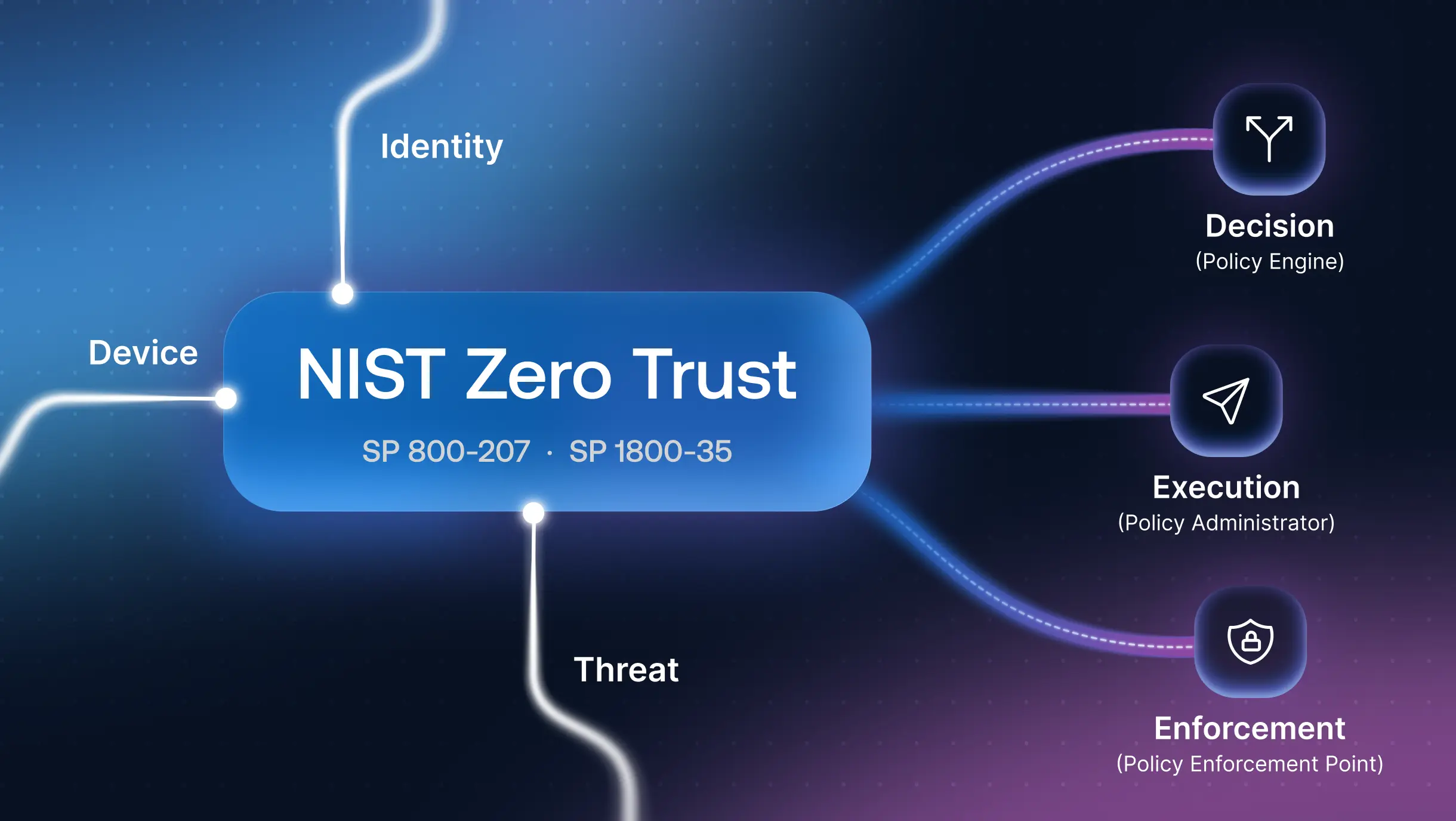
Endpoint Security and Zero Trust
The future of endpoint security is not just about protecting devices. It is about continuously verifying both the device and the person using it. In frontline environments where devices are shared and workflows move fast, identity attribution becomes just as important as malware detection. That is the gap traditional endpoint security leaves behind, and where modern identity-driven approaches are becoming essential.
Endpoint security and Zero Trust architecture are deeply connected.In a Zero-Trust implementation, no device or user is trusted by default, regardless of whether they sit inside or outside the network perimeter.
Endpoint security provides the enforcement mechanism: it assesses device posture, verifies compliance status, and feeds that information into access control decisions. A device that fails a posture check, because it is unpatched, running an unauthorized application, or flagged for suspicious activity, can be denied access or placed under additional scrutiny before it reaches sensitive resources.
This is especially relevant in environments with shared devices and high workforce turnover, where verifying the device and the identity of whoever is currently using it are both critical. Solutions like OLOID's passwordless authentication platform, built specifically for frontline and operational environments, integrate with endpoint posture signals to ensure that access decisions reflect both who is logging in and the security state of the device they are using.
Why Does Endpoint Security Break Down on Shared Devices?
Most endpoint security platforms assume one user per device. Frontline environments violate that assumption constantly. A single workstation or handheld scanner might be touched by 20 or more workers in a day, each logging in briefly to complete a task and moving on. Standard endpoint security tools were not designed for this model. They assume a persistent user session, a personal device, and an employee who has time to complete an MFA prompt on their phone.
That assumption creates real gaps:
- Shared devices make it difficult to tie activity logs to a specific individual, which breaks audit trails
- Password-based logins on shared terminals create credential-sharing habits that undermine access controls
- Phone-based MFA is impractical for workers who do not carry personal devices on the floor
- High workforce turnover means access permissions are frequently outdated or over-provisioned
These are not edge cases. They are the daily reality for the majority of frontline workers across regulated industries.
Endpoint security in these environments needs to go beyond device monitoring. It needs to know who is using the device at any given moment, not just whether the device itself is compliant.
This is where OLOID addresses a gap that traditional endpoint tools leave open. OLOID's passwordless authentication platform is built specifically for frontline and operational workplaces, enabling workers to authenticate quickly using biometrics, badges, or mobile credentials without passwords or personal phones. Every login is tied to a verified individual identity, every session is auditable, and device posture signals feed directly into access control decisions.
The result is endpoint security that works the way frontline environments actually operate: fast, shared, and accountable at the individual level.
Enterprise vs. Consumer Endpoint Security
| Aspect | Traditional Endpoint Security | Frontline-Aware Endpoint Security |
|---|---|---|
| Device model | Assumes one user per device | Built for shared-device workflows |
| Authentication | Password or phone-based MFA | Badge, biometric, or mobile credential |
| User attribution | Weak, session-level only | Verified individual identity per session |
| Login experience | Multi-step, designed for desk workers | Fast tap-and-go, designed for shift workers |
| Audit trail | Device-level logs | Individual-level, auditable access records |
| Compliance fit | Adequate for standard environments | Built for HIPAA, PCI DSS, and regulated industries |
How to Choose an Endpoint Security Solution
Three questions cut through the noise when evaluating solutions:
1. How comprehensive is the protection?
The solution should cover prevention, detection, investigation, and response across on-premises, cloud, hybrid, and disconnected environments, ideally through a single agent. Gap coverage matters as much as depth of capability.
2. Does it offer centralized management?
Managing endpoints at scale requires a single console that supports bulk policy deployment, remote remediation, patch management, and real-time monitoring. Solutions that require managing devices individually do not scale.
3. Does it support proactive risk management?
Strong solutions include AI-powered threat prioritization, automated alert correlation, and frameworks like MITRE ATT&CK mapping for ongoing posture assessment. They also support compliance reporting for regulated industries and integrate cleanly with identity and access management tools already in use.
For organizations where workers share devices across shifts, such as healthcare facilities, distribution centers, and manufacturing plants, the integration between endpoint security and identity verification becomes critical. Each login needs to be authenticated, and the device state at the time of that login needs to be known.
Conclusion
Endpoint security has moved from a line item in an IT budget to a core operational requirement. The combination of distributed workforces, BYOD policies, IoT proliferation, and increasingly sophisticated threats has made every connected device a meaningful risk that organizations need to understand and manage.
The foundational stack of EPP, EDR, and XDR gives organizations a layered defense that covers prevention, detection, and response across every device type. Layering Zero Trust access control on top turns that defense into an active system where device health and user identity work together to determine what gets access and what does not.
The future of endpoint security is not just about protecting devices. It is about continuously verifying both the device and the person using it. In frontline environments where devices are shared and workflows move fast, identity attribution becomes just as important as malware detection. That is the gap traditional endpoint security leaves behind, and where modern identity-driven approaches are becoming essential. OLOID is built specifically for that gap, bringing verified, auditable, passwordless authentication to the shared-device environments where traditional endpoint tools fall short.
FAQs
1. What is endpoint security in simple terms?
It is the practice of protecting every device connected to your network from cyberattacks, unauthorized access, and data theft.
2. What is the difference between EPP, EDR, and XDR?
EPP prevents known threats at the device level. EDR continuously monitors and responds to threats that get through. XDR extends that detection and response across endpoints, networks, cloud, and applications.
3. Is antivirus enough for endpoint security?
No. Antivirus protects one device against known threats and needs manual updates. Endpoint security covers all devices on a network, detects unknown threats, and updates automatically via the cloud.
4. What is the relationship between endpoint security and Zero Trust?
Endpoint security continuously assesses device posture and feeds that data into access control decisions. Zero Trust uses that signal to determine whether a device and user combination should be granted access at all.
5. How does endpoint security support compliance?
It enforces access controls, encrypts data, logs device activity for audit trails, and enables rapid incident response. All of these directly map to requirements under HIPAA, PCI DSS, and similar frameworks.
6. Can endpoint security protect shared workstations?
Standard endpoint security protects the device, but cannot always identify who is using it at any given moment. Protecting shared workstations fully requires integrating endpoint security with identity verification so every session is tied to a specific, authenticated individual rather than just a device login.
7. What industries need endpoint security most?
Healthcare, manufacturing, logistics, retail, and financial services face the greatest exposure because of the volume of devices, the mix of shared and personal endpoints, and the compliance frameworks they operate under. Any industry managing sensitive data or operating under regulatory requirements has a high need.

Get the latest updates! Subscribe now!
