




Policy-Based Access Control (PBAC): How It Works and Why It Matters

.webp)
Key Takeaways
- Policy-based access control (PBAC) governs access using centrally managed policies that evaluate who a user is, what they want to access, what action they want to take, and the context surrounding the request.
- Unlike RBAC, which grants access by role alone, PBAC layers in attributes and real-time context for far more precise decisions.
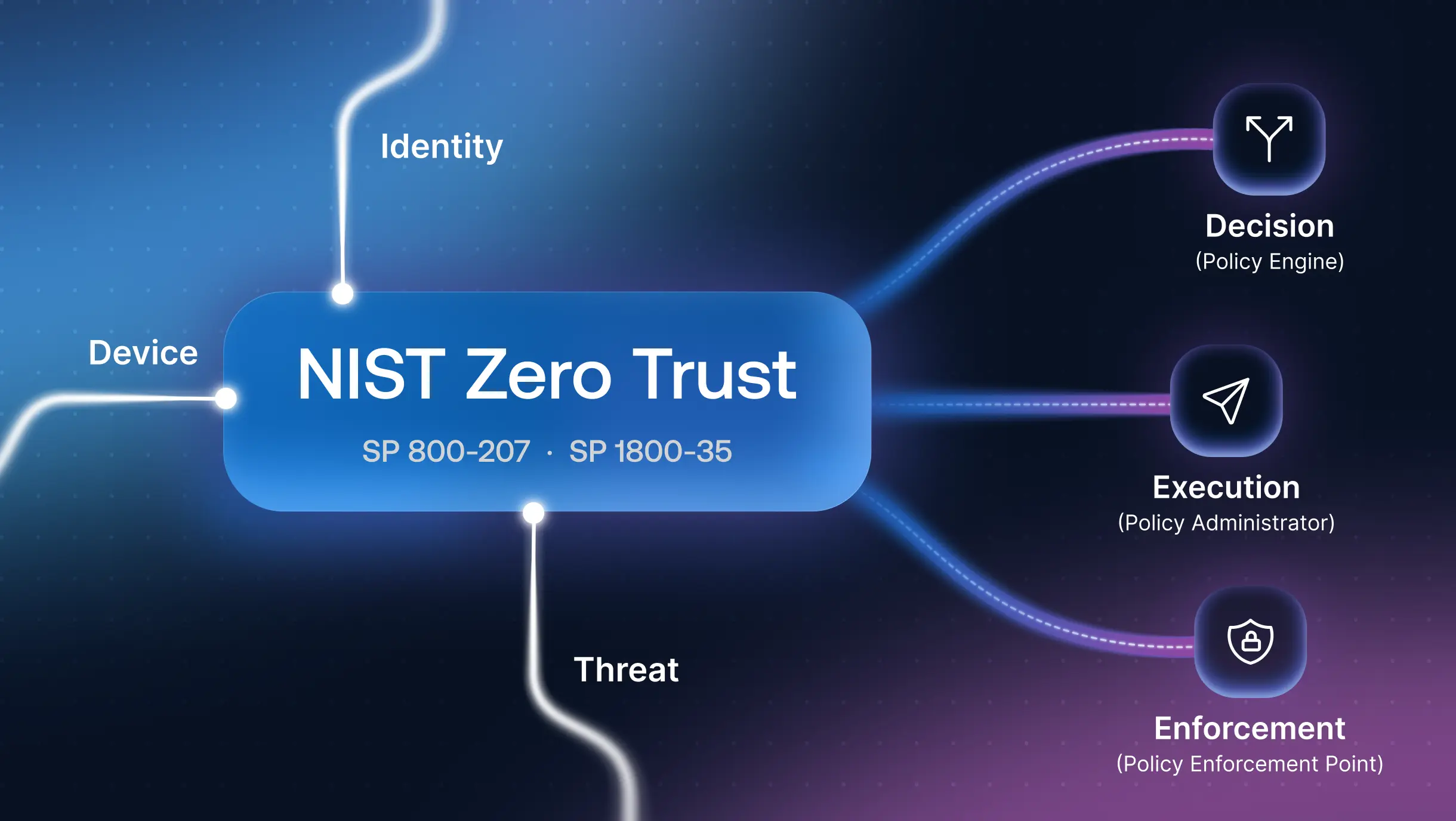
- The three core components - PDP, PEP, and PAP - work together to evaluate, enforce, and manage access policies.
- PBAC directly supports Zero Trust by treating every access request as a fresh evaluation rather than a standing permission.
- Common implementation pitfalls include policy sprawl, conflicts between overlapping policies, and inadequate testing before rollout.
Picture a hospital at 2 AM. A nurse logs into a shared workstation in the ICU to check a patient's medication history. Access granted instantly. Now imagine a billing analyst at that same workstation, same hour, trying to open the same record. Should the system respond identically?
If it does, something has gone wrong. Role alone rarely captures the full picture. Context matters: the resource, the time, the device, the location. In environments where employees share devices across rotating shifts, getting context wrong carries real consequences.
The numbers confirm it. According to the Verizon 2024 Data Breach Investigations Report, stolen or compromised credentials have been involved in 31% of breaches over the last decade, with a significant portion tracing back to overly permissive access with no contextual guardrails.
Policy-based access control (PBAC) is the model built to close that gap.
[[content-box]]
This blog explores how PBAC works, what sets it apart from other models, its real benefits and challenges, where it fits inside a Zero Trust strategy, and how to implement it cleanly.
The Problem with Static Access Control
Static access models were designed for simpler times - stable office environments, predictable roles, and clear perimeters. Today's reality looks different: hybrid workforces, multi-cloud infrastructure, contractors needing temporary access, and operational environments where multiple workers share a single device.
Role-Based Access Control (RBAC) assigns permissions at the role level and applies them uniformly. At a small scale, that works. As organizations grow, roles multiply, and permissions pile up. Security teams call this "role explosion", and it leaves users with far more access than they need. Attribute-Based Access Control added attributes, but without centralized governance, policies scatter across systems and become difficult to audit consistently.
PBAC addresses both problems from the ground up.
How Policy-Based Access Control (PBAC) Works
The 3-Phase Flow of PBAC
Every PBAC access decision follows the same sequence:
- Request - A user or system attempts to access a resource.
- Evaluation - The system checks the request against applicable policies, factoring in user attributes, resource characteristics, the action requested, and contextual signals.
- Decision - Access is granted, denied, or conditionally limited.
Key Components of PBAC
Policy Decision Point (PDP): The logic engine. It retrieves relevant policies, evaluates them against all available context, and returns a decision.
Policy Enforcement Point (PEP): The gatekeeper. It intercepts access requests, consults the PDP, and applies the decision at the application or data layer.
Policy Administration Point (PAP): The management layer. Administrators define, update, version, and retire policies here - the single source of truth for all access rules.
What a Policy Actually Looks Like
A PBAC policy defines four things: who (subject), what resource (object), what action, and under what conditions. In plain language: "Sales analysts can read quarterly revenue reports if the request originates from a corporate network between 8 AM and 7 PM on a weekday." Behind the scenes, Boolean logic evaluates whether every condition is simultaneously met.
Fail-Open vs. Fail-Closed
When the PDP goes offline, one of two behaviors activates. Fail-open grants access by default while the system recovers - keeping operations running but creating a temporary security gap. Fail-closed denies access until the PDP is restored - protecting security but potentially blocking critical workflows. Healthcare environments handling emergencies may lean fail-open with compensating controls. Financial systems typically choose fail-closed.
The 4 Types of Attributes in Policy-Based Access Control (PBAC)
Subject attributes describe the person requesting access: job role, department, seniority, security clearance, and employment type.
Object attributes describe the resource: file type, data classification, system owner, and sensitivity level.
Action attributes define the intended operation: read, write, edit, delete, export.
Environmental attributes capture context: time of day, location, device type, network (corporate vs. public), and IP address.
When these four dimensions combine inside a well-structured policy, access decisions become precise, contextual, and fully auditable.
PBAC vs. RBAC vs. ABAC
| Model | How It Works | Key Limitation |
|---|---|---|
| RBAC | Access tied to job role | No context, causes role explosion |
| ABAC | Uses attributes for decisions | No centralized governance, hard to audit |
| PBAC | Policies combine roles, attributes, and context | Requires disciplined policy governance |
The clearest distinction between PBAC and ABAC: PBAC expresses access rules in human-readable, versioned policies. ABAC encodes them in logical conditions that are harder to communicate, audit, and update across teams.
Benefits of Policy-Based Access Control (PBAC)
Fine-grained control reduces privilege creep; users get exactly what they need for exactly the situation they are in.
Centralized consistency means one policy change propagates everywhere. No conflicting permissions across applications.
Auditability simplifies compliance. Versioned, traceable policies let teams demonstrate exactly what access was granted, to whom, under what conditions, and when; directly supporting HIPAA, SOX, GDPR, and PCI DSS requirements.
Operational efficiency reduces manual work. Automating policy enforcement frees administrators from managing individual user permissions across dozens of systems.
Business agility keeps pace with change. Onboarding users after an acquisition, adjusting for a regulatory update, or restricting access during a security incident requires updating a policy - not rewriting application code.
Challenges of Policy-Based Access Control (PBAC)
Policy sprawl creeps in over time. Redundant or overlapping policies make troubleshooting difficult and audits unnecessarily complex.
Conflict resolution is a gap that teams often discover too late. When two policies apply to the same request and produce contradictory outcomes, the system needs a defined hierarchy for which policy wins.
Performance at scale matters. Real-time evaluation across thousands of concurrent requests can introduce latency if the PDP infrastructure is not properly sized.
Testing and rollback require discipline. A single misconfigured policy can lock out legitimate users or expose sensitive data. Staging environments, policy-as-code practices, and rollback procedures are essential - not optional.
Policy-Based Access Control and Zero-Trust
Zero-Trust operates on a single principle: never assume access should be granted because it was granted before. Every request gets verified independently.
PBAC is the authorization layer that makes Zero-Trust operational. Identity verification answers "who is this user?" - PBAC answers "should this user get access right now, given everything we know about this specific request?" Together, they create continuous verification.
For frontline workers authenticating on shared devices across shifts, this pairing matters most. Platforms like OLOID, which enable passwordless authentication through badge ID, facial recognition, and PIN, ensure the identity signal entering the PBAC evaluation is strong from the start, without slowing workers down.
Policy Lifecycle Management
Policies need governance throughout their existence, not just at creation.
Define policies with input from security, IT, compliance, and the business teams whose data they govern. Approve every policy through a structured review before it reaches production. Version every change with author, date, and reason. Review on a schedule - quarterly for high-risk resources, annually for stable environments. Deprecate unused policies formally rather than leaving them dormant, where they create audit confusion and security gaps.
Real-World Use Cases
Healthcare
A nurse authenticates at a shared bedside terminal with a badge tap and pulls up only the records relevant to their unit during their scheduled shift. A physician in a different department gets a different policy outcome on the same request. Every access decision logs automatically, making HIPAA audit trails straightforward and complete.
Manufacturing
A floor operator clocks in and gets access to their assigned line's production data and equipment controls. A supervisor on the same shift accesses broader operational dashboards. Neither touches the other's scope. When a shift ends, policies automatically expire those access rights, so the next worker starts clean regardless of who used the terminal before them.
Retail
A store associate can access inventory and point-of-sale systems for their location during store hours. Regional managers can query data across multiple stores, but cannot modify store-level configurations directly. Policy boundaries keep each role productive without creating cross-location data exposure.
Pharmaceuticals
Researchers access trial data scoped strictly to their assigned study and clearance level. Regulatory submissions require a separate approval workflow before data can be exported. PBAC enforces both restrictions at the policy layer, keeping 21 CFR Part 11 and GxP compliance built into every access decision rather than dependent on manual controls.
Implementing Policy-Based Access Control: Step by Step
- Assess your current framework: Identify overly permissive roles and systems lacking contextual controls.
- Define your attributes: Map subject, object, action, and environmental attributes before writing any policy.
- Start with high-risk resources: Pilot where the compliance and security stakes are highest.
- Test in staging: Use policy-as-code practices and simulation tools before any policy touches production.
- Deploy gradually: Roll out by system or user group, monitoring real access patterns.
- Integrate with identity and security systems: Connect to IAM, SIEM, and monitoring tools for unified visibility.
- Establish a review cadence: Schedule policy reviews so the system stays current as your organization evolves.
For organizations managing frontline workers who need fast, frictionless access across shared devices, an integration-ready identity layer like OLOID ensures strong authentication signals flow cleanly into the PBAC evaluation, keeping both security and usability intact.
Conclusion
Policy-based access control moves access decisions from static snapshots to real-time evaluations. Every request gets checked against the full context of who is asking, what they want, what they intend to do, and the conditions surrounding the request. The result is a security posture that scales with organizational complexity, adapts to regulatory change, and reduces the exposure that comes from overly permissive roles and shared credentials.
Getting there requires disciplined policy governance and ongoing review. But the environments that benefit most are often the ones where access has historically been the hardest to control; shift-based workplaces, shared terminals, high-turnover teams where credentials get passed around and permissions never get cleaned up. For those environments, OLOID’s auditable shared-account login brings the identity layer that PBAC needs to work properly: workers authenticate with what they carry or who they are, policies evaluate the request in real time, and access stays accurate without adding friction to already demanding jobs.
That is where policy-based access control stops being a framework on a slide and starts being something people actually experience every time they clock in.
FAQs
1. What is the difference between PBAC and RBAC?
RBAC grants access based on job role alone. PBAC adds real-time context: time of request, device, location, and the specific resource, on top of the role. This makes access decisions far more precise and harder to exploit.
2. Is PBAC the same as ABAC?
Both use attributes to control access, but PBAC expresses rules as human-readable, centrally managed policies. ABAC encodes them in logical conditions that are harder to audit and update at scale. PBAC is essentially ABAC with governance built in.
3. How does policy-based access control support Zero Trust?
Zero Trust requires every access request to be verified independently. PBAC enforces this by evaluating each request against current policies in real time rather than relying on standing permissions, making it the authorization layer that Zero Trust depends on.
4. Can policy-based access control work with existing IAM tools?
Yes. PBAC sits on top of your existing IAM infrastructure rather than replacing it. Identity providers like Okta, Azure AD, or similar tools handle authentication, and PBAC uses the identity signals they produce to evaluate access policies. Most organizations layer PBAC into their current stack without a full rip-and-replace.
5. What happens when two PBAC policies conflict with each other?
The system follows a predefined conflict resolution hierarchy, typically either a deny-overrides or permit-overrides approach. Deny-overrides means if any applicable policy denies access, the request is blocked regardless of other policies that might permit it. Most security teams default to deny-overrides since it is the safer choice, but the right approach depends on the risk profile of the resource being protected.

Get the latest updates! Subscribe now!
