




How to Evaluate, Strengthen, and Future-Proof Your Identity Provider Security

Key Takeaways
- An IdP authenticates users and issues access tokens. Identity provider security protects both the IdP and the flows it governs.
- Centralizing identity means one hardened system to secure instead of credentials scattered across dozens of apps.
- A compromised or downed IdP takes every connected application with it. Redundancy and phishing-resistant MFA are baseline requirements.
- Shared-device environments expose a gap most IdPs were not built for. The one-person-one-device assumption breaks down on a hospital ward or factory floor.
- An IdP is not IAM. It confirms who the user is. IAM determines what that user can access and under what conditions.
- The direction is passwordless and continuous. Passkeys and biometrics are replacing the static login model that attackers have spent years exploiting.
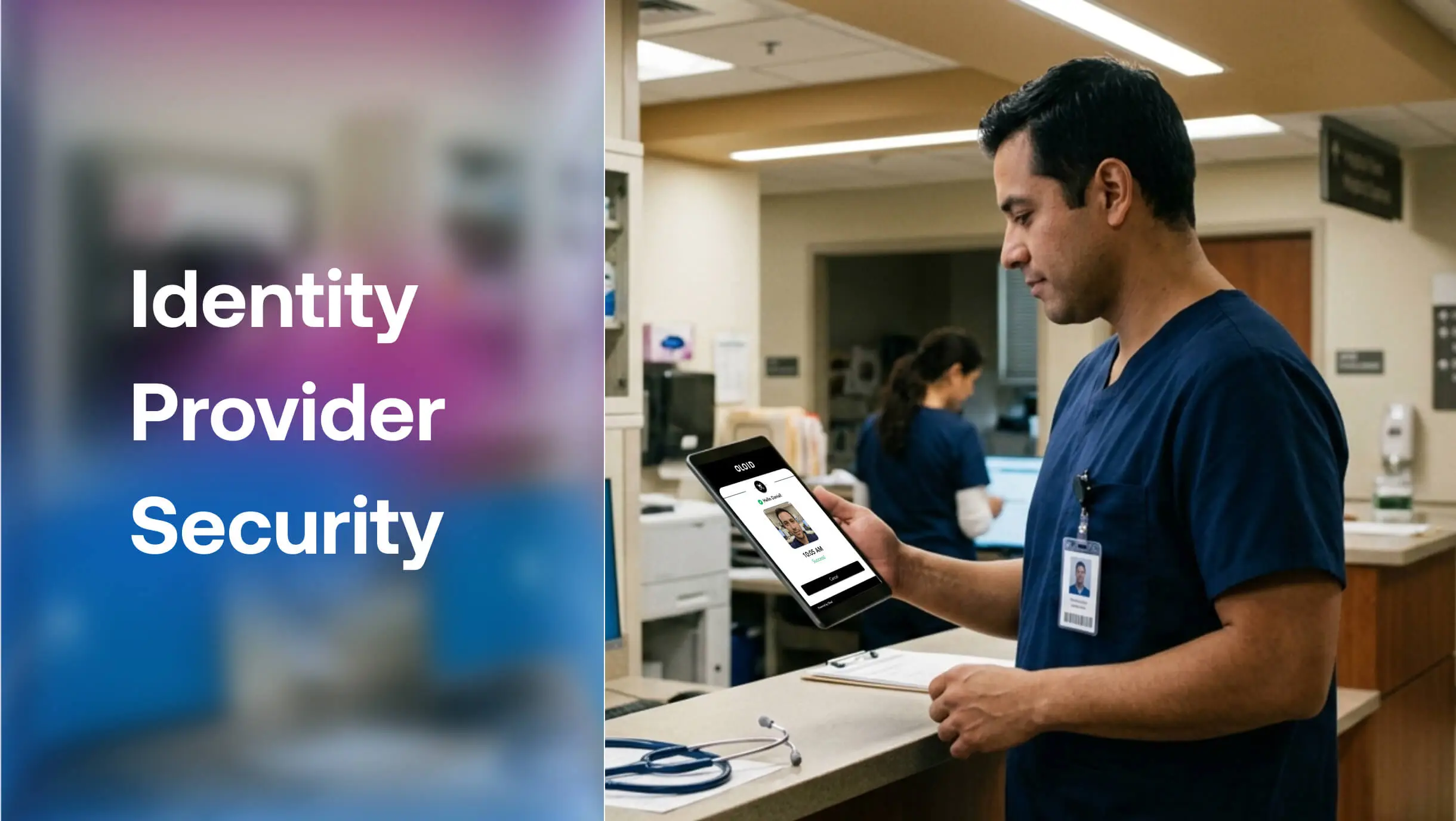
Imagine a hospital where nurses rotate across three shared workstations during a single shift. Each login takes 45 seconds; multiply that across a 12-hour shift, dozens of staff members, and hundreds of access attempts, and you realize the authentication layer is not just a security checkpoint. It is a friction point baked into the daily rhythm of people doing critical work. Now consider what happens when that layer breaks down. Credentials get shared, logins stay open. Someone accesses a patient record they should not. And by the time IT notices, the breach has already happened.
This is not a hypothetical. The Permiso State of Identity Security Report 2026 found that 77% of organizations now say identity compromise drives at least a quarter of all their security incidents. And the part that should concern every security leader: organizations that believed they had full visibility into their identities dropped from 93% to just 46% in a single year. The threats multiplied. The visibility did not keep up. The numbers reflect a reality that security teams in healthcare, manufacturing, retail, and critical infrastructure already feel: identity is the new perimeter. And protecting that perimeter starts with understanding identity provider security.
[[content-box]]
Whether you are an enterprise managing thousands of employees or a factory floor running dozens of shared terminals, identity provider security determines how trustworthy and resilient that authentication layer actually is. This guide covers what securing an IdP actually requires, where most deployments leave gaps, and what a complete solution looks like when the standard assumptions break down.
How an Identity Provider Works
An IdP handles three things: authenticating users, authorizing access, and communicating that information to the applications users need.
When a user logs in, the IdP validates their credentials, which can include a password, biometric scan, one-time code, or any combination of factors. After successful validation, the IdP generates an authentication token, a digital certificate confirming the user's identity, and sends it to the requesting application. The application trusts the token and grants access without ever seeing the user's raw credentials.
IdPs communicate using standardized protocols SAML, OAuth 2.0, and OIDC:
- SAML (Security Assertion Markup Language): Used widely in enterprise environments for Single Sign-On (SSO) with tools like Salesforce and Workday
- OAuth 2.0: Token-based and flexible, ideal for consumer-facing and API-driven applications
- OpenID Connect (OIDC): Built on top of OAuth 2.0, it adds an identity verification layer and works well for modern cloud apps
These protocols allow IdPs to interoperate with hundreds of applications, reducing the need for each app to manage its own credentials.
What Identity Provider Security Actually Covers
Identity provider security refers to the practices, configurations, and controls that protect the IdP itself and the authentication flows it governs. It goes well beyond setting up SSO and calling it done.
A secure IdP strategy addresses:
Authentication Strength:
Passwords alone are no longer sufficient. Identity provider security requires multi-factor authentication (MFA) as a baseline. Adaptive MFA, which adjusts verification requirements based on login context such as device, location, or behavior, adds an intelligent layer on top.
Access Control Policies:
The IdP should enforce role-based access control (RBAC), ensuring that users can access only the resources their role permits. In operational environments like manufacturing plants or logistics warehouses, where workers frequently move between stations or share terminals, granular role policies prevent privilege creep from compounding over time.
Session Management:
Tokens must expire, sessions must time out. Refresh tokens must be rotated and invalidated on logout. Poor session management is one of the most exploited gaps in IdP deployments, especially on shared workstations where the previous user's session may remain technically active.
Audit Trails and Monitoring:
Every login attempt, access request, and authentication event should be logged. These logs enable compliance reporting under frameworks such as GDPR, HIPAA, and SOC 2, and provide security teams with the forensic data needed to investigate incidents quickly.
The IdP itself is a Target:
Most organizations treat the IdP as the security layer, not as an asset that requires its own protection. Attackers increasingly target IdP configurations directly, exploiting misconfigurations, weak admin credentials, and token validation gaps. SaaS Security Posture Management (SSPM) tools can monitor and harden IdP settings continuously.
When the IdP is compromised, the damage extends far beyond a single account. Audit trails break. Compliance evidence becomes unreliable. And because every downstream application trusted the IdP's tokens, attackers move laterally across systems without triggering a single additional authentication check.
Where Identity Provider Security Fails in Practice
Even well-configured IdPs fail in predictable ways. Here is where the gaps appear most consistently.
Shared devices: No user attribution
In healthcare, manufacturing, and retail, multiple workers access the same terminal across a single shift. Traditional IdPs assume one person behind one device. When that assumption breaks, there is no reliable way to attribute actions to individuals. Audit trails become meaningless. Compliance evidence becomes undefendable. Insider risk climbs silently.
Persistent sessions: Audit gaps
When session timeouts are too long or absent entirely, the previous user's authenticated session remains active. The next person who sits down inherits it. Every action they take gets logged under the wrong identity. This is not a theoretical risk; it is a daily reality on shared workstations.
MFA dependency on personal devices: Frontline friction
Push notification MFA assumes every worker carries a smartphone. Many frontline workers do not. When the MFA method does not match the work environment, staff route around it. Credentials get shared. The security control becomes theater.
Identity mismatch: Role vs. person
In shift-based environments, access rights are often tied to a role, not a verified individual. When credentials are passed between workers, the IdP authenticates the credentials, not the person holding them. The system never knows the difference.
Here is how those gaps translate in practice:
| Capability | IdP Only | With OLOID |
|---|---|---|
| User attribution on shared devices | None | Per-person, every login |
| Session isolation | Manual policy | Automatic on step-away |
| MFA without personal devices | Not supported | Badge-tap or biometric |
| Audit reliability | Limited | Complete and defensible |
| Credential sharing risk | High | Eliminated |
Identity Provider Security in Operational Environments
Most IdP security guidance is written for knowledge workers sitting at dedicated desks. The reality in hospitals, factory floors, and distribution centers looks very different. Frontline workers often share devices, work without personal email addresses, rotate through roles mid-shift, and have limited tolerance for authentication friction. A nurse cannot stop to complete a five-step verification every time she accesses a patient record. A logistics worker does not carry a smartphone for push notifications.
Solving this requires extending identity verification beyond the IdP and bringing it to the point of use. Instead of asking workers to authenticate to a system, the authentication comes to them through a badge-tap, biometric scan, or proximity-based login at the terminal itself. This is the model OLOID is built around: verified, passwordless authentication that works on shared devices without requiring workers to carry personal devices, remember credentials, or slow down to complete a five-step login sequence. The IdP still governs access policy. But the trust signal feeding it is tied to a verified individual, not a shared credential.
When that signal is missing, the IdP cannot distinguish between the right person and whoever happens to be sitting at the terminal. That is not an authentication gap. That is an audit gap, a compliance gap, and an insider risk waiting to surface.
Key Features of a Secure IdP Strategy
Whether you are evaluating a new identity provider or hardening your existing setup, the following capabilities mark the difference between a foundational IdP and a secure one.
MFA with contextual adaptation: Static MFA can frustrate users and generate alert fatigue. Adaptive MFA evaluates risk signals like new device, unusual location, or time of access, and requests additional verification only when warranted.
SSO with strong session controls: SSO reduces authentication friction and centralizes credential management. Paired with enforced session timeouts and token expiration policies, it becomes a security asset rather than just a user convenience.
Automated provisioning and deprovisioning: When someone joins, their access should be provisioned instantly based on their role. When they leave, their access should be revoked across all connected systems immediately, not days later. Manual deprovisioning delays are one of the most common sources of unauthorized lingering access.
Comprehensive logging: Every authentication event should generate a log entry. Integrating those logs with a SIEM platform like Splunk or Microsoft Sentinel lets security teams correlate signals and detect anomalies before they escalate.
Global coverage and compliance alignment: For organizations operating across regions, the IdP must accommodate local data residency requirements and authentication regulations. A provider with global infrastructure simplifies this considerably.
What strong IdP security delivers in practice:
- Full user-level attribution on every authentication event, even on shared devices
- Eliminated shared credentials across shift-based environments
- Audit logs that hold up under HIPAA, SOC 2, and internal security reviews
- Login sequences fast enough that workers do not route around them
The Buyer Evaluation Checklist
The right IdP depends on organizational size, security maturity, and operational context.
Small and mid-sized businesses benefit from cloud-based IdPs that deploy quickly, receive automatic updates, and require minimal infrastructure investment. Enterprises with strict compliance needs or highly sensitive data often prefer hybrid or on-premises deployments that give them direct control over credential storage.
[[content-box-2]]
The Future of Identity Provider Security
Identity threats are not plateauing. Attackers now prioritize identity as the primary attack surface because compromising a valid credential is faster and cheaper than exploiting a technical vulnerability. AI is accelerating social engineering. Infostealers are harvesting session tokens at scale. Credential-based attacks now account for a significant majority of initial access methods across industries.
The response is moving in two directions simultaneously. First, authentication is becoming passwordless. Biometrics, hardware tokens, passkeys, and proximity-based methods remove the password entirely, eliminating the most common attack vector at its root. Second, identity verification is becoming continuous. Rather than confirming identity once at login, adaptive systems re-evaluate trust signals throughout the session.
For organizations with frontline workers and shared infrastructure, like the hospital in the opening scenario, these advances are not optional improvements. They are operational requirements. OLOID's approach to identity in these environments, combining passwordless authentication with workstation-aware access controls, reflects where the industry is heading: authentication that is invisible to the user but robust under the hood.
Conclusion
Identity provider security sits at the intersection of user experience and organizational resilience. Get it right, and users move fluidly through their workday while unauthorized access gets stopped before it starts. Get it wrong, and a single shared password or an open session becomes a breach that takes months to detect.
The core principles are consistent across industries: centralize authentication, enforce MFA, control access by role, log everything, and treat the IdP itself as a critical asset worth protecting. But applying those principles in a way that fits how people actually work, whether on a corporate laptop or a shared terminal on a factory floor, requires intentional design.
Identity is no longer just an IT concern. It is an operational one. The organizations that close the gap between IdP policy and how workers actually authenticate are the ones building security that holds, and audit trails that hold up when it matters most.
FAQs
1. Can an identity provider itself get hacked, and what happens if it does?
Yes, and the blast radius is wide. An IdP issues tokens that every connected application trusts automatically, so one compromised IdP hands attackers authenticated access to every federated system at once. Treat the IdP as a high-value target: enforce phishing-resistant MFA on admin accounts, monitor configuration changes continuously, and integrate authentication logs with a SIEM.
2. What is the difference between an IdP and IAM?
An IdP handles authentication, confirms who the user is, and issues a token. IAM (Identity and Access Management) is the broader framework that determines what a user can do. The IdP feeds verified identity into the IAM system, which then enforces access policies, role assignments, and compliance controls.
3. Does using an IdP mean you have Zero Trust security?
No. An IdP handles the initial identity check, which is one layer of Zero Trust. A full Zero Trust architecture continuously verifies every access request throughout the session, factoring in device posture, behavioral signals, and least-privilege controls. An IdP is a necessary foundation, not a finished implementation.
4. What happens to access when an IdP goes down?
Every application that depends on IdP goes down with it. The mitigation is redundancy: failover to a secondary IdP or a fallback authentication method for critical roles. Industries like healthcare and critical infrastructure need formal continuity plans built around this scenario specifically.
5. How does identity provider security work differently for frontline workers?
Most IdP setups assume one person, one dedicated device, one smartphone for MFA. Frontline workers share terminals, rotate shifts, and cannot afford a slow login sequence. Authentication in these environments needs to match the physical reality of the work; badge tap, biometric scan, or proximity login, backed by session controls that clear credentials automatically when a worker steps away.

Get the latest updates! Subscribe now!
