




What is Cloud Identity and Access Management (IAM)? A Complete Guide

.webp)
Key Takeaways
- Cloud identity and access management is central to modern cloud security because it verifies identities and controls access across cloud environments.
- An effective IAM system combines identity management, role-based access control, and lifecycle management to manage access efficiently.
- Cloud Identity and Access Management enhances security by enforcing security policies and monitoring user access across multiple cloud platforms.
- Traditional IAM approaches can create security issues in shared or high-traffic environments where user attribution becomes difficult.
- Strong best practices for Cloud Identity and Access Management include continuous monitoring, privileged access management, and tight access management policies.
- The right cloud Identity and Access Management solution should integrate with existing cloud service providers and support secure access across platforms.
- As organizations use cloud computing more heavily, the role of IAM in the cloud continues to expand into risk management and zero-trust strategies.
At 7:12 a.m., the first shift logs into a shared workstation on the factory floor. By noon, six different employees had used the same terminal. By evening, the audit log shows only one thing with certainty: the system was accessed. What remains unclear is which user performed which action.
This is the quiet identity problem many enterprises still underestimate. While organizations have invested heavily in cloud security, attackers continue to walk through the front door using valid credentials. Verizon’s Data Breach Investigations Report repeatedly shows that stolen or misused credentials remain involved in a large share of breaches. IBM reports the average global breach cost has climbed to $4.45 million, putting real financial weight behind what used to be treated as an IT issue.
Cloud Identity and Access Management, or Cloud IAM, sits at the center of this challenge.
Cloud Identity and Access Management (IAM) is the framework of policies, technologies, and processes that verifies digital identities and controls what users, devices, and workloads can access across cloud environments.
Its job is simple in theory and demanding in practice: make sure the right entity gets the right access at the right time.
Most IAM conversations focus on knowledge workers with dedicated laptops. Real operations are messier. Hospitals, manufacturing plants, retail floors, and logistics hubs run on shared systems and fast user turnover. In these environments, identity assurance can quietly weaken even when IAM is technically in place. In this blog, we explore how Cloud Identity and Access Management works, why it has become foundational to modern security, where traditional approaches struggle in real world conditions, and how organizations can extend strong identity controls all the way to the frontline.
What is Cloud Identity and Access Management
Cloud Identity and Access Management is the framework that verifies digital identities and controls access to cloud resources. It combines policies, tools, and processes to ensure the right people can reach the right systems at the right time.
Think of traditional IAM as security for a single office building, where most users work from fixed desks inside a defined network. Cloud IAM operates more like security for a distributed campus, where users, applications, and devices connect from multiple locations across cloud environments.
Cloud IAM performs two essential functions:
- Authentication confirms the user’s identity
- Authorization determines what that user can access
Modern IAM platforms manage identities across employees, contractors, partners, and machine workloads. They also enforce the principle of least privilege so users only receive the access required for their role. Most enterprises deploy IAM through a central identity provider that connects to cloud apps, infrastructure, and internal systems. This creates a single control plane for access decisions.
However, many IAM deployments still assume each user has a dedicated device and predictable login pattern. That assumption begins to crack in real world operational environments.
Why Cloud IAM Became Mission Critical
The Collapse of the Traditional Security Perimeter
Security used to rely heavily on network boundaries. If a user sat inside the corporate network, they were often trusted by default. That model made sense when applications lived in on-premises data centers and employees worked from office desktops.
Several shifts disrupted that model:
- SaaS adoption moved applications outside the firewall
- Remote and hybrid work expanded access points
- Mobile and unmanaged devices increased risk exposure
- Multi-cloud environments fragmented visibility
Today, sensitive systems sit everywhere, and users connect from almost anywhere. Network location alone cannot establish trust.
Identity is the New Security Control Point
As infrastructure became distributed, identity moved to the center of security strategy. Every access request now requires verification, context, and policy enforcement.
Credential theft, phishing campaigns, and session hijacking continue to rise. Attackers focus on identities because valid credentials provide quiet entry into systems. Once inside, they often move laterally across environments.
Cloud Identity and Access Management helps organizations respond to this reality by providing:
- Centralized authentication
- Consistent access policies
- Continuous monitoring
- Stronger user verification
These capabilities form the backbone of Zero-trust initiatives across many enterprises. Traditional IAM platforms were built around individual users with dedicated devices. Frontline environments operate differently, with shared systems, rapid shift changes, and time-sensitive workflows. Extending identity assurance into these environments requires a more dynamic approach to authentication, session management, and user attribution.
The Overlooked Risk: Shared Devices and Frontline Access
While most IAM conversations focus on knowledge workers, many industries depend heavily on shared systems.
Consider a few everyday scenarios:
- Nurses logging into shared clinical workstations
- Factory operators accessing production terminals
- Retail associates using point of sale systems
- Warehouse staff rotating across handheld devices
In these environments, password sharing, badge swapping, and session persistence often creep in as practical shortcuts. Over time, accountability becomes blurry and audit trails lose clarity. This is where traditional IAM assumptions start to show strain. Identity assurance must extend beyond single user laptops and into high velocity, shared access environments.
In these scenarios, shared workstation authentication becomes critical for maintaining accurate user attribution and reducing security risks. Without it, security teams often struggle to map individual actions to specific users in high-velocity environments. Strengthening identity controls at the workstation level helps preserve accountability without disrupting operational workflows.
[[cta]]
How Cloud Identity and Access Management Works
Step 1: Identity Creation and Directory Services
Everything begins with identity creation. When a new employee joins, the IAM system provisions a digital identity and stores it in a central directory.
The directory maintains:
- User attributes
- Group memberships
- Role assignments
- Credential data
IT teams rely on this directory as the source of truth. Automated provisioning ensures users receive appropriate access when they join, change roles, or leave the organization. For example, when a new finance analyst starts, the system can automatically assign access to budgeting tools while restricting engineering systems.
Step 2: Authentication
Authentication verifies that the person requesting access is legitimate. Common methods include:
- Passwords
- One time passcodes
- Push notifications
- Biometrics
- Hardware tokens
- Passwordless approaches
Many organizations now enforce multi factor authentication to strengthen login security. Even if a password leaks, the additional factor helps block unauthorized entry. In fast paced environments, passwordless methods such as badge tap or proximity based login help reduce friction while maintaining strong identity assurance.
Step 3: Authorization and Access Control
Once the user is authenticated, the IAM platform evaluates what the user can access. This decision relies on policies and access models such as:
- Role based access control
- Attribute based access control
- Context aware policies
For instance, an engineer may access code repositories but not payroll systems. Context signals such as device posture, location, or time of day can further refine access decisions. Least privilege enforcement plays a critical role here. By limiting permissions, organizations reduce the blast radius if an account becomes compromised.
Step 4: Continuous Monitoring and Auditing
Modern IAM does not stop at login. It monitors user activity and session behavior to detect anomalies.
Key capabilities include:
- Access logs
- Session tracking
- Risk alerts
- Compliance reporting
Security teams use this data to investigate incidents, support audits, and identify unusual patterns. Continuous visibility helps close gaps that periodic reviews often miss.
Core Components of a Modern Cloud IAM Architecture
A mature Cloud Identity and Access Management environment typically includes several interconnected layers.
- Identity provider
The central service that authenticates users and issues access tokens. - Directory services
The repository that stores identities, groups, and attributes. - Single sign on
Allows users to access multiple applications with one login session. - Multi factor authentication
Adds extra verification beyond passwords. - Access policy engine
Evaluates roles, attributes, and context to make authorization decisions. - Lifecycle automation
Handles onboarding, role changes, and offboarding automatically. - Audit and analytics
Provides visibility into access activity and supports compliance. - Passwordless authentication layer
Reduces reliance on passwords and speeds up secure access. - Proximity or badge based authentication
Enables fast, user specific login on shared devices and frontline systems.
Together, these components form the foundation of identity centric security.
Key Benefits of Cloud IAM for Enterprises
Stronger Security Posture
Cloud Identity and Access Management reduces unauthorized access by enforcing consistent authentication and authorization policies. Multi factor authentication and least privilege controls help contain credential based attacks. Security teams also gain better visibility into who accessed what and when.
Centralized Visibility and Control
With a unified identity layer, IT teams can manage access across SaaS apps, cloud infrastructure, and internal systems from a single place. This simplifies governance and reduces configuration drift.
Improved User Experience
Single Sign-On and passwordless options streamline the login experience. Users spend less time juggling credentials and more time working. For example, an employee can open multiple business apps after one secure login instead of reentering passwords repeatedly.
Operational Efficiency and Automation
Automated provisioning removes manual account setup and cleanup. When employees change roles or leave the company, the IAM system can update access automatically. This reduces help desk workload and lowers the risk of orphaned accounts.
Regulatory Compliance Support
IAM platforms generate detailed logs that support compliance efforts. Many regulations require proof of controlled access, user attribution, and audit readiness. Centralized identity data makes audits faster and more reliable.
Scalability for Hybrid and Multi Cloud
Cloud Identity and Access Management scales with organizational growth. Whether the company adds new SaaS tools, expands to another region, or adopts additional cloud providers, the identity layer can extend accordingly.
Where Traditional IAM Falls Short in Real World Environments
Assumption of Dedicated Devices
Many IAM deployments evolved around knowledge workers with assigned laptops. Policies, session handling, and authentication flows often reflect that model. In frontline settings, workers frequently rotate across shared terminals. When systems assume one device per user, identity assurance weakens.
Password Friction in High Velocity Environments
Repeated password entry slows down fast moving workflows. In busy environments, workers sometimes look for shortcuts. Common workarounds include:
- Shared credentials
- Sticky note passwords
- Persistent unlocked sessions
Each shortcut introduces security and compliance risk.
Visibility Gaps on Shared Workstations
When multiple users access the same device, session attribution becomes harder. Security teams may see that a workstation accessed a sensitive system but struggle to confirm which individual performed the action. This ambiguity complicates investigations and audit trails.
Impact on zero-trust Initiatives
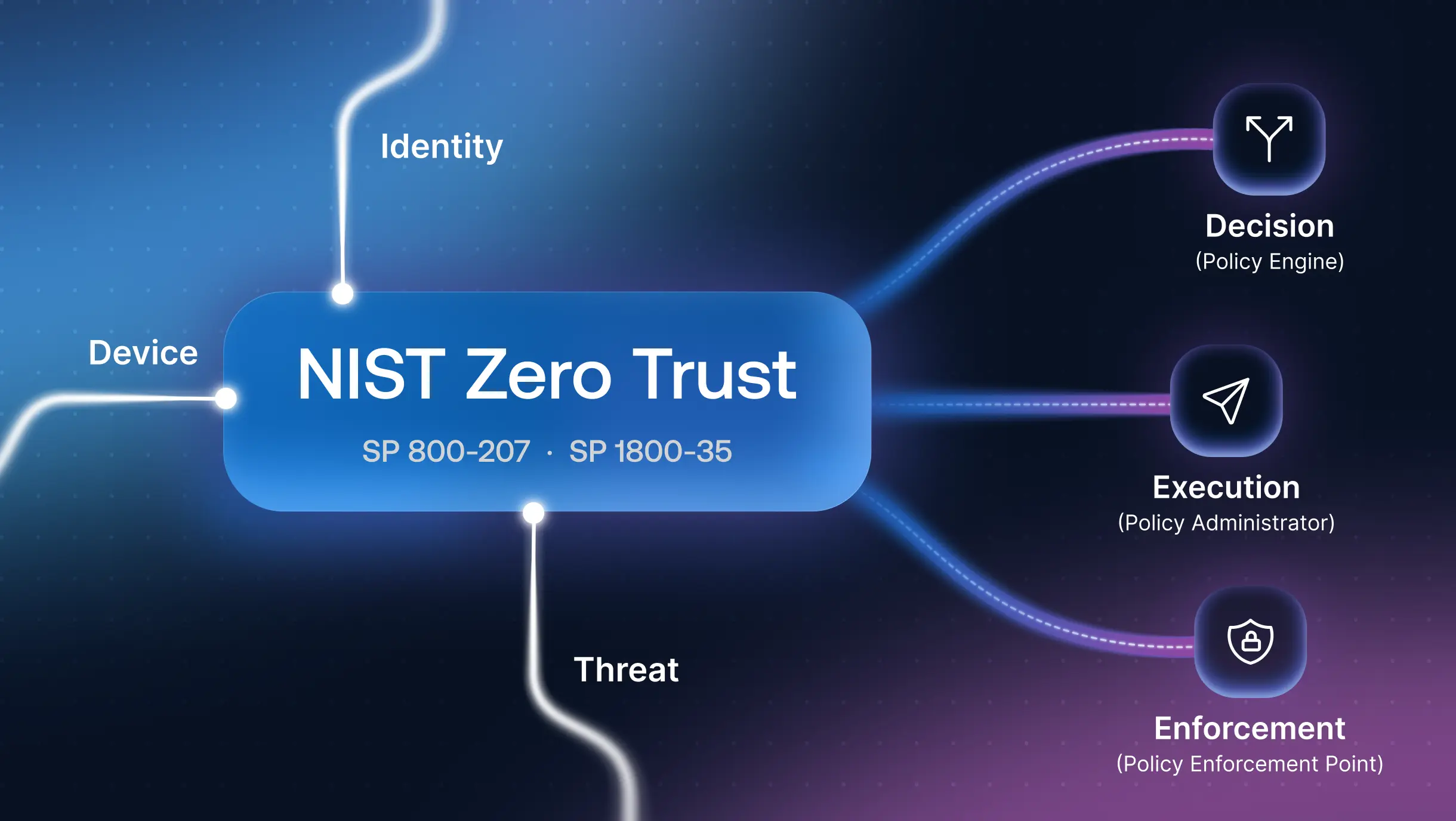
Zero-trust depends on strong, continuous identity validation. When shared access patterns blur user attribution, policy enforcement becomes less precise. To fully support zero-trust goals, IAM strategies must extend identity confidence all the way to the edge.
How Cloud IAM Differs From Traditional IAM
Traditional IAM systems were designed for on-premises environments where applications lived inside a corporate network and users typically worked on dedicated devices. Cloud IAM operates across distributed cloud services and requires centralized identity control, consistent access policies, and continuous monitoring across dynamic environments.
As organizations adopt more cloud services and support frontline workflows, identity management must extend beyond static network boundaries.
Cloud IAM in Action Across Industries
Healthcare : Healthcare environments depend on fast, secure access to electronic health records, clinical applications, and medical systems. In hospital settings, clinicians frequently rotate across shared workstations and nursing stations. Healthcare access management must balance strict regulatory compliance with workflow efficiency. A cloud identity and access management strategy helps enforce access control policies, maintain user-level attribution, and support secure access to sensitive patient data across cloud services.
Manufacturing: Manufacturing access management focuses on securing production systems, operational terminals, and industrial applications. On factory floors, employees often share devices across shifts. Managing identities and access in these environments requires strong authentication and continuous monitoring. A cloud IAM system helps control access to production resources, enforce role-based access control, and reduce security risks without slowing operations.
Retail: Retail access control must protect point-of-sale systems, inventory platforms, and customer data across distributed store locations. Employees frequently access cloud-based applications during high-traffic hours. Cloud identity and access management enables centralized management of identities and access rights while supporting secure access across multiple cloud platforms and store environments.
How OLOID Extends Cloud IAM to the Frontline
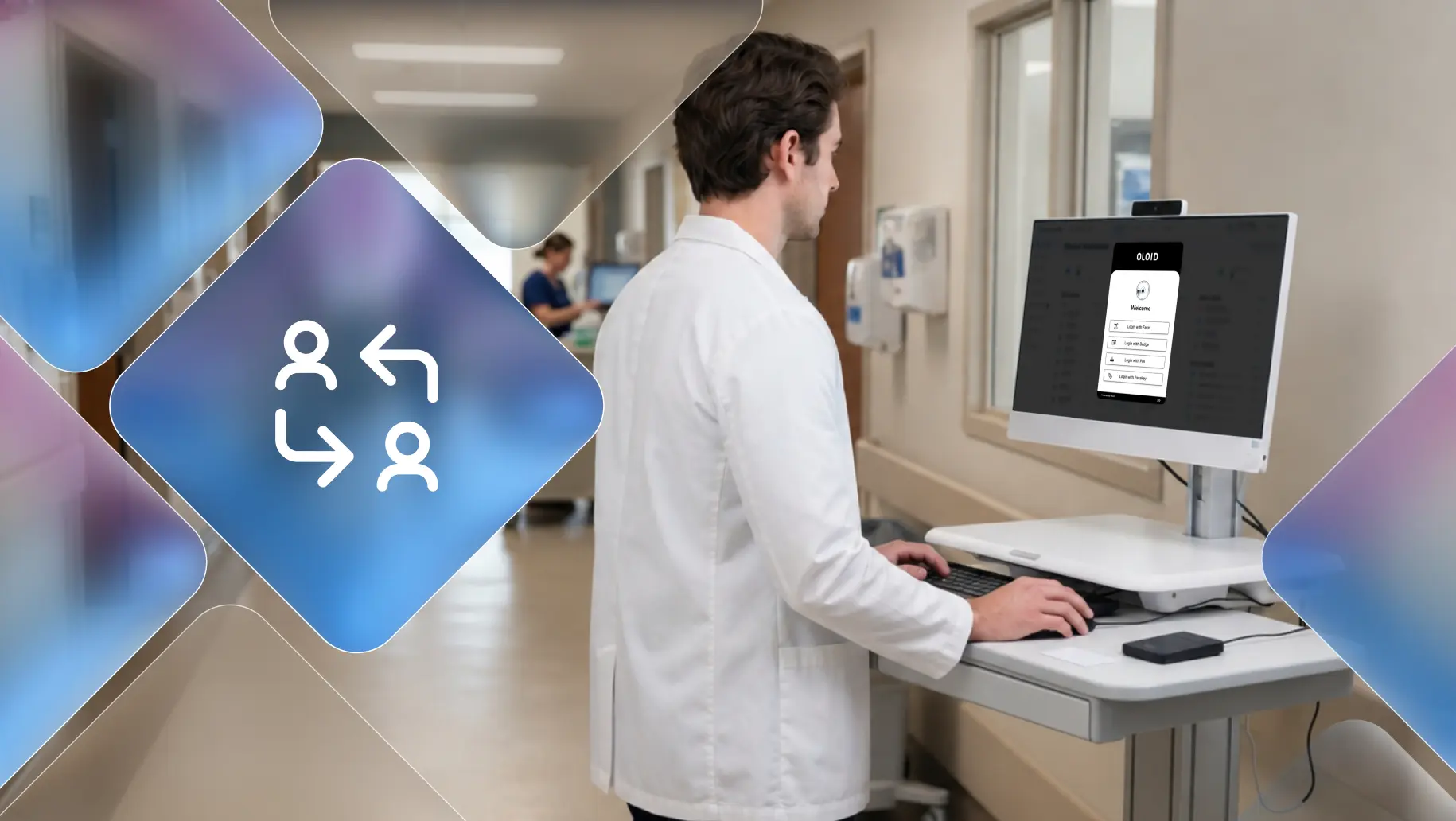
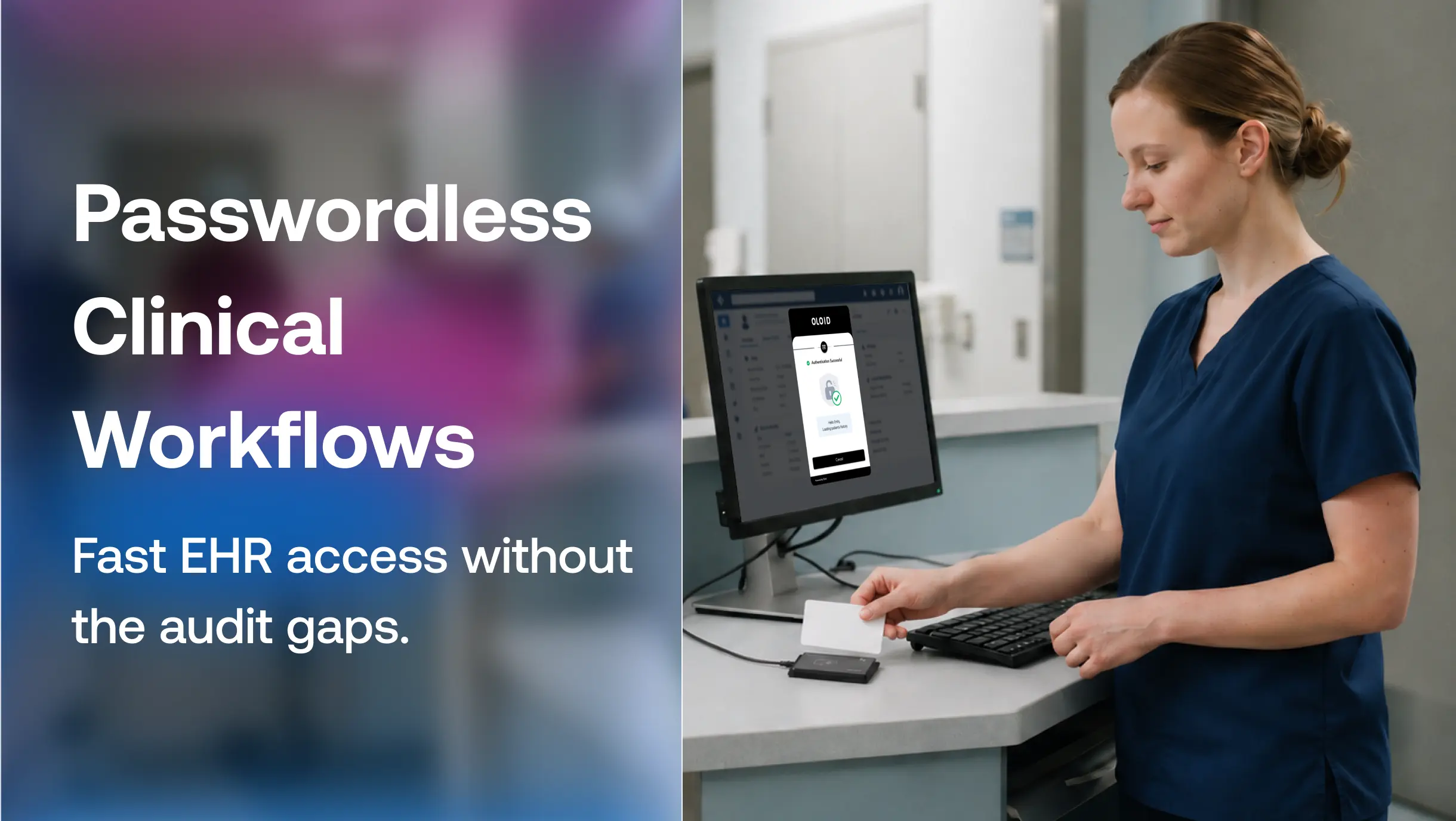
OLOID extends Cloud Identity and Access Management into environments where traditional identity controls often lose precision. Unlike traditional methods that rely heavily on passwords or static credentials, OLOID enables fast, user-level authentication on shared devices without disrupting operational workflows. This approach strengthens frontline identity management by ensuring each user interaction is individually verified and continuously tracked. As frontline environments grow more digitized, maintaining precise identity assurance at the point of work becomes essential for both security and compliance. OLOID delivers secure passwordless authentication through badge tap, mobile proximity, and similar methods, allowing users to log in within seconds without typing complex credentials.
In a hospital nurse station, for example, a clinician can tap a badge to access a shared workstation and step away just as quickly when finished. This keeps workflows moving while preserving strong identity assurance. By binding each session to a verified individual, OLOID restores clear user attribution on shared devices, giving security teams greater confidence in audit logs and access histories. Continuous validation and rapid session switching help maintain policy enforcement even in high traffic operational settings, supporting broader zero-trust strategies.
OLOID also integrates with existing identity platforms such as Okta, Microsoft Entra ID, and Ping, allowing organizations to strengthen frontline access without replacing their current IAM investments. This layered approach closes the last mile of identity coverage while keeping the existing infrastructure intact.
[[cta-2]]
Cloud IAM Best Practices for Modern Enterprises
Enforce Phishing Resistant MFA
Use strong Multi-Factor Authentication methods that resist common phishing techniques. Hardware backed or biometric factors offer stronger protection than basic SMS codes.
Adopt Least Privilege by Default
Grant only the access users need for their roles. Review permissions regularly and remove unnecessary privileges.
Automate Identity Lifecycle Management
Automated onboarding and offboarding reduces human error. When employees leave, their access should close immediately across all systems.
Monitor Continuously
Do not rely only on periodic audits. Continuous monitoring helps detect unusual behavior early and supports faster response.
Secure Shared and Frontline Devices
Evaluate environments where multiple users share systems. Implement fast, user specific authentication methods to maintain accountability.
Align IAM with Zero-trust Strategy
Identity, device posture, and context signals should work together. IAM plays a central role in enforcing zero-trust principles across cloud and on premises environments.
How to Choose the Right Cloud IAM Strategy
When evaluating IAM approaches, consider several practical factors.
Workforce composition
Do employees primarily use dedicated laptops, or do many roles rely on shared systems
Device model
High levels of shared device usage often require faster authentication methods and stronger session controls.
Compliance requirements
Industries such as healthcare and manufacturing may require detailed user attribution and audit trails.
Integration needs
The IAM platform should connect smoothly with existing cloud providers, SaaS tools, and security systems.
Passwordless readiness
Assess whether passwordless methods can improve both security and user experience.
Frontline coverage maturity
Many organizations secure knowledge workers first and address frontline access later. A balanced strategy covers both.
The Future of Cloud IAM
Cloud Identity and Access Management continues to evolve as environments grow more distributed and dynamic.
Several trends are gaining momentum:
- Wider adoption of passwordless authentication
- Greater use of behavioral and risk signals
- Deeper integration with zero-trust architectures
- Increased focus on machine and workload identities
- Stronger identity coverage for frontline operations
Organizations that treat identity as a continuous signal rather than a one-time login event will be better positioned to manage modern risk. As industries digitize operational workflows, identity assurance at the point of work will receive greater attention. Fast, secure, and user-specific access is becoming essential across shared and high-velocity environments.
As organizations expand digital operations beyond the office, IAM for frontline workers will become a higher priority. Security leaders are increasingly focused on extending identity controls to operational technology systems, shared environments, and distributed workforces where traditional access models often fall short.
FAQs
1. What is cloud identity and access management?
Cloud identity and access management is a framework that manages user identity, access rights, and security policies across cloud services. It ensures the right users gain access to the right resources in a cloud environment while reducing security risks.
2. How does cloud IAM enhance security?
Cloud IAM enhances security by centralizing identity management, enforcing access control policies, and monitoring user access across platforms. Features such as role-based access control, privileged access management, and federated identity management help reduce unauthorized access.
3. What are the common challenges of cloud IAM?
Some common Cloud Identity and Access Management challenges include managing identities across multiple cloud platforms, maintaining visibility into privileged access, and aligning traditional identity management systems with modern cloud computing environments. Shared devices and rapid user turnover can also create gaps in user identity information.
4. What are the key components of a cloud IAM system?
Core components of cloud IAM include an identity provider, directory services, access management policies, lifecycle management, and monitoring tools such as security information and event management integrations. Together, these components help control access and manage identities across cloud environments.
5. How do you choose the right cloud IAM solution?
To choose the right Cloud Identity and Access Management solution, organizations should evaluate IAM capabilities, integration with cloud providers such as Microsoft Azure and Google Cloud, support for privileged access, and the ability to manage access across multiple cloud environments. The solution should also support best practices for cloud security and scale with business growth.
Get the latest updates! Subscribe now!

