




The Workaround Problem: When Authentication is too Hard, Workers Invent their Own Security

Key Takeaways
- Workarounds are a rational response to poorly designed authentication, not employee negligence or policy failure.
- Authentication systems built for desk workers create unavoidable friction when deployed in frontline environments like healthcare, manufacturing, and logistics.
- The operational cost of authentication friction, lost time, line stoppages, and care delays rarely gets measured alongside breach risk, but operations teams feel it daily.
- Organizations are stuck in a false binary between secure-but-slow and fast-but-risky. A third option exists: authentication designed for the frontline from the ground up.
- Closing the workaround gap requires security and operations to share a common problem statement, not operate from separate priorities
Security teams have spent years treating workarounds as a human behavior problem. Train the employees, post the policy, run the phishing simulation, and enforce the password requirements. The assumption underneath all of it is that if workers just followed the rules, the risk would go away.
That assumption is wrong, and it's costing organizations in ways that never show up cleanly on an audit.
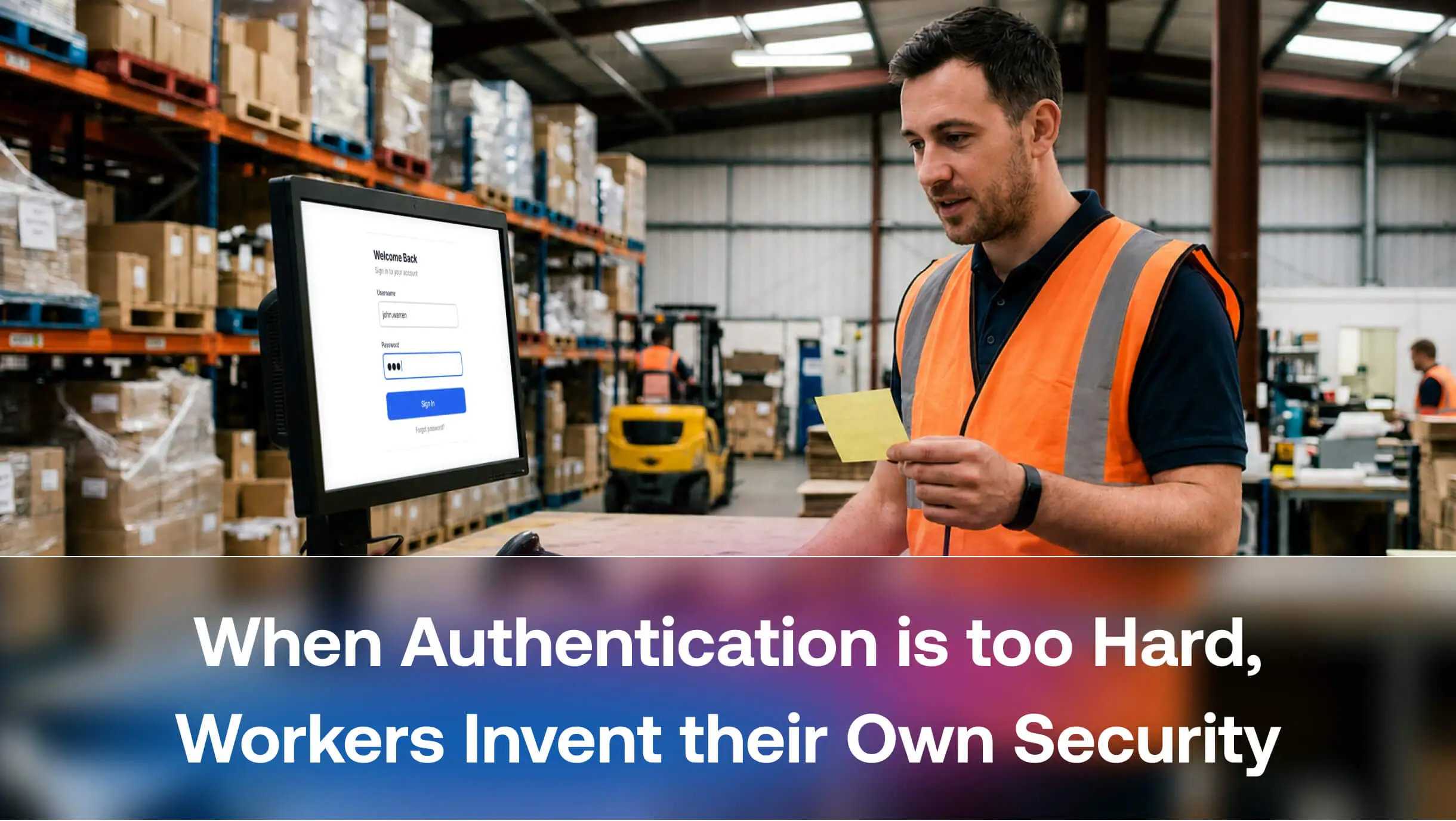
Workarounds are not deviations from rational behavior. They are rational behavior. When authentication takes 45 seconds on a shared device and a frontline worker has eight tasks queued behind that login screen, the calculus is simple: speed wins. When a password policy requires a new 12-character combination every 60 days, and workers are on their feet for 10 hours with no access to a password manager, the calculus is equally simple. The sticky note wins.
The friction caused by poor authentication design doesn't disappear just because you add a policy memo. It gets absorbed elsewhere in the system, usually in a way that's invisible to security but very visible to operations.
What Workarounds Actually Signal
Every workaround is a signal. Not about employee negligence, but about authentication systems that were designed for desk workers and then deployed, largely unchanged, across environments where they were never going to function.
Frontline workers, the 80 percent of the global workforce who don't spend their days at a personal computer, operate in fundamentally different conditions. They share devices. They move between stations constantly. They wear gloves. They work in loud, high-pressure environments where a 30-second login delay has downstream consequences across an entire shift.
The authentication architectures most enterprises still rely on were designed in an era when a single user sat at a single workstation for eight hours. The challenge was proving identity once at the start of the day. That problem is different in kind from what a charge nurse faces logging in and out of clinical systems 40 times per shift, or what a line supervisor faces when authorizing a process override in the middle of a production run.
When you deploy an architecture designed for one context into a radically different one, workarounds are not the failure mode. They are the expected output.
The Cost Security Teams are Not Measuring
Most security conversations about workarounds focus on breach risk. Shared credentials are a real exposure vector. Credential stuffing, insider threat, and post-incident forensics are documented and understood.
But there is a second cost that rarely enters the security conversation: the operational drag of authentication friction itself.
In healthcare, studies have found that clinicians spend up to 45 minutes per shift navigating login workflows, time taken directly from patient-facing care. A 2023 Imprivata report found that nurses log in and out of clinical systems an average of 70 times per shift. In manufacturing, failed authentication attempts on shared terminals create line stoppages that compound across shifts and facilities. In retail and logistics, access delays at shift handoffs have been shown to add 3 to 5 minutes of unproductive time per worker per day, and across hundreds of workers, that accumulates into thousands of hours annually.
Operations leaders see this clearly. They measure it. They build it into their labor cost modeling. And many of them have concluded, rationally, that the workaround is less expensive than the compliant alternative, not because they don't care about security, but because no one has offered them a third option.
This is the real problem. Organizations are running a false binary: friction-heavy compliant authentication, or fast, insecure workarounds. The conversation is stuck inside that binary when it should be interrogating the premise.
Rethinking the Design Contract
Eliminating workarounds requires changing the object of the design effort. The question cannot only be: how do we prevent unauthorized access? It also has to be: how do we make authorized access fast enough, simple enough, and reliable enough that no rational worker would choose a workaround instead?
That requires treating the frontline worker's environment as an engineering input, not a compliance edge case.
In practice, that means authentication that works on shared devices, where the user is authenticated rather than the machine. It means modalities suited to physical reality: badge tap, fingerprint, or face recognition that functions with gloves on, in low light, at a workstation cycling through dozens of users per shift. It means session management calibrated to context, maintaining appropriate security posture based on what is being accessed, rather than demanding full reauthentication at every interaction.
It also means measuring the right things. If your security program tracks policy compliance and breach incidents but not authentication friction and workaround prevalence, you are measuring the outputs you want while ignoring the inputs that produce them.
What Frontline-Friendly Authentication Actually Looks Like
Not all authentication is built for the same environment. Frontline-friendly authentication is distinguished by a specific set of characteristics that desk-worker-oriented solutions rarely prioritize:
- Works on shared devices: every session is individually attributed to a verified individual, regardless of which terminal a worker uses
- Supports badge tap, biometrics, and passwordless methods: modalities that work in physical environments, with gloves, in low light, at speed
- Enables fast user switching: one worker logs out and another logs in within seconds, without creating shared credential shortcuts
- Maintains full auditability: every session is tied to a verified individual, giving security teams the attribution trail they need without manual overhead
- Minimizes login interruptions: session management calibrated to context, so workers are not pulled out of workflow for unnecessary reauthentication
When these properties exist together, the tradeoff between speed and security disappears. Workers don't need to invent workarounds because the compliant path is already the fastest one.
Security and Operations Need a Shared Problem Statement
For security leaders, the most productive shift is from a compliance frame to a systems design frame. Compliance asks: Are workers following policy? Systems design asks: is the system producing the behavior we want, and if not, what is it actually producing?
For operations leaders, the framing is different. Most already know where the workarounds are. They tolerate them because the alternative has historically meant slower workers, more escalations, and lower throughput. The argument they need to hear is not another recitation of breach risk. It is that modern authentication, designed for its environment, does not require that tradeoff.
Those two conversations need to happen in the same room. The organizations that will close the workaround gap are the ones where security and operations leadership share a common problem statement: authentication that is too slow to use is authentication that will not be used.
The Worker is not the Vulnerability
Until enterprise security programs internalize that framing, they will keep investing in enforcement and watching workaround rates hold steady. More training. More policy. More monitoring. The needle won't move because the root cause isn't behavior. It's infrastructure.
Solving this requires authentication that is secure by design and fast by design, where both properties exist simultaneously rather than in tension. It requires building for the frontline environment as the primary use case, not retrofitting solutions built for the corporate desktop.
OLOID approaches this differently. Instead of adapting corporate identity infrastructure for frontline use, it starts with the frontline environment as the baseline. The result is authentication that doesn't ask workers to choose between speed and compliance. Organizations using frontline-first authentication solutions consistently see reductions in credential sharing, faster workstation access, and stronger audit trails, without adding workflow friction. That is where the problem lives. And that is where the work has to happen.





Get the latest updates! Subscribe now!
