




5 Years of Game-Changing Access Control Innovations
The blog explores how the access control industry has evolved rapidly over the past five years, transforming physical and digital security worldwide. It highlights groundbreaking technologies such as mobile access, cloud-based security, biometrics, AI, and the Internet of Things that are redefining how people manage and experience secure entry. Gain insights into emerging trends, innovations driving the future of security, and how businesses can adapt to a more connected, intelligent access ecosystem.

In 2019, the total value of physical security goods manufactured worldwide was $34.3 billion, an 8.5% rise from 2018. The security market has been thriving for the past five years, expanding at a CAGR of 7.2%. The access control market has grown faster than the CCTV and incursion markets combined, with a CAGR of 8.7%.The access control industry is expected to further concentrate its growth in the coming years. As a result of COVID-19, businesses have realized the significance of user management.
Over the past five years, advances in access control technology and functionality have made gaining entry to buildings a more pleasant and efficient process for everyone involved. Here are ten access control innovations to keep an eye on as we prepare for the future of access control.
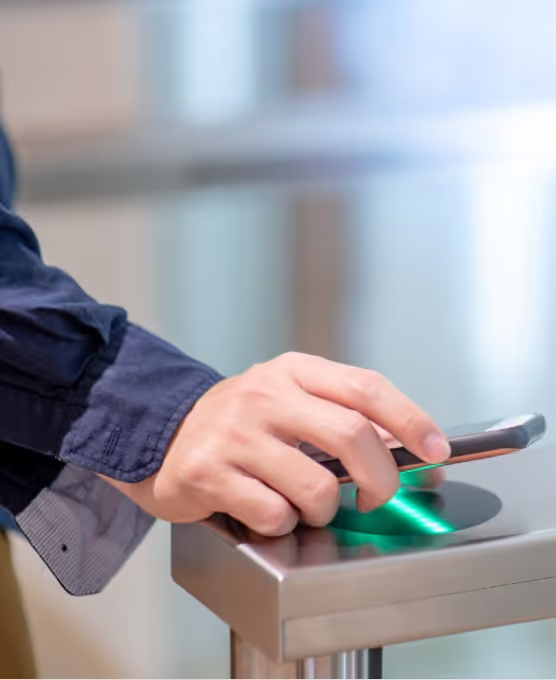
1. Mobile Access Control
Mobile technology has changed everything from how we eat to meet people to how we travel, shop or enter our houses. Virtual keys have already replaced traditional key cards for many homes, buildings, shops, and businesses.
It is just a matter of time before access control technology, in conjunction with smart technology, becomes the standard by which we enter our homes. After all, we're in the decade of portable gadgets.
2. Cloud-Based Security
As more and more data continues to be uploaded to the internet, cloud computing continues to increase at an exponential rate, much like its own universe. As a result, many of our daily needs and commercial operations can benefit from the cloud's cheap infrastructure investment requirements.
There has been a shift from on-premise to cloud-based access control systems, and in recent research, 92% of firms now have systems running in the cloud.
Most traditional key cards are being phased out in favour of virtual key fobs, cellphones, tablets, and biometric access controls, all of which rely on cloud-based technology. Security measures traditionally seen solely in government buildings are now commonplace in private residences and businesses of all stripes. To keep more information permanently, cloud-based access restrictions will revolutionize our lives in the following years.
3. Multi-Factor Authentication
Since 2020, when a large percentage of the workforce worked remotely, multi-factor authentication has become increasingly commonplace. Multiple-factor authentication (MFA) safeguards data by requiring confirmation from the user via a combination of factors.
This is becoming increasingly obvious as a trend in controlling who has access to what. Two or more forms of identification may be required before admittance is granted to a building. In the context of security systems, this might require a smartphone and a fingerprint to get entry.
4. Contactless Access
These days, fewer and fewer individuals are willing to put their finger on a button or touch a doorknob to get in. As a result, the most cutting-edge technology in access control this decade is, without a doubt, contactless access solutions.
It will seem silly to take a chance on germs by touching door knobs or elevator buttons in the not-too-distant future. However, as a result of its decreasing cost, this technology has quickly become widespread in the field of access control security.
5. Biometric Authorization
Humans can now be verified as authorized to enter a building by biometric access controls, which read and analyze various biometric data. The excellent protection offered by this access control system makes it more than just one of the most practical options.
In most cases, these readers will use fingerprint and iris recognition for identification purposes, facilitating the efficient management of high-traffic areas, such as entrances, exits, and escalators. This is the way of the future regarding security systems, and you can expect to see more of it soon.
6. Integrations and Hybrid Solutions
The capabilities we now possess as a result of technical developments in recent decades are truly remarkable. Connecting devices to the cloud and back to local programs, data, and files have significantly impacted our lives.
The ability to interface with devices and share data easily has led to access control security or hybrid integrated platforms, which are at the heart of this. Access control systems and integrated control technology work hand in hand to make the future a safer place to live in.
7. Video Access Control
We have all personally encountered this current trend in access control. Video entry systems will become increasingly common in households and businesses in 2023.
This access control system can graphically record every entry request in real time before access is granted. Cameras with two-way audio and video transmission are one example of this technology, as they enable the people on either end to have a remote conversation before granting access.
8. Artificial Intelligence
Both artificial intelligence and machine learning are rapidly becoming more mainstream in our day-to-day lives. Physical acts such as climbing a fence, faking a badge, or forcing a door open signal a perimeter security concern. We can identify these dangers early on by leveraging AI rather than waiting for a security issue to occur. Since it is self-learning, an AI-powered access control system may recognize potentially dangerous circumstances and take appropriate action.
9. Internet of Things
Internet of Things refers to any physical object or electronic equipment that can connect to the internet through software and other technologies inherent inside it. These cutting-edge advancements in access control technologies will eventually place safety within reach of everyone, everywhere. Internet of Things accesses control systems are based mostly on intelligent door-locking systems.
10. Leveraging Analytics
Data will be the primary resource for physical access control in the near future. The development of AI analytics has sped up and simplified the process of identifying useful data trends and gaining actionable insights across all of a company's security and building systems. As a result, better space and amenity management, lease renegotiation, office containerization, and energy-efficient and environmentally friendly building systems can be achieved with the help of business intelligence analytics, which is crucial for increasing ROI and making more informed business decisions.
Looking ahead at the developments in access control, one thing is certain: flexibility is essential, but it must not be at the expense of safety. Access management in the future, especially for organizations, will involve more than just safeguarding data and limiting access; it will also include doing it more quickly and reliably as more people rely on web-based services for their day-to-day activities. Platforms that put a premium on adaptability and scalability will save firms money while allowing them to respond to shifting conditions. The development of novel approaches to the protection of buildings, the confidentiality of data, and the ease of use of associated systems will shape the future of access control.

Get the latest updates! Subscribe now!

