




What is OAuth? A Complete Guide to Open Authorization

Key Takeaways
- OAuth handles authorization, not authentication. It controls what an application can access. OIDC handles identity verification. Both are typically needed together.
- Tokens replace passwords entirely. Access tokens are short-lived, scoped, and revocable, which makes them fundamentally safer than stored credentials.
- The implicit grant is deprecated. OAuth 2.1 removes it. Use the authorization code with PKCE for any public client.
- Different scenarios need different grant types. Machine-to-machine workflows, shared terminals, mobile apps, and web apps each have a purpose-built OAuth flow.
- OAuth 2.1 is the standard to build toward now. PKCE mandatory, refresh token rotation required, implicit grant removed.
- Shared-device environments need deliberate OAuth configuration. The device authorization flow and short-lived tokens address frontline access patterns, but only when the surrounding IAM layer enforces session attribution per individual.
Picture a nurse midway through a 12-hour shift. She logs in to the EHR system on a shared ward terminal, pulls up a patient record, and steps away to administer medication. Three minutes later, a colleague at the same terminal is accidentally still inside her session. No malicious intent. Just the ordinary chaos of a busy hospital floor and a system that never properly ended the first session.
Now scale that to 40,000 frontline workers across 200 facilities, each sharing terminals across rotating shifts. The access problem compounds quickly. And at the center of it is almost always the same culprit: credentials that linger longer than they should, attached to sessions that were never properly scoped or terminated.
The CrowdStrike 2025 Global Threat Report found that 79% of attacks in 2024 involved no malware at all. Attackers logged in using legitimate credentials rather than breaking in. When those credentials belong to a shared account, there is no anomaly to detect.
OAuth was built specifically to solve this.
What is OAuth?
[[content-box]]
This guide covers how OAuth works, which grant type fits which scenario, how it relates to OIDC, SAML, and SSO, and where its token model becomes especially important for operational environments.
[[content-box-2]]
Why OAuth Exists
Before OAuth, apps that needed access to your data used one method: ask for your username and password, store them, and log in as you. Security teams called this the password anti-pattern, because it meant a third-party application held credentials it never needed to hold, indefinitely.
OAuth replaced that with token-based delegation. The user grants access, and the application receives a scoped, time-bound token. When access is revoked, the token is invalidated immediately. Passwords stay out of the equation entirely.
For shared-device environments, this shift is not just architectural; it is operational. A token that expires at the end of a session cannot be cached by the next worker who sits down at the same terminal. A password can.
How OAuth Works
The four key roles
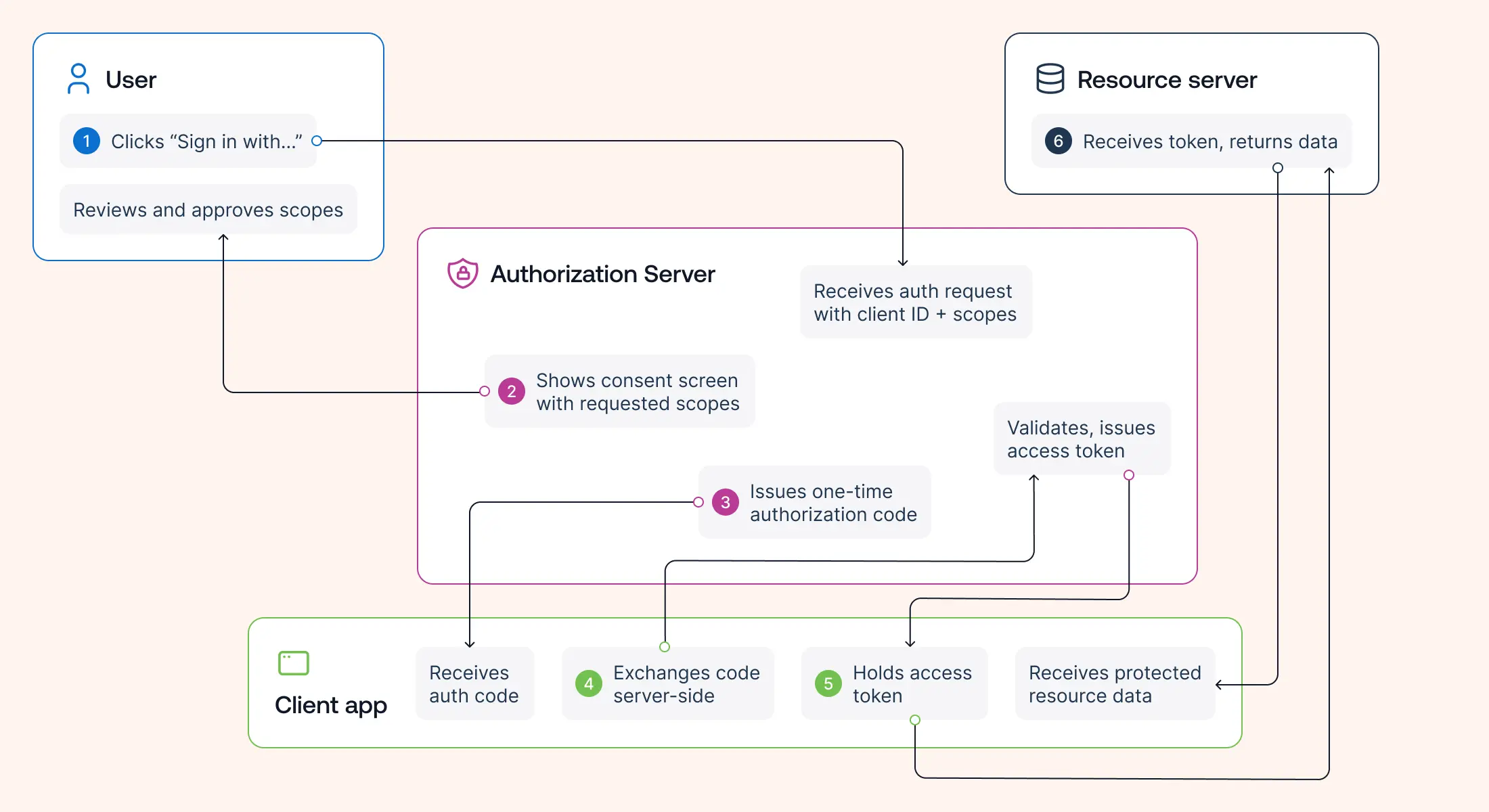
Every OAuth transaction involves four participants:
- Resource Owner: The user who owns the data and grants permission
- Client: The application requesting access (a mobile app, a third-party integration, a microservice)
- Authorization Server: The gatekeeper that verifies the resource owner and issues tokens
- Resource Server: The server that holds the protected data and accepts token-based requests
Tokens: Access tokens and refresh tokens
OAuth runs on two types of tokens.
An access token is short-lived, typically valid for minutes to an hour. The client presents it to the resource server on every request. If it is stolen, the exposure window is narrow.
A refresh token is longer-lived. The client exchanges it for a new access token when the current one expires, without prompting the user to log in again. Refresh tokens live server-side and never travel to APIs directly.
Modern security practice requires refresh token rotation: each time a refresh token is used, the server issues a new one and invalidates the old one. This limits the damage from a stolen refresh token significantly.
Scopes: Controlling what gets shared
Scopes define the boundaries of access. When an app requests authorization, it declares exactly what it needs: read access to a calendar, write access to a document, or view-only access to a contact list. The user sees and approves those specific scopes. Nothing beyond the declared scope is accessible.
The step-by-step OAuth flow
- The client sends an authorization request to the authorization server with its client ID and required scopes.
- The authorization server authenticates the resource owner and presents a consent screen.
- The resource owner approves.
- The authorization server issues an authorization code.
- The client exchanges that code for an access token (and optionally a refresh token).
- The client presents the access token to the resource server and retrieves the approved data.
OAuth Grant Types: Which One to Use
Different applications need different flows. Choosing the wrong one is one of the most common OAuth implementation mistakes.
Authorization code (web apps)
The authorization server returns a one-time code that the client exchanges with the server for an access token. Credentials never touch the client application.
Authorization code + PKCE (mobile apps, SPAs, the current default)
PKCE (Proof Key for Code Exchange) introduces a cryptographic challenge to prevent authorization code interception. OAuth 2.1 is expected to make this mandatory for all public clients. If you are building anything new, start here.
Client credentials (machine-to-machine)
Used when no human user is involved. A background service or microservice authenticates with its own credentials to access system resources. Common in healthcare data pipelines, logistics integrations, and manufacturing ERP connections.
Device authorization (kiosks, shared terminals, IoT)
Built for input-constrained devices that cannot display a standard browser login. The device shows a short code; the user approves on a separate device. This flow directly addresses the shared-terminal problem: a worker can authenticate on their own phone and authorize a session on the shared kiosk, without the kiosk ever holding their password.
Refresh token grant
Handles session continuity when an access token expires. Paired with token rotation, this keeps sessions alive without credential re-entry.
Implicit grant: why it is deprecated
This flow returned access tokens directly in the browser URL, exposing them in history logs and referrer headers. OAuth 2.1 removes it formally. Any vendor still recommending the implicit grant is working from an outdated playbook.
Grant type decision guide
| Scenario | Recommended Grant Type |
|---|---|
| Traditional web application | Authorization Code Grant |
| Mobile app or single-page app (SPA) | Authorization Code Grant with PKCE |
| Service-to-service communication (no user involved) | Client Credentials Grant |
| Shared terminal, kiosk, or smart TV | Device Authorization Grant |
| Session renewal without re-authentication | Refresh Token Grant |
OAuth 1.0 vs. OAuth 2.0 vs. OAuth 2.1
OAuth 1.0 (2007) required cryptographic signatures on every request. Secure in principle, but difficult enough to implement that adoption stalled.
OAuth 2.0 (2012, RFC 6749) dropped request-level signatures in favor of HTTPS/TLS, dramatically simplifying the protocol. It expanded to cover web apps, mobile apps, APIs, and devices. OAuth 2.0 is the current standard.
OAuth 2.1 (in draft) consolidates a decade of accumulated best practices. It makes PKCE mandatory, removes the implicit grant, and requires refresh token rotation. New implementations should align to OAuth 2.1 principles now, not after formal ratification.
OAuth vs. Related Protocols
| Protocol | Purpose | Relationship to OAuth |
|---|---|---|
| OIDC (OpenID Connect) | Authentication: verifying who you are | Built on top of OAuth 2.0, adds an identity layer |
| SAML | Enterprise SSO, XML-based | Parallel standard targeting enterprise federation |
| SSO | Single sign-on user experience | Often implemented using OAuth and OIDC together |
| JWT | Token format | OAuth commonly uses JWT to carry access token data |
The most important distinction: OAuth handles authorization (what an app can access). OIDC handles authentication (who is logged in). They are designed to work together, not replace each other.
OAuth in Shared-Device and Frontline Environments
In frontline environments, multiple workers share the same terminal across shifts. Session boundaries need to be explicit and enforced. Tokens need to expire when a worker steps away, and a new token needs to be tied to the next verified individual, not to the device itself.
OAuth's device authorization flow and short-lived access token model handle this well, but they require the surrounding IAM infrastructure to enforce it. Platforms like OLOID’s passwordless SSO are built specifically for this architecture, tying each OAuth-issued session to a verified individual identity rather than a shared device credential. The token expires when the shift ends. The next worker starts a clean, attributed session.
This is where the gap between standard OAuth implementations and operational reality becomes visible. Most enterprise IAM assumes one worker, one device. The frontline access model looks fundamentally different, and OAuth needs to be configured and governed accordingly.
Common OAuth Implementation Mistakes
Choosing the right grant type is only half the battle. How OAuth gets implemented in practice is where most security gaps appear.
- Still using the implicit grant: The implicit grant returns access tokens directly in the browser URL, exposing them in browser history, server logs, and referrer headers. OAuth 2.1 removes it formally, and for good reason. Any system still using the implicit grant should migrate to authorization code with PKCE as a priority, not a backlog item.
- Over-scoping tokens: Requesting broader permissions than the application actually needs is one of the most common and quietly damaging mistakes. An over-scoped token turns a minor credential leak into a major breach because the attacker gets access to everything the token was authorized for, not just what the application needed. Always request the minimum scopes required and nothing beyond.
- Using long-lived access tokens: Access tokens with extended lifetimes increase the blast radius of any compromise. A token valid for 24 hours gives an attacker an entire working day. Short-lived tokens paired with refresh token rotation limit exposure to minutes and ensure that even a stolen token becomes useless before significant damage can be done.
- Incomplete logout handling: Logging a user out of the client application without revoking the underlying token leaves that token active and exploitable. In shared-device environments where a nurse, warehouse operative, or retail associate hands a terminal to the next person at shift end, this is not a theoretical risk. It is the exact scenario that creates unauthorized access to the previous worker's session. Proper logout must include token revocation at the authorization server, not just a local session clear.
Security Considerations
OAuth is robust, but implementation choices determine whether that robustness holds.
- Token theft: Short access token lifetimes limit the exposure window. Refresh token rotation limits long-term risk.
- Redirect URI manipulation: Register exact redirect URIs with the authorization server. Wildcard URIs create exploitable open redirects.
- Token revocation and introspection: Users must be able to revoke access immediately. Resource servers should verify token validity in real time, not rely on expiry alone.
- PKCE as default: Every public client should use PKCE. It prevents code interception even when redirect URI validation is partially compromised.
Implementation Best Practices
- Always use HTTPS for every OAuth interaction without exception
Plain HTTP exposes tokens and authorization codes in transit. There is no scenario where OAuth over unencrypted connections is acceptable, even in development environments. - Store client secrets server-side only, never inside mobile or browser-based clients
Public clients, by definition, cannot protect a secret. If a secret is embedded in a mobile app or JavaScript bundle, treat it as already compromised and use PKCE instead. - Register and validate redirect URIs explicitly and reject any unregistered URI
This single control eliminates an entire class of redirect-based attacks. The authorization server should match the exact URI, not a partial string or pattern. - Request minimum scopes only and never ask for access beyond what the application actually requires
Over-scoped tokens increase the blast radius of a compromise. If the application only needs to read a user's profile, requesting write access creates unnecessary risk. - Set short access token lifetimes and enforce refresh token rotation
A 15-minute access token significantly limits the damage window from token leakage. Rotation ensures that even a stolen refresh token becomes useless after a single use. - Build token revocation and introspection from day one, not as an afterthought
Retrofitting revocation into a live system is significantly more complex than building it up front. Every OAuth implementation should ship with revocation endpoints and introspection support from the first release. - Align new implementations to OAuth 2.1 principles now, ahead of formal ratification
The changes OAuth 2.1 introduces, mandatory PKCE, removed implicit grant, and required token rotation, reflect a decade of production learnings. Waiting for formal publication before adopting them means shipping to an already-outdated standard.
Conclusion
OAuth started as a fix for a single problem: applications demanding passwords they had no business holding. What it became is the authorization backbone of modern identity infrastructure, powering everything from "Sign in with Google" buttons to machine-to-machine service calls across enterprise cloud environments.
The protocol is well-understood at a surface level. The gaps show up in implementation: wrong grant type for the use case, implicit flow still in production, tokens with no rotation policy, and revocation endpoints that were never built. OAuth 2.1 addresses most of these structurally, and building to its principles now means not inheriting technical debt when it ratifies.
For organizations managing access in shared-device and frontline environments, the stakes are higher. Standard OAuth assumptions break down when a terminal has six users across three shifts. The protocol has the right tools, specifically the device authorization flow and short-lived tokens, but governance at the identity layer has to back them up. Understanding what OAuth is at an implementation level, not just a conceptual one, is what separates a secure deployment from one that recreates the credential risk it was supposed to eliminate.
FAQs
1. What is OAuth in simple terms?
OAuth is a security protocol that lets you give one application limited, time-bound access to your data in another application, without sharing your password. When you tap "Sign in with Google" on a third-party app, OAuth is what happens in the background: the app receives a scoped token, not your Google credentials.
2. What is the difference between OAuth and SSO?
SSO (Single Sign-On) is the experience of logging in once and accessing multiple applications. OAuth is one of the authorization protocols that powers SSO under the hood. SSO is the outcome; OAuth is part of the mechanism that makes it work.
3. Is OAuth secure?
OAuth 2.0 is secure when implemented correctly. The common failure points are poor grant-type selection (especially the continued use of the deprecated implicit grant), weak redirect-URI validation, and insecure token storage. Pairing OAuth with PKCE, short token lifetimes, and refresh token rotation addresses the most significant risks.
4. What changes between OAuth 2.0 and OAuth 2.1?
OAuth 2.1 consolidates best practices from a decade of OAuth 2.0 deployment. It makes PKCE mandatory for all clients, formally removes the implicit grant, and requires rotation of refresh tokens. The core authorization model stays the same; 2.1 is a security hardening of 2.0.
5. Can OAuth work without a password?
Yes. The client application never handles a password in any OAuth flow. The authorization server may authenticate the resource owner using a password, a biometric, a passkey, or any other method, but that happens directly between the user and the authorization server. The client only ever receives a token.
Get the latest updates! Subscribe now!

