




About
Mona Sata is a B2B content and narrative specialist with experience in cloud-native and security technology. She translates complex concepts into clear messaging that helps technical teams communicate with authority and earn buyer trust.
Usually writes about
LDAP vs Active Directory: What's the Difference?
LDAP and Active Directory are often used interchangeably, but they solve different problems. LDAP is the protocol that lets applications query and authenticate against a directory. Active Directory is Microsoft's directory service that uses LDAP, alongside Kerberos, to manage users, devices, and policies. This guide breaks down how the two relate, when to use each, and where their legacy design starts to strain in shared-device and frontline environments.

What is Credential Vaulting? A Practical Guide for Operational Workplaces
Credential vaulting is the practice of storing passwords, keys, and certificates in a centralized, encrypted system instead of leaving them exposed in scripts, spreadsheets, or shared notes. Most coverage of this topic assumes a one-user-per-credential world, built for IT admins and cloud infrastructure rather than shift-based, shared-device teams. This guide covers what credential vaulting actually means, how it works, where it overlaps with PAM and SSO, and why it functions differently in healthcare, manufacturing, logistics, and retail environments. It closes with where credential vaulting alone falls short, and where passwordless authentication picks up the gap for frontline operations.
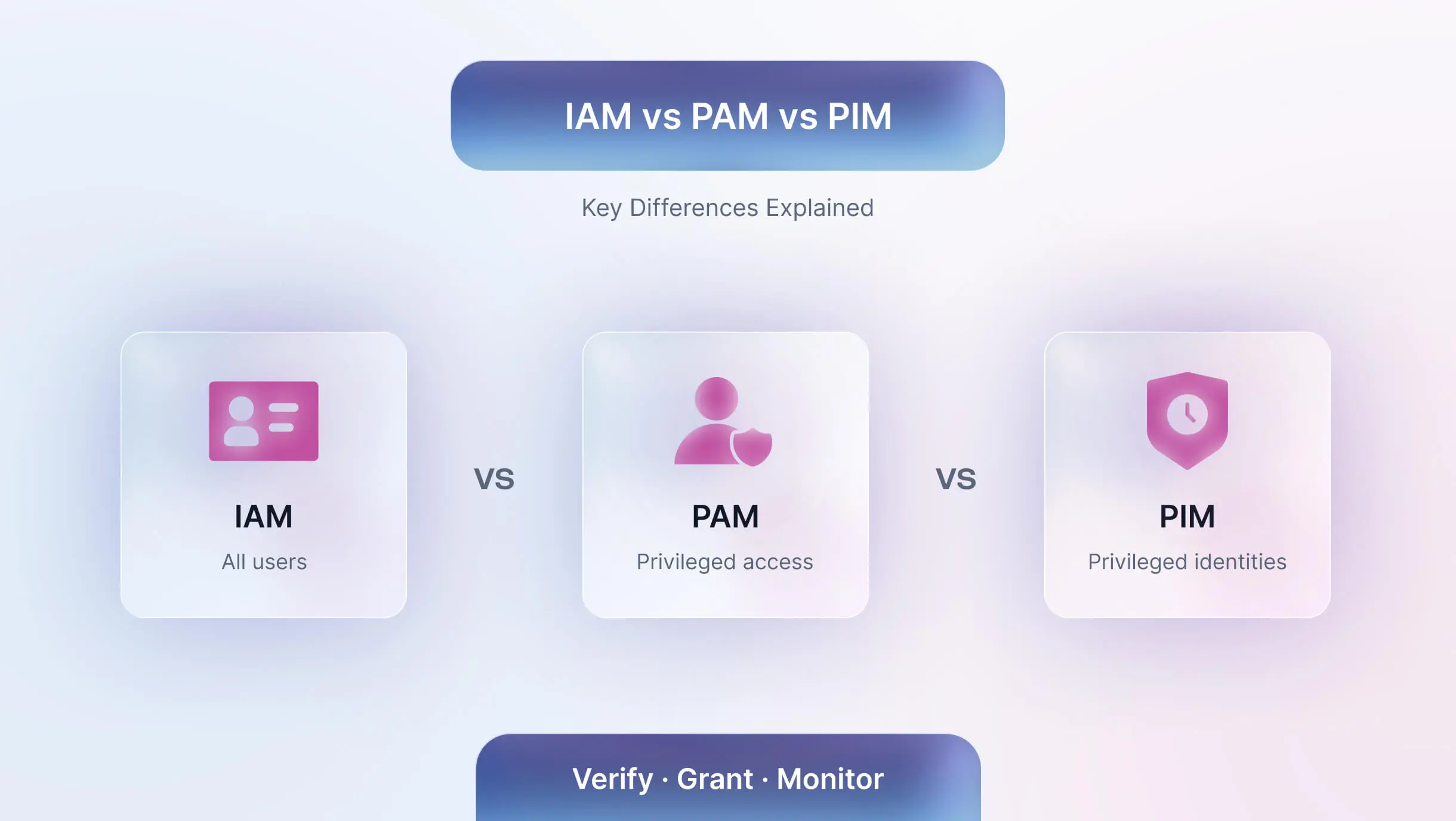
IAM vs PAM vs PIM: Key Differences Explained
IAM, PAM, and PIM get used interchangeably, but each governs a different layer of access. This guide breaks down what each framework actually controls, clears up the hierarchy confusion found across most vendor content, and shows how they work together. It also covers where standard IAM, PAM, and PIM assumptions break down in shared-device and frontline environments common in healthcare, manufacturing, logistics, and retail.
What is HITRUST? A Complete Guide to Certification, Compliance, and the CSF Framework
HITRUST is the certifiable framework that lets organizations prove information security across 70+ regulatory standards through a single assessment cycle. This guide explains what HITRUST is, how the CSF works, and how the three certification levels map to different risk profiles and organizational maturity. It also covers how HITRUST compares to HIPAA, SOC 2, and ISO 27001, and why "assess once, report many" makes it operationally efficient for multi-framework compliance programs. Organizations in healthcare, manufacturing, logistics, and retail increasingly encounter HITRUST as a vendor qualification requirement in enterprise procurement and third-party risk management. Coverage includes certification costs, timelines, the six-step process, what triggers a corrective action plan, and where HITRUST access control requirements intersect with frontline and shared-device environments.
SAML vs OAuth vs OpenID Connect: What's the Difference and Which Should You Use?
SAML, OAuth 2.0, and OpenID Connect are the three standards that govern how identity is verified and access is granted across enterprise environments, but most comparisons stop at definitions. This guide covers what each protocol actually does, what token it issues, and how they work together in a mature identity stack. It addresses the decision framework most articles skip: not just which protocol fits which architecture, but which fits the operational reality of your workforce. That includes the specific gap these protocols share in frontline and shared-device environments; healthcare wards, factory floors, warehouses, and retail counters, where the one-user-one-device assumption quietly breaks security. If you're evaluating protocol selection or auditing your IAM stack, this is the comparison built for that decision.
OIDC vs OAuth: How to Choose the Right Protocol
OIDC and OAuth are two of the most widely used identity protocols, and two of the most commonly confused. OAuth 2.0 governs authorization: what an application is allowed to access on a user's behalf. OpenID Connect adds the identity layer: it confirms who the user actually is, using a signed ID token built on top of the OAuth framework. Using one where the other is needed is not just an architectural mistake; it is a documented security risk that shows up in breach post-mortems. This guide covers how each protocol works, where they differ, how they are used together, and why the distinction matters most in environments where multiple workers share the same device.

Making every day-in-the-life of frontline workers frictionless & secure!
Get the latest updates! Subscribe now!
